










Seeing a spider dart across your living room floor or drop from the bedroom ceiling is enough to make anyone shudder. While most house spiders are beneficial because they eat other insects, nobody wants to share their personal space with an eight-legged roommate. If you are dealing with a serious invasion, you need highly effective, targeted pest control for spiders.
Before you panic and spend hundreds of dollars on a professional exterminator, you need to understand one crucial fact: standard bug sprays rarely work on spiders.
In this ultimate 2026 guide, we will break down exactly why spiders are so hard to kill, what the professionals actually use, and the exact step-by-step DIY process to reclaim your home. Whether you are dealing with common cellar spiders, terrifying wolf spiders, or the dangerous brown recluse, this guide has you covered.
Why is Pest Control for Spiders So Difficult? (The Biology)
Have you ever sprayed a spider with a standard grocery store insecticide, only to watch it run away seemingly unharmed? There is a biological reason for this.
- They Walk on Tiptoes: Insects like ants and roaches drag their bellies along the ground. When they walk over a dried chemical barrier, their bodies absorb the poison. Spiders, however, walk high up on the tips of their eight legs, meaning their bodies rarely touch the treated surfaces.
- They Don’t Groom Themselves: When a roach walks through poison, it eventually licks its legs to clean itself, ingesting the fatal chemical. Spiders do not groom themselves with their mouths. If they step in poison, they usually don’t ingest it.
- They Avoid High-Traffic Areas: Spiders build webs in high corners or hide deep inside clutter where standard foggers and broadcast sprays simply cannot reach.
Because of this, effective best pest control for spiders requires a multi-layered approach: eliminating their food source, using specific micro-encapsulated chemicals, and deploying mechanical traps.
Step 1: Starve Them Out (The Pre-Treatment)
Spiders are predators. They only enter your home because there is a food source available—namely, other bugs. If you have a spider problem, you actually have a general insect problem. Before applying any chemicals, you must do the following:
- Change Your Outdoor Lighting: Traditional white porch lights attract moths, mosquitoes, and beetles. Spiders build their webs near these lights to catch an easy meal. Switch your exterior bulbs to yellow “bug lights” or sodium vapor lamps, which are invisible to most insects.
- Declutter Your Storage: Spiders, especially the Brown Recluse, love cardboard boxes. Replace all cardboard storage boxes in your basement and attic with airtight plastic bins.
- Dehumidify: Insects (spider food) thrive in moist environments. Running a dehumidifier in your basement to keep humidity below 50% will drastically reduce the bug population, causing spiders to leave in search of food.
Step 2: The Best Pest Control for Spiders (Chemicals & Traps)
Once you have removed their food source and hiding spots, it is time to go on the offensive. Here is exactly what you need to buy and how to use it.
1. Micro-Encapsulated Perimeter Sprays
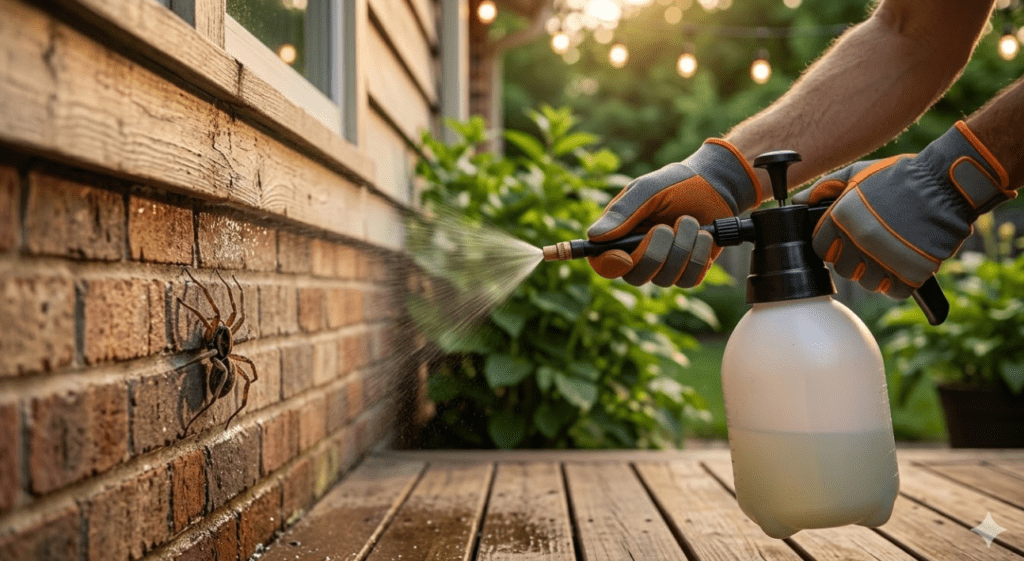
Because spiders don’t absorb chemicals easily through their feet, you need a “micro-encapsulated” insecticide (like Demand CS or Suspend PolyZone). These products contain microscopic capsules of poison. When a spider walks over it, the capsules stick to their hairy legs and eventually break open, delivering the lethal dose.
How to apply: Mix the concentrate in a pump sprayer. Spray a continuous 3-foot band around the exterior foundation of your home, focusing heavily on window frames, door sweeps, and areas where pipes enter the wall. Indoors, apply a light mist to the baseboards in unfinished basements and garages.
2. Glue Boards (The Ultimate Indoor Weapon)
As mentioned, spiders are hard to poison. Therefore, mechanical trapping is the absolute best indoor method. Sticky traps (glue boards) are non-toxic, cheap, and 100% effective.
Pro Placement Tip: Do not place traps in the middle of a room. Spiders navigate by hugging walls. Place glue boards flush against the baseboards behind sofas, under beds, and on either side of your garage door.
⚠️ Crucial Safety Warning: Pets and Children
Many effective spider sprays contain Pyrethrins or Permethrin. While generally safe for humans and dogs once completely dry, these chemicals are highly toxic to cats. If you have feline friends, never let them enter a treated room until the spray is 100% dry and ventilated. For households with curious toddlers, rely heavily on hidden glue boards and organic Peppermint Oil sprays rather than indoor liquid chemicals.
Targeting the Worst Offenders: Recluse & Wolf Spiders
Different spiders require slightly different tactics. Here is how to handle the two most common (and terrifying) invaders.
Pest Control for Brown Recluse Spiders
The brown recluse is highly venomous, identified by the dark violin shape on its back. True to its name, it is a “recluse.” It hides in dark, undisturbed areas like shoes, old coats, and attics.
Pest control for brown recluse spiders relies heavily on Insecticidal Dust (like Delta Dust). You must puff this dust directly into wall voids (behind electrical outlets) and under baseboards where they hide. Combined with massive deployment of sticky traps, this will eradicate a recluse population. Remember to always shake out your shoes before putting them on!
Pest Control for Wolf Spiders
Wolf spiders are massive, hairy, and incredibly fast. They do not spin webs; they are active nocturnal hunters that run down their prey. Because they actively roam your floors at night, effective pest control for wolf spiders is all about creating strong chemical perimeters. Heavy application of micro-encapsulated sprays around your exterior doors and basement windows will kill them as they try to enter your home looking for warmth.
Frequently Asked Questions
What do pest control companies use for spiders?
Professional exterminators rarely use aerosols. They rely on micro-encapsulated synthetic pyrethroids (like Lambda-cyhalothrin) for perimeter sprays, and waterproof insecticidal dusts for wall voids. They also utilize high-quality pheromone and glue traps to monitor the infestation levels.
Does peppermint oil really keep spiders away?
Yes, as a short-term deterrent. Spiders have sensory organs on their legs, and strong essential oils overwhelm them. Spraying a mixture of water, dish soap, and peppermint oil around window sills will repel them, but it needs to be reapplied every few days and will not kill an existing infestation.
How often should pest control be done for spiders?
If you are applying a DIY exterior perimeter spray, you should reapply it every 60 to 90 days. However, if you experience heavy rainfall or extreme UV sunlight, the chemical barrier will break down faster, requiring application every 45 days. Check your sticky traps monthly and replace them when they are full of dust or insects.
Disclaimer: Always read the manufacturer’s label before mixing or applying any chemical pest control products. Wear appropriate PPE (gloves, long sleeves, and a mask) when spraying.