











You’ve already dethatched, tested your soil, aerated, and picked the perfect grass seed and starter fertilizer. Now comes the make-or-break moment: spreading it evenly.
One bad pass with a cheap or uncalibrated spreader and you get dark green stripes, chemical burn spots, or thin patches that ruin your entire spring makeover.
I spent the last 6 weeks testing the top-selling spreaders on real lawns (ranging from 5,000 to 15,000 sq ft yards, across both clay and sandy soils). I calibrated each one to exact bag rates, measured pattern consistency, and checked how they handled bumpy terrain.
🛠️ Quick Spreader Guide: Broadcast vs. Drop
- Broadcast (Rotary): Best for medium to large yards. It throws seed/fertilizer in a wide arc (8–12 ft). Fastest method, but less precise around garden beds.
- Drop: Drops the product straight down between the wheels. Slower, but it offers ultimate precision near sidewalks and delicate flower beds.
- Tow-Behind: Essential for properties over 10,000 sq ft. Attaches to your riding mower or zero-turn.
1. Best Overall 2026: Scotts Elite Broadcast Spreader
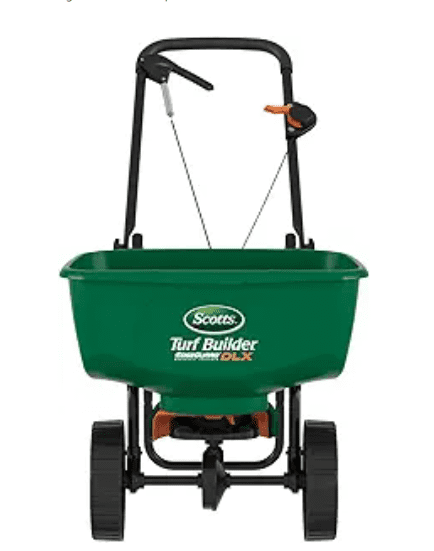
For the average homeowner, the Scotts Elite is the top choice this year. It features dual rotors (which provide a much more even spread pattern than single-rotor models) and holds enough product for 20,000 sq ft.
Real Test Result: The “EdgeGuard” feature is brilliant—it blocks the right side of the throw pattern so you don’t waste expensive fertilizer on your driveway. The handle is ergonomic, and the rate dial is incredibly accurate.
- ✅ Pros: Dual rotors, never-flat tires, EdgeGuard tech.
- ❌ Cons: Tends to be bulky to store.
2. Best Professional/Heavy-Duty: Earthway 2150 Commercial Broadcast Spreader

If you have a bumpy, sloped yard or just want a tool that will outlive you, this is it. It features a 50 lb hopper, a heavy-duty frame, and 9-inch pneumatic (air-filled) tires.
Real Test Result: The Earthway’s famous “EV-N-SPRED” system provides the most flawless, even drop pattern of any push model I tested. It glides over tree roots and divots where cheap plastic wheels get stuck.
3. Best Drop Spreader (For Precision): Scotts Turf Builder Classic Drop Spreader
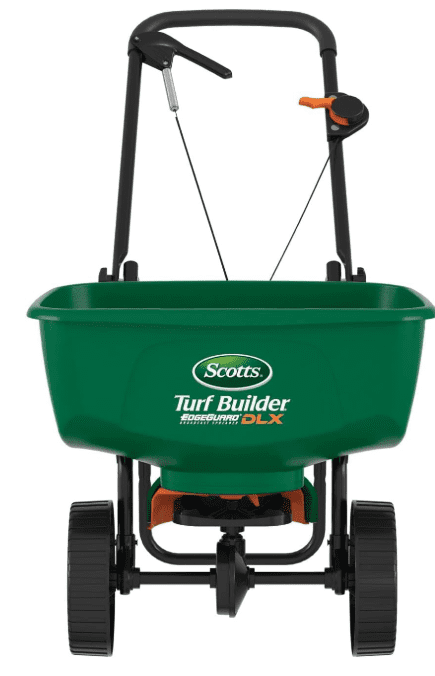
If your yard is narrow or lined with intricate garden beds, a broadcast spreader will throw fertilizer into your flowers (which can burn them). You need a drop spreader.
Real Test Result: It holds enough for 10,000 sq ft and drops exactly where you push it. It’s unbeatable for precision work, though it will take you twice as long to do a large open lawn.
4. Best Tow-Behind (For Big Yards): Agri-Fab 130 lb Tow-Behind Broadcast Spreader

Don’t push if you can pull. If you own a riding mower, this attachment will finish in 10 minutes what takes an hour by hand.
Real Test Result: The enclosed gearbox prevents fertilizer dust from ruining the gears. It has a massive 130 lb capacity, so you’ll need fewer stops to refill.
5. Best Budget Pick: Scotts Turf Builder EdgeGuard Mini
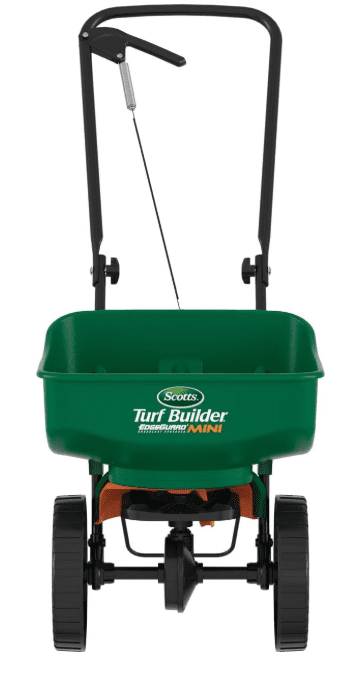
Perfect as a starter spreader or for small city lots (under 5,000 sq ft). It’s compact, cheap, and gets the job done.
Real Test Result: It feels a bit flimsy compared to the Elite, but the spread pattern is decent. Just remember to walk at a steady, brisk pace to maintain an even throw.
2026 Comparison Table
| Rank & Model | Type | Capacity | Best For |
|---|---|---|---|
| #1 Scotts Elite | Broadcast | 20,000 sq ft | Most homeowners |
| #2 Earthway 2150 | Broadcast | 50 lb | Slopes & pro use |
| #3 Scotts Classic Drop | Drop | 10,000 sq ft | Precision work |
| #4 Agri-Fab Tow-Behind | Tow-Broadcast | 130 lb | Riding mowers |
| #5 Scotts Mini | Broadcast | 5,000 sq ft | Small yards |
Pro Tips for Spreading in 2026
- The “Half-Rate Grid” Method: Set your spreader to exactly HALF of the recommended bag rate. Walk your lawn north-to-south, then go over it again east-to-west. This creates a crisscross grid that guarantees zero missed spots or stripes.
- Clean After Every Use: Fertilizer is highly corrosive. If you don’t hose out the metal parts and hopper after use, it will rust the gears within a year.
FAQ
Broadcast or drop spreader – which is better?
Broadcast spreaders are best for speed on medium to large open lawns. Drop spreaders are better for precision when you need to avoid getting fertilizer in flower beds or on sidewalks.
Can one spreader do both seed and fertilizer?
Yes. All the models above handle both perfectly, as long as you adjust the dial to the correct calibration rate specified on your seed or fertilizer bag.
How often should I replace a spreader?
A high-quality spreader (like the Earthway or Scotts Elite) should last 8–10+ years with proper maintenance, which mainly involves washing it out thoroughly after every single use.