














You’ve planted your tree, read the Ultimate Bartlett Pear Guide, and maybe even planted a pollination partner. Everything was going great this spring.
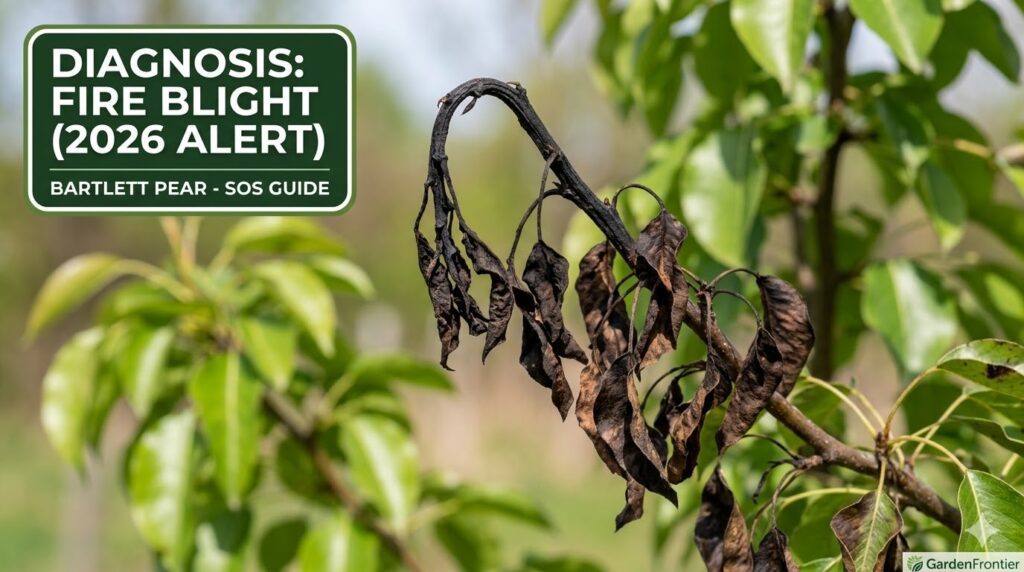
Then, suddenly, the new growth starts drooping. The leaves turn a dark, crusty black, and the branches look like they were burned in a fire. This isn’t a watering issue, and it’s not a nutrient deficiency. It’s Fire Blight, and Bartlett pears are notoriously susceptible to it in 2026.
Here is exactly how to identify it, stop it from spreading, and save your tree.
1. How to Identify Fire Blight on a Bartlett Pear
Before you start hacking away at your tree, let’s make sure it’s actually Fire Blight. Look for these three classic signs:
- The “Shepherd’s Crook”: The tips of the new, infected branches will bend over into a hook shape, resembling a shepherd’s staff.
- Scorched Appearance: The leaves don’t just turn yellow and fall off; they turn black and stay attached to the dead branch.
- Oozing Cankers: In wet, warm spring weather, you might see a sticky, amber-colored liquid oozing from the bark on older branches. This is the bacteria spreading.
2. The Action Plan: How to Save Your Tree
There is no “cure” for Fire Blight once it’s inside the branch. You must amputate the infected parts to stop the bacteria from reaching the main trunk.
Step 1: The 12-Inch Rule for Pruning
You must cut off the infected branch at least 8 to 12 inches BELOW the lowest visible sign of damage. The bacteria travels ahead of the visible blackened area. If you cut too close, you’ll just spread it further.
Step 2: Sterilize Between EVERY Cut
This is where 90% of home gardeners fail. If you use your pruners to cut a blighted branch and then immediately cut a healthy branch, you just infected the healthy one. You must dip your pruning shears in a solution of 10% bleach (or rubbing alcohol) between every single cut.
Pro Tip: Use bypass pruners, not anvil pruners, for a clean cut that heals quickly.
Step 3: Burn or Bag the Debris
Do NOT put the infected branches in your compost pile. The bacteria will survive. Bag them tightly in plastic and throw them in the trash, or burn them if it’s legal in your area.
3. Prevention: Copper Fungicide is Your Shield
Since Bartlett pears are highly susceptible, your best defense is a good offense next spring. Applying a liquid copper fungicide right as the buds start to swell (before they open) creates a barrier that makes it very difficult for the Fire Blight bacteria to enter the tree.
The most reliable spray for 2026: Liquid copper concentrate.
FAQ: Fire Blight on Pear Trees
Will Fire Blight kill my Bartlett pear tree?
Yes, if left untreated. If the bacteria reach the main trunk (the central leader), the tree will likely die. Prompt pruning is essential.
Can I spray the black leaves to save them?
No. Once the leaves and branches are black, they are dead. Fungicides only work as a preventative measure, not a cure for existing damage.