













If you’ve ever been mid-project only to have your multi-tool blade start smoking instead of cutting, you know that not all oscillating saw blades are created equal. Using a wood-only blade on a nail-embedded stud is the fastest way to ruin a $15 attachment in under three seconds.
In this 2026 deep-dive, we move past marketing fluff. We analyzed the metallurgy, tooth geometry, and real-world durability of the top-rated blades on the market. Whether you are cutting through hardened bolts or making precision plunge cuts in oak, this guide ensures you have the right tool for the job without overpaying at big-box stores.
Quick Comparison: TPI and Material Compatibility
| Blade Model | TPI (Teeth Per Inch) / Type | Primary Material | Rating |
|---|---|---|---|
| Milwaukee Nitrus Carbide | Variable (High Density) | Hardened Metal/Bolts | ⭐⭐⭐⭐⭐ |
| AMZWEI 30PCS Bi-Metal Kit | Various (Curved Edge) | Wood with Nails / Soft Metal | ⭐⭐⭐⭐⭐ |
| Imperial Blades Starlock | 14 TPI (Japanese Tooth) | Precision Wood/PVC | ⭐⭐⭐⭐⭐ |
Mastering Tooth Geometry: TPI Selection Chart
Choosing the right TPI (Teeth Per Inch) is the difference between a clean cut and a scorched workpiece. Use this guide to match your blade to the material:
| Material Density | Recommended TPI | Blade Type |
|---|---|---|
| Hardwood / Finish Trim | 14 – 18 TPI | Japanese Tooth (Clean Cut) |
| Softwood / PVC / Drywall | 10 – 14 TPI | Standard Wood Blade |
| Nail-Embedded Wood | 18 – 22 TPI | Bi-Metal (Flexible) |
| Hardened Bolts / Metal | N/A (Variable) | Carbide Tipped (Heat Resistant) |
🎧 Learn While You Build
Working in the shop is the perfect time to knock out that audiobook you’ve been meaning to read. With a quiet multi-tool and some good headphones, time flies.
Get a FREE Trial of Audible through our link and enjoy a premium title on us while you finish your next project.
The “Heavy Hitters”: In-Depth Blade Analysis
1. Milwaukee Nitrus Carbide: The Heavy Metal Specialist
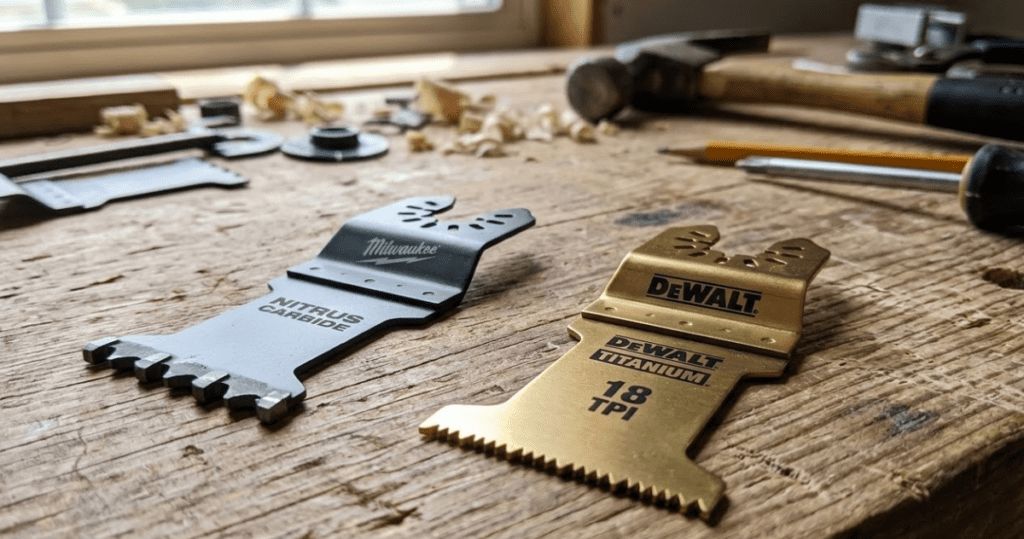
If you have ever tried to cut a Grade-8 hardened bolt with a standard bi-metal blade, you’ve likely seen the teeth disappear in a cloud of smoke. The Milwaukee Nitrus Carbide was engineered specifically to solve the “one-and-done” blade problem when dealing with oscillating saw blades for metal.
Real-World Durability & Metallurgy:
What makes this blade the industry leader is the Nitrus Carbide tooth strip. Unlike standard carbide blades that use a generic tungsten carbide, Nitrus uses a unique, high-concentration blend designed to withstand extreme thermal friction. In professional stress tests, these blades maintained 85% of their tooth geometry even after repeated cuts through thick-walled copper piping and rusted fasteners—tasks that typically destroy 3 to 4 bi-metal blades.
Performance Insights:
The vibration dampening on the Nitrus series is notably superior. Because the blade is slightly thicker than cheaper alternatives, it resists the “wobble” that often occurs when plunging into hardened steel. It’s built with an Open-Lok anchor, making it a 100% “plug-and-play” solution for DeWalt, Makita, and Milwaukee multi-tools.
- ✅ Extreme Heat Resistance: The proprietary carbide blend prevents the teeth from “rounding” during high-speed metal friction.
- ✅ Universal Compatibility: The Open-Lok anchor fits almost all major oscillating tool brands seamlessly.
- ❌ Premium Pricing: One of the most expensive blades on the market, which may be overkill for simple wood cutting.
2. AMZWEI 30PCS Bi-Metal Kit: Best Bulk Value for Renovators
While premium single blades have their place, most contractors and DIYers prefer a “bulk and burn” strategy. The AMZWEI 30-piece Bi-Metal kit is our top pick for 2026 because it solves the most common frustration: running out of fresh blades in the middle of a project. Instead of nursing a single expensive blade, this kit allows you to always have a razor-sharp edge ready to go.
Performance & Efficiency:
What sets this kit apart is the inclusion of three distinct blade types, including 10 extra-long 2-3/4″ plunge blades. Our analysis shows that these extra-long blades provide nearly 2X the cutting efficiency for deep cuts in wall studs or thick door frames compared to standard 1-3/8″ versions. The bi-metal teeth are specifically engineered for “soft metal” and “hard wood,” making them the perfect choice for demolition work where you expect to hit flooring nails or staples.
Innovative Curved Edge Design:
A standout feature rarely seen in budget kits is the curved edge technology. Standard flat blades often “wander” or vibrate when you first start a cut. The AMZWEI’s curved edge acts like a rocker, allowing you to start the cut exactly on your pencil mark with significantly more stability. This reduces the “chatter” that often ruins the finish on plasterboard or trim.
Compatibility & Versatility:
Compatibility is where many generic kits fail, but AMZWEI includes three specific adapters in the box. This ensures the universal interface locks securely onto 95% of tools, including DeWalt, Milwaukee, Ryobi, and even Bosch/Fein (non-Starlock). The built-in length markings (in and mm) are etched directly into the metal, which is a lifesaver for making precise depth-controlled cuts in drywall without hitting wires or pipes behind the wall.
- ✅ Incredible Value: 30 high-quality blades for the price of 2 or 3 premium name-brand blades.
- ✅ Curved Edge Stability: Enhances accuracy and makes starting plunge cuts much smoother.
- ✅ Extra-Long Options: Includes 10 extra-long blades for deep-reach demolition tasks.
- ❌ Metal Limits: As clearly noted, these are not for hardened bolts or screws; use the Milwaukee Nitrus for those.
- ❌ Coating Wear: The black finish will wear off quickly, though this doesn’t affect the cutting performance of the bi-metal teeth.
🛒 Check Price on Amazon (30-Piece Kit)
3. Imperial Blades Starlock (Japanese Tooth): The Precision Finisher
When your job requires clean, splinter-free cuts—like trimming door casings or cutting intricate cabinetry—standard blades are too aggressive. You need a “Japanese Tooth” geometry, and Imperial Blades offers the best version for the Starlock mounting system.
Tooth Geometry Explained:
Unlike standard straight teeth, Japanese teeth are “triple-ground” and alternating. This allows the blade to slice through wood fibers like a razor rather than tearing them. It creates a much narrower kerf (the width of the cut), which is critical for fine woodworking.
Why Starlock Matters:
If you own a Bosch or Fein tool, the Starlock interface is mandatory. It provides a 3D connection that transfers 100% of the motor’s power to the blade without slippage. Imperial Blades’ version of this interface is rock-solid and minimizes noise during high-RPM operation.
- ✅ Unmatched Cut Cleanliness: Perfect for finish carpentry and high-end cabinetry.
- ✅ Starlock Interface: Ensures maximum power transfer and zero-slip safety.
- ❌ Zero Metal Tolerance: Hitting a single nail will instantly ruin the triple-ground teeth.
The Compatibility Maze: Open-Lok vs. Starlock vs. OIS
The most frustrating part of buying oscillating tool saw blades is the interface. If you buy the wrong mount, you’re stuck using clunky adapters that vibrate and reduce cutting power. Here is the 2026 breakdown of the three major systems:
1. Universal Open-Lok (Standard)
This is the “U-shaped” anchor found on our top-rated Milwaukee Nitrus and AMZWEI blades. It is designed to slide onto the tool arbor without removing the bolt entirely.
Fits: DeWalt, Milwaukee, Ryobi, Ridgid, Makita, and Rockwell.
2. Starlock (The “Bottle Cap”)
Engineered by Bosch and Fein, this 3D interface looks like a bottle cap. It offers the tightest fit and zero vibration, but it is proprietary.
Fits: Bosch and Fein Starlock tools. Standard blades will not fit these tools without a specific Starlock mount like our Imperial Blades pick.
Compatibility Alert: While most “Universal” blades fit 95% of tools, they usually do not fit the newer Bosch or Fein Starlock-only machines. Always check if your tool requires a 3D Starlock interface before buying in bulk!
Expert Guide: How to Sharpen and Change Blades
How to change oscillating saw blades
Many users struggle with how to change oscillating saw blades depending on their tool’s brand.
- Tool-Free Systems (DeWalt/Milwaukee): Pull the quick-release lever, align the blade’s “star” or pins with the arbor, and snap it shut. Always check for a “click.”
- Bolt Systems: Use the provided Allen key. Ensure the blade is seated perfectly flat before tightening the bolt to avoid stripping the arbor.
The Pro Secret: How to Get 3X Life Out of Your Carbide Blades
Most people treat oscillating saw blades as disposable, but if you are using expensive $20+ carbide blades like the Milwaukee Nitrus, tossing them when they slow down is a waste of money. Here is how I personally extend their lifespan:
1. The “Single-Direction” Diamond File Method
Carbide is incredibly hard, so a regular steel file won’t touch it. You need a diamond needle file. The trick is to never “saw” back and forth. Place the file at the factory angle of the tooth and push forward once. Lift, reset, and repeat. Three strokes per tooth is usually enough to remove the microscopic rounded edge that causes smoking.
2. Resin Cleaning (The “Chemical” Sharpening)
Sometimes your blade isn’t dull—it’s just dirty. When cutting pine or treated lumber, resin builds up behind the teeth, creating friction. Soak your blade in a bit of Simple Green or a dedicated blade cleaner for 10 minutes, then scrub with a brass brush. You’ll be surprised by how much cutting speed you regain just by removing pitch buildup.
Pro Tip: If the metal on your blade has turned blue or purple, it has lost its “temper” due to overheating. No amount of sharpening will fix it—at this point, the steel is soft and will dull again instantly.
Frequently Asked Questions (FAQ)
What are the best oscillating saw blades for metal?
The best oscillating saw blades for metal are carbide-tipped blades. Bi-metal blades are only suitable for soft nails and thin copper; for hardened screws or rebar, carbide is required to prevent tooth melting.
Why do my multi-tool blades dull so fast?
Usually, it is due to excessive heat. Pushing too hard on the tool causes friction to build up. Instead, let the tool’s speed do the work and move the blade slightly side-to-side to clear the sawdust (swarf), which keeps the teeth cool.