


















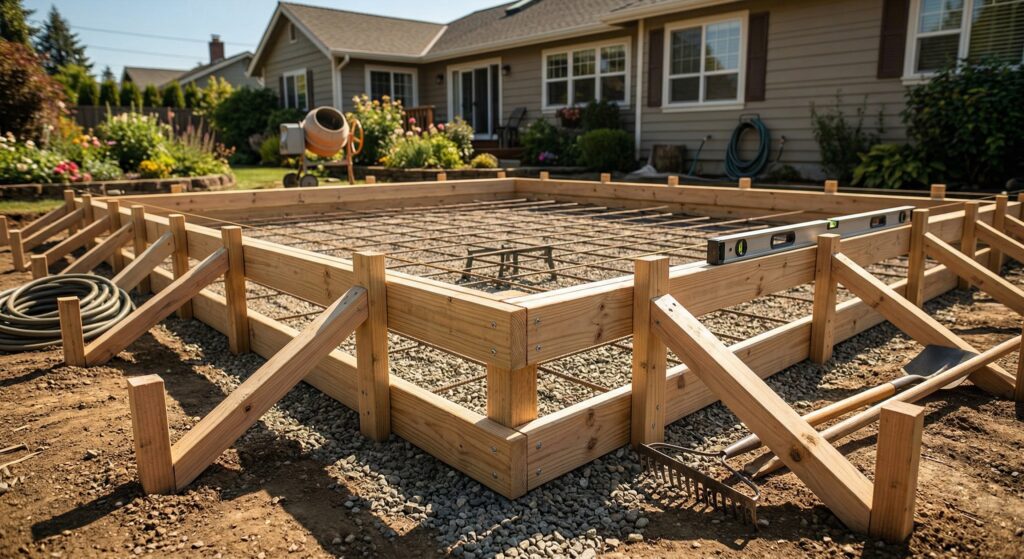
If you are planning to pour a new patio, build garden steps, or create a sturdy concrete slab, the actual pouring of the concrete is only half the battle. The real secret to a professional, long-lasting result lies entirely in the preparation. Concrete forms are the most critical tool in any masonry project. A well-built form holds the immense weight of wet concrete in place until it cures, ensures clean, perfectly straight edges, and prevents disastrous blowouts that can ruin your entire weekend.
Whether you are wondering how to make concrete forms for the first time or you want to upgrade your skills to tackle complex curved pathways, this comprehensive guide covers everything. We will walk through the exact materials you need, step-by-step construction methods for slabs and stairs, and the crucial timing for removing concrete forms without damaging your fresh pour.
What Are Concrete Forms (and Which Materials Actually Work)?
Before diving into the construction process, it is important to understand exactly what a concrete form is and which materials are suited for specific residential projects. Essentially, concrete forming is the process of creating a temporary or permanent mold into which wet concrete is poured. Because wet concrete exerts thousands of pounds of outward pressure, your forms must be incredibly rigid.
For the vast majority of DIY projects, dimensional lumber is your best friend. Standard pressure-treated 2x4s or 2x6s are the industry standard for flatwork like sidewalks and patios. If you are learning how to make concrete wall forms, you will need heavy-duty 3/4-inch plywood reinforced with 2×4 bracing to prevent the walls from bowing under the immense lateral pressure.
Many homeowners ask about modern alternatives, such as Insulated Concrete Forms (ICF). While insulated concrete forms are fantastic for building energy-efficient home foundations, they are generally too complex and expensive for simple backyard projects. For DIYers, sticking to wood, flexible plastics for curves, and specialized cardboard tubes for footings is the most cost-effective and practical approach.
Step-by-Step: How to Make a Form for a Concrete Slab
Learning how to form for a concrete slab is the foundational skill every DIYer must master. Whether it is a base for a garden shed or a new driveway extension, the principles remain the same. The goal is to create a rigid, perfectly level perimeter that will not shift when heavy wet concrete hits it.
First, clear and level your subgrade, adding a layer of compacted gravel for drainage. Next, lay out your perimeter using a string line to ensure your corners are perfectly square (use the 3-4-5 triangle method). Once your lines are set, it is time to build the frame. Use straight 2×4 lumber for a standard 4-inch thick slab. Drive wooden or metal stakes into the ground on the outside of your form every 24 to 36 inches. This tight spacing is mandatory; if you space your stakes too far apart, the weight of the concrete will cause the wood to bow outward, leaving you with a crooked slab.
When attaching the forms to the stakes, always use exterior-grade wood screws, not nails. Screws hold tighter during the pour and, more importantly, they are much easier to back out when it is time to dismantle the form. Finally, use a long level to ensure your forms have a slight slope (about 1/4 inch per foot) directing water runoff away from any nearby buildings.
The Complexity of Elevation: How to Form Concrete Steps
Pouring stairs requires significantly more planning than a flat slab. When figuring out how to form concrete steps, you are essentially building a series of stacked, interlocking boxes. The most critical components of stair forms are the side panels (stringers) and the front-facing boards (risers).
To build concrete steps, start by cutting two solid side panels from 3/4-inch plywood that match the exact profile of your desired staircase. Secure these side panels firmly into the ground with heavy stakes and diagonal bracing. Next, attach your riser boards horizontally across the front. Professional tip: Cut the bottom edge of your riser boards at a 45-degree inward bevel. This allows your finishing trowel to slide smoothly to the back corner of the tread without the form board getting in the way.
Because stairs hold a massive volume of concrete stacked vertically, the pressure at the bottom step is immense. You must reinforce the center of your riser boards with vertical strongbacks (a 2×4 running down the middle) attached to stakes in front of the bottom step. Without this, your bottom step will bow outward like a balloon.
Mastering Curves: How to Make Round and Curved Concrete Forms
Straight lines are relatively easy, but learning how to make curved concrete forms elevates your landscaping to a professional level. Rigid 2x4s will not work here. To form a sweeping garden path or a curved patio edge, you need flexible materials.
For gentle curves, hardboard siding or 1/4-inch plywood ripped into long strips works perfectly. Because these materials are thin, you will need to double your staking; place stakes every 12 to 18 inches to hold the curve’s tension and prevent the concrete from pushing the thin wood out of shape. For tight, aggressive circles, many professionals use specialized flexible plastic form boards that can be bent almost entirely in half without snapping.
If you are wondering how to use a concrete form tube (commonly known as Sonotube), the process is straightforward. These heavy-duty cardboard cylinders are designed for pouring round deck footings or mailbox posts. You simply dig your hole below the frost line, drop the tube in, backfill dirt around the outside to hold it plumb, and pour your concrete directly inside.
The Secret to Clean Edges: How to Keep Concrete From Sticking to Forms
One of the most devastating mistakes a beginner can make is pouring expensive concrete into dry wood forms. When the concrete cures, it bonds directly to the porous wood fibers. When you try to pry the boards away, you will chip off the crisp corners of your new slab, ruining the finish.
So, how to keep concrete from sticking to forms? You must use a release agent. While some old-school DIYers wipe used motor oil or cooking spray on their boards, these can leave ugly yellow stains on your finished concrete and prevent sealers from adhering later. The correct method is to use a commercial, chemically formulated concrete form release oil. You simply spray or brush a thin, even coat onto the inside of your wood or plastic forms just before pouring.
Crucial Timing: When to Remove Concrete Forms
This is by far the most common point of anxiety for DIYers. The questions of when to remove concrete forms, how long before removing concrete forms, and can you leave concrete forms on too long dominate every masonry forum. Removing forms too early can cause the soft concrete to collapse, while leaving them on too long makes removal incredibly difficult as the wood swells with moisture.
As a general rule for standard residential projects, you should wait 24 to 48 hours before stripping concrete forms. During this initial 48-hour window, the concrete undergoes its primary chemical hydration, generating heat and hardening enough to support its own weight. For flatwork like sidewalks and patios, carefully backing out the screws and tapping the boards away after 24 hours is perfectly safe.
However, if you are learning to remove forms from concrete on vertical structures such as retaining walls, heavy steps, or load-bearing columns, patience is vital. You should leave these forms in place for at least 3 to 7 days. Vertical structures rely entirely on their internal strength to remain standing, and concrete takes 28 days to reach its maximum cured strength. When you do finally strip the forms, never use a crowbar directly against the fresh concrete. Instead, wedge your pry bar between the wooden stakes and the form boards to gently peel the wood away from the cured surface.
FAQ – Common Questions About Concrete Forms
How many times can I reuse plastic forms?
High-quality reusable plastic concrete forms can withstand 20 to 40 pours, provided you clean them thoroughly and apply a proper concrete form release agent before each use. Traditional wood forms (like 2x4s) are typically good for only 1 to 3 pours before they warp or split.
Is it cheaper to build forms or rent them?
For a single residential project like a backyard patio or garden steps, it is far cheaper to build your own forms using dimensional lumber. However, if you are planning multiple large projects or pouring long, straight retaining walls, renting metal concrete forms from a local supplier can save you both time and money in the long run.
Can I use concrete forms for curved shapes?
Yes. Rigid lumber won’t work, but you can use flexible materials like 1/4-inch plywood ripped into strips, hardboard siding, or specialized flexible plastic forms. For perfectly round columns or footings, cardboard concrete form tubes (like Sonotubes) are the industry standard.
How soon can I remove the forms?
For small, flat projects like sidewalks or slabs, you can safely remove the forms after 24 to 48 hours. However, for structural work like heavy concrete steps or vertical walls, you must leave the forms in place for 3 to 7 days to ensure the concrete can support its own weight.
Do I need special tools to build concrete forms?
No, basic carpentry tools are enough for most DIY masonry jobs. You will need a circular saw or hand saw, a long level, a hammer, a drill with exterior-grade wood screws, wooden or metal stakes, and a string line to keep everything perfectly straight and square.