


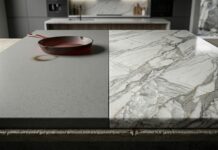












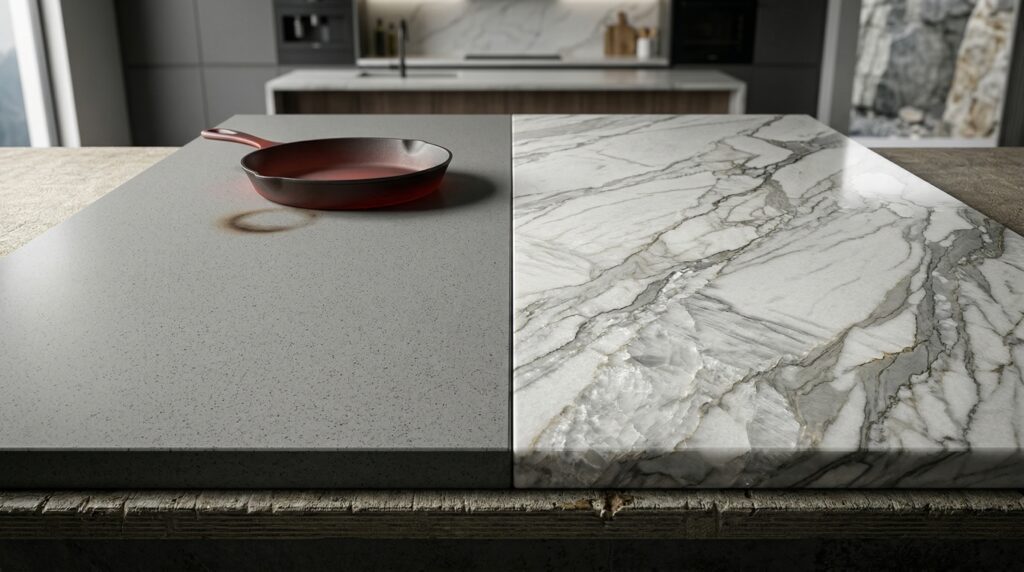
If I had a dollar for every time a homeowner confused quartz with quartzite, I could pay for a whole kitchen remodel. The names sound almost identical, but structurally, aesthetically, and functionally, they are completely different animals. Sales reps at big-box stores often use the terms interchangeably, which is a massive mistake. If you put a hot cast-iron skillet on the wrong one, you will permanently ruin a $4,000 slab.
Before you drop serious money on a kitchen island or an outdoor patio bar, let’s cut through the showroom marketing. Here is the unfiltered truth about quartzite vs quartz, including the real costs, the maintenance nightmares, and how they actually hold up in a busy home.
The Core Difference: Man-Made vs. Mother Nature
To understand how these materials will behave in your kitchen, you have to look at how they are made.
Engineered Quartz (The Man-Made Marvel)
Quartz countertops are not slabs cut from a mountain. They are engineered in a factory. Manufacturers take crushed natural quartz crystals (about 90-93% of the mix) and bind them together with heavy-duty polymer resins and pigments (the remaining 7-10%).
- The result: A completely non-porous, highly uniform slab that requires zero sealing.
Natural Quartzite (The Earth-Forged Rock)
Quartzite is a 100% natural metamorphic rock. Millions of years ago, it started as pure quartz sandstone. Through extreme tectonic heat and pressure beneath the earth’s crust, those sand grains fused into an incredibly dense, solid stone. It is quarried in massive blocks and sliced into slabs.
- The result: A wildly unique, glass-like stone with natural veining that is actually harder than granite, but still slightly porous.
Pros and Cons: A Side-by-Side Comparison
When weighing quartz vs quartzite pros and cons, it usually comes down to how you cook and how much maintenance you are willing to tolerate.
The Cost Trap: Quartzite vs Quartz Price
Budgeting for stone is tricky because the price per square foot only tells half the story. Fabrication and installation fees can drastically change the final number. Because quartzite is so dense, it requires specialized diamond blades to cut, and fabricators take twice as long to edge it. That labor cost gets passed down to you.
Here is the realistic cost of quartz vs quartzite installed in 2026:
Pro Tip: If a fabricator quotes you a price for natural quartzite that seems suspiciously cheap (like $60 installed), walk away. They are likely trying to sell you marble disguised as quartzite—a notorious industry scam that will leave you with etched and stained countertops in weeks.
The “Taj Mahal” Confusion
Let’s address one of the most common questions I get: Taj Mahal quartz vs Taj Mahal quartzite.
“Taj Mahal” is the name of a specific, highly sought-after natural quartzite quarried in Brazil. It is famous for its creamy, translucent background and soft, wispy gold veining. Because it is incredibly popular (and expensive), quartz manufacturers have created engineered copies (like Lumataj Quartz).
If you want the depth and the ability to put hot pans on it, you need the real Taj Mahal Quartzite. If you want the look but refuse to deal with annual sealing, buy the engineered Taj Mahal Quartz replica.
Granite vs Quartz vs Quartzite: The Big Three
If you are stuck choosing between the three heavyweights, here is the quick contractor breakdown:
- Granite: The reliable workhorse. Cheaper than quartzite, heat resistant, busy patterns, needs sealing.
- Quartz: The modern standard. Zero maintenance, clean uniform colors, but melts under high heat and fades outside.
- Quartzite: The luxury flex. The most durable and heat-resistant of all three, looks like high-end marble, but comes with a premium price tag and requires strict sealing.
Essential Care & Maintenance Products
Since you are investing thousands of dollars in these materials, maintaining them correctly is crucial to avoid permanent damage. Here are the absolute best products you should keep under your sink, directly from my contractor toolkit:
1. Best Quartz Countertop Repair Kit

Even though engineered quartz is tough, accidentally dropping a heavy cast-iron pan on the edge will cause a chip. Instead of paying a fabricator $300 for a service call, the HIMG Light Cure Acrylic Surface Repair Kit is the industry-standard DIY solution. It uses a light-curing acrylic that permanently fills and blends the chip in less than 10 minutes.
2. Best Quartz Countertop Cleaner
Do not use regular dish soap or ammonia-based glass cleaners on quartz. Over time, they will leave a cloudy, hazy film over the resin. You need a dedicated, pH-neutral spray. Weiman Quartz Clean & Shine is my top recommendation because it protects the resins from UV fading while leaving a brilliant, streak-free finish.
3. Best Quartzite Sealer
Contractor Warning: Quartz does not need a sealer, but natural quartzite absolutely does! If you have real quartzite, you must use a high-end impregnating sealer to stop oils and wine from sinking deep into the stone. The Tenax Proseal Nano is a professional-grade solvent that penetrates deep into microscopic pores, providing years of heavy-duty protection without altering the stone’s appearance.