













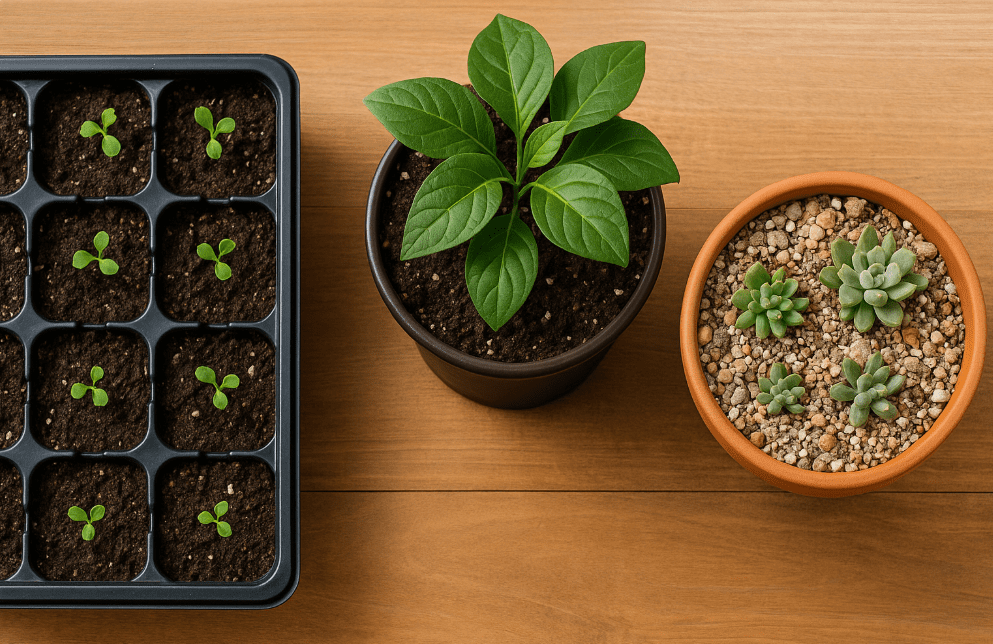
Why Seedlings, Houseplants, and Succulents Need Different Care
Table of Contents
Toggle“Plants in pots” is not a single category. Seedlings, houseplants, and succulents all live in containers, but what they expect from you is completely different.
Treat them all the same and you’ll quickly run into problems: leggy seedlings, yellowing houseplants, and succulents that turn to mush.
In this guide, you’ll learn:
-
How seedlings, houseplants, and succulents differ
-
The best potting mix type for each
-
How to water and feed each group
-
Simple rules that keep mixed collections healthy
Pair this with a good soilless potting mix and you’ll eliminate most of the guesswork from container gardening.
Seedlings: Fragile Sprinters
Seedlings are plants in their earliest growth stage, right after germination. They grow incredibly fast but are also very easy to stress or kill.
What Seedlings Need
-
Light: Bright but gentle. Indoors, this typically means positioning grow lights 10–20 cm (4–8 in) above the leaves. Without enough light, seedlings stretch and become weak and floppy.
-
Temperature: Warm and steady, typically 18–24 °C (65–75 °F) for most vegetables and flowers.
-
Moisture: Evenly moist, never waterlogged and never bone dry.
Best Potting Mix for Seedlings
Seedlings perform best in a fine, sterile seed-starting mix rather than heavy garden soil.
Ideal characteristics:
-
Fine-textured peat or coconut coir for moisture retention
-
Vermiculite to keep moisture even and improve seed-to-mix contact
-
A little perlite for drainage and air space
-
Very low nutrient levels (you feed later)
A full-strength houseplant mix is usually too coarse and too rich and can increase the risk of damping-off disease.
Watering and Feeding Seedlings
-
Watering: Bottom-watering works well. Set the trays in a shallow pan of water and let the mix absorb moisture, then drain off the excess.
-
Feeding: Start after the first set of “true leaves” appears. Use a balanced liquid fertilizer at ¼ to ½ strength every 1–2 weeks.
Common Seedling Mistakes
-
Using garden soil or dense potting mix
-
Not providing enough light (leggy, weak stems)
-
Overwatering in poorly drained containers
-
Fertilizing too early or too strongly
Houseplants: Long-Term Roommates
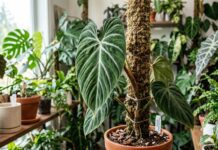
Houseplants are the plants you live with year-round: pothos, peace lilies, monstera, rubber plants, and dozens of others. They aren’t in a rush like seedlings, but they need consistent, moderate care over months and years.
What Houseplants Need
-
Light: Most popular houseplants prefer bright, indirect light. Some tolerate low light, while others (like some ficus or citrus) want more brightness.
-
Humidity: Many tropical species appreciate higher humidity than typical indoor air, especially in winter.
-
Airflow: Gentle airflow reduces pest and fungal problems.
Best Potting Mix for Houseplants
Houseplants thrive in a balanced, all-purpose soilless mix that holds moisture but still drains well.
A typical blend includes:
-
Peat moss or coconut coir for water retention
-
Perlite and/or fine bark for drainage and aeration
-
A small amount of slow-release fertilizer as a starter charge
You can tweak the texture:
-
Tropical foliage plants: More coir/peat and some bark for a moisture-retentive but airy mix
-
Aroids (monstera, philodendron, etc.): Extra bark for a chunkier, oxygen-rich substrate around the roots
Watering and Feeding Houseplants
-
Watering: Check moisture with your finger 2–3 cm down. Water when the mix feels dry at that depth for most species. Empty any water that collects in saucers.
-
Feeding: During active growth (spring and summer), feed with a balanced liquid fertilizer or rely on slow-release granules as directed. Reduce or pause feeding in low-light winter months.
Common Houseplant Mistakes
-
Using containers with no drainage holes
-
Watering on a fixed schedule instead of checking the mix
-
Leaving pots standing in water
-
Allowing the potting mix to compact and starve roots of air over time
Succulents: Desert Specialists
Succulents, including cacti, are survival experts built for dry conditions. In containers, they’re most often killed by overwatering and overly rich, moisture-holding soil.
What Succulents Need
-
Light: Lots of it. Most succulents require several hours of bright, direct sun each day. Indoors, a south- or west-facing window or strong grow light is ideal.
-
Dry periods: Succulents expect cycles of soaking rain and long dry spells. Constant moisture quickly leads to root rot.
-
Fast drainage: Their roots must never sit in a soggy mix.
Best Potting Mix for Succulents
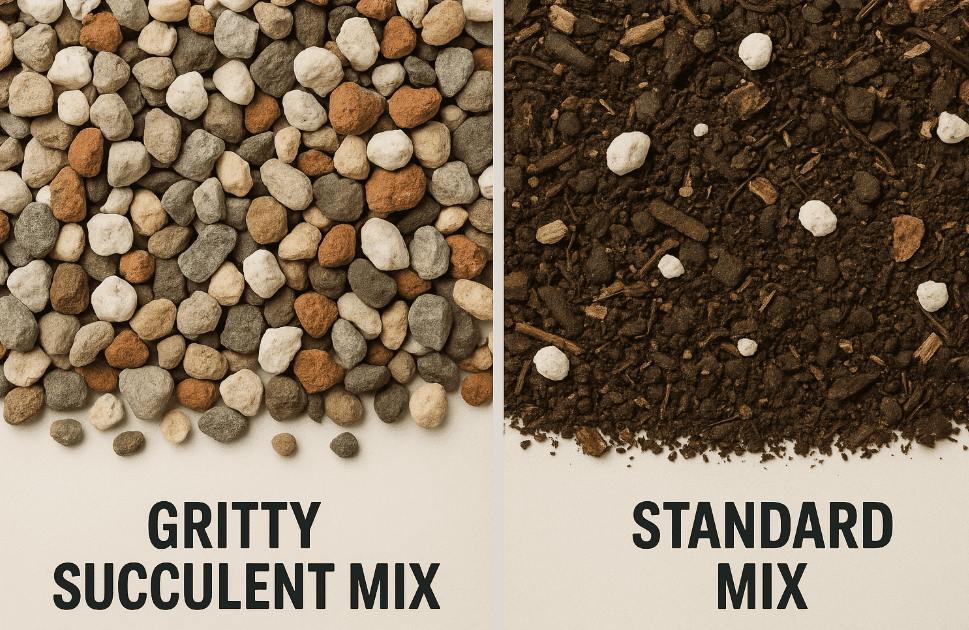
Succulents demand a very fast-draining, gritty mix.
Look for or blend:
-
A smaller proportion of peat or coir
-
Large amounts of perlite, pumice, or coarse sand
-
Optional small gravel or crushed rock for extra grit
A simple starting recipe:
-
40% coir or peat
-
40% perlite or pumice
-
20% coarse sand or small gravel
If the mix feels heavy or stays wet for too long, add more perlite or grit.
Watering and Feeding Succulents
-
Watering: Water thoroughly until it drains from the bottom, then allow the mix to dry almost completely before watering again. In cool, low-light conditions, watering may be needed only every few weeks.
-
Feeding: Succulents are light feeders. A diluted, low-nitrogen fertilizer, applied once or twice during the growing season, is usually sufficient.
Common Succulent Mistakes
-
Planting in standard potting soil with poor drainage
-
Using decorative containers without drainage holes
-
Watering “a little every day” instead of deep, infrequent watering
-
Keeping succulents in low light so they stretch and weaken
Seedlings vs. Houseplants vs. Succulents: Comparison at a Glance
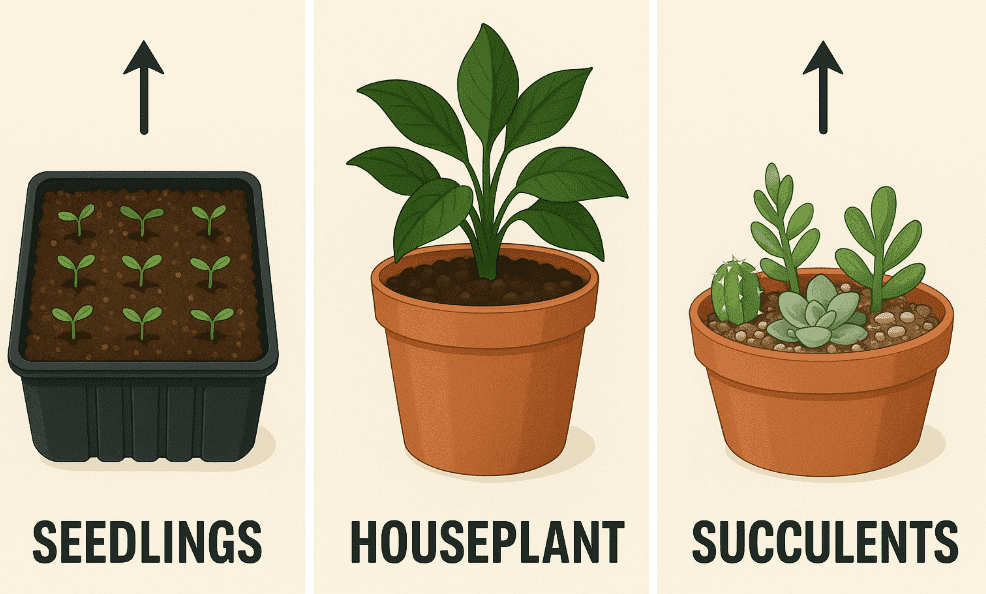
| Feature | Seedlings | Houseplants | Succulents |
|---|---|---|---|
| Growth stage | Very young, fast-growing | Established, long-term | Slow to moderate, drought-adapted |
| Typical location | Trays under lights or bright windows | Indoors on shelves, sills, stands | Bright windowsills, sunny patios |
| Potting mix texture | Fine, sterile, very airy | Medium texture, balanced moisture & air | Very gritty, extra fast-draining |
| Watering style | Evenly moist, never saturated | Deep, then partial dry between waterings | Soak, then allow to dry almost fully |
| Fertilizer level | Very light and diluted | Moderate in growing season | Very light and occasional |
| Biggest risk | Damping-off, stretching | Overwatering, root rot, pests | Overwatering, poor light |
How a Soilless Potting Mix Fits All Three
A good soilless potting mix can be the base for seedlings, houseplants, and succulents, as long as you modify it for each group:
-
For seedlings:
Use a fine seed-starting version with extra vermiculite and minimal fertilizer. -
For houseplants:
Use a standard soilless mix with coir or peat, perlite, and some bark. A slow-release fertilizer charge makes care easier. -
For succulents:
Start with the same soilless base but mix in lots of perlite, pumice, or coarse sand until the blend feels very loose and gritty.
One flexible base mix, customized in three ways, keeps your potting shelf simple while still providing each plant type with exactly what it needs.
Practical Tips for Mixed Collections
Most gardeners grow all three groups simultaneously: trays of spring seedlings, a rack of foliage houseplants, and a few pots of succulents. These tips keep that mixed collection under control:
-
Group plants by needs, not by style
Keep moisture-loving tropicals away from sun-hungry succulents. Grouping by light and water preference makes care much easier. -
Use the right container for the job
-
Seedlings: shallow trays or cell packs with excellent drainage
-
Houseplants: pots with drainage holes sized just a bit larger than the root ball
-
Succulents: wide, shallow pots with multiple drainage holes; unglazed clay dries faster
-
-
Label your potting mixes
When you adjust your base mix for seedlings or succulents, label buckets or bins so you can repeat successful recipes. -
Adjust care with the seasons
-
Seedlings are mostly a spring project.
-
Many houseplants slow down in winter and need less water and fertilizer.
-
Succulents may rest in the coolest months and should be kept much drier.
-
FAQ
Seedlings vs. Houseplants vs. Succulents
What is the main difference between seedlings, houseplants, and succulents?
Seedlings are young plants just after germination and need fine, sterile mix and steady moisture. Houseplants are established plants grown indoors long-term and prefer balanced, all-purpose mixes. Succulents are drought-adapted plants that require very gritty, fast-draining mixes and long dry periods between waterings.
Can I use the same potting mix for all three?
You can start with the same soilless base, but you should modify it. Seedlings need a finer, low-fertility version. Houseplants do well in a standard mix. Succulents need extra perlite, pumice, or sand to create a much drier, grittier substrate.
How often should I water seedlings compared with houseplants and succulents?
Seedlings need consistently moist mix and may require watering every day or two, depending on light and temperature. Houseplants are usually watered when the top few centimeters of mix feel dry. Succulents are watered thoroughly and then left alone until the mix has almost completely dried.
What kind of fertilizer should I use for each group?
Seedlings should receive a very diluted, balanced liquid fertilizer after they form true leaves. Houseplants can use a balanced liquid or slow-release fertilizer during the growing season. Succulents are light feeders and typically need only a diluted, low-nitrogen fertilizer once or twice a year.
Why do my succulents rot while my other plants look fine?
Succulent roots are easily damaged by constant moisture and poorly drained soil. If succulents are planted in a regular houseplant mix, watered frequently, or kept in low light, they often develop root rot and mushy stems. Switching to a gritty mix and brighter light usually solves the problem.
Conclusion
Match the Mix and Watering to the Plant
Seedlings, houseplants, and succulents might share your shelves and windowsills, but they do not share the same rules.
Once you adjust potting mix, light, and watering for each group, you’ll see:
-
Stronger, sturdier seedlings
-
Houseplants that stay lush for years
-
Succulents that keep their compact shape and color
The more you match your care to the type of plant, the easier and more rewarding container gardening becomes.