















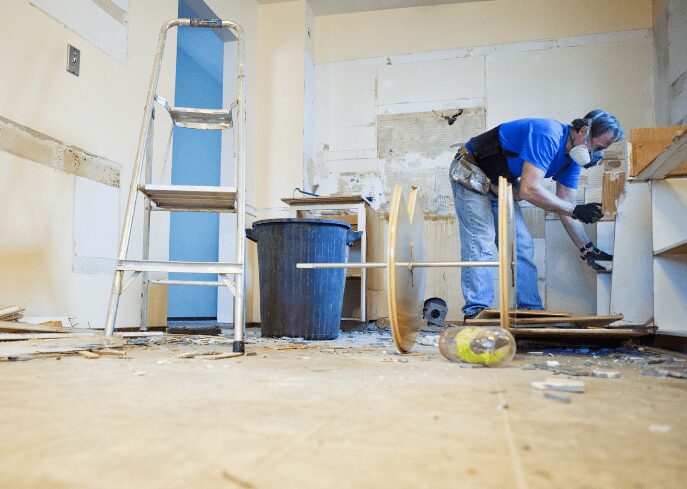
A kitchen cabinet renovation can be one of the most financially challenging and time-consuming home projects, regardless of whether you are preparing your home for sale or wish to give your home a new look.
But painting your cabinets may be one of your kitchen’s most straightforward DIY projects, giving them a more economical and unique makeover.
An experienced painter shares his finest painting advice so you may give your kitchen the facelift you’ve been longing for.
What Kind Of Paint To Use
Color isn’t the only factor to consider when choosing paint for your kitchen cabinets.
For long-lasting results, you must understand which paint kind will work on your cabinets, whether wood, metal, or laminate.
Laminate cabinets could require more investigation, although wood and metal cabinets are simple to recognize.
You most likely have laminate cabinets if they have a printed finish or a glass-like, plastic look.
Here is a quick guide to the most common paint types and the best uses for each.
Oil-based paint
Good: Oil paint offers smooth coverage, good coverage, and better durability in high-traffic areas
Bad: Fading color over time, requires frequent touch-ups, emits strong fumes, is challenging to dispose of, and is not environmentally friendly.
Best for: Metal cabinets
Latex paint
Good: Latex paints are water-based. Unlike oil paint, latex paint does not tend to fade over time, is quick-drying, and is a bit more environmentally friendly.
Latex paints are much more accessible; some newer ones now provide smoother and more durable finishes.
Bad: Keep in mind that latex paint usually requires more coats, which can lead to peeling and some swelling.
Best for: Most cabinets, especially wood.
Enamel paint
Pros: It dries harder with a durable finish.
Cons: Enamel paint is oil-based, so it shares all the same downsides as other oil-based paints.
Best for: Laminate cabinets or cabinets that won’t be sanded before painting
Once you’ve chosen your paint, it’s time to gather your materials and prepare your kitchen for painting.
What you will need for kitchen cabinet renovation
-
Drill
[amazon box =”B07YB2RZ6M”]
-
Screwdriver
[amazon box =”B08DRVM38X”]
-
Painter’s tape
[amazon box =”B07MSWZM9R”]
-
Utility blade or 5-in-1 tool
[amazon box =”B08KKTMQ82″]
-
Degreaser spray
[amazon box =”B08QPC2WNH”]
-
Liquid sander deglosser
[amazon box =”B01MTJ1TPY”]
-
Sandpaper or sand machine (optional)
[amazon box =”B086VX135D”]
[amazon box =”B07CSNC4NY”]
-
All-purpose putty (for repairs)
[amazon box =”B0007ZHTTS”]
-
Painter stands
[amazon box =”B08ZMKBJ4Z”]
-
Wide square paintbrush
[amazon box =”B01MG5HEZX”]
-
Angled paintbrush
[amazon box =”B07MDVBK3K”]
-
Paint rollers
[amazon box =”B07VX6SVC2″]
-
Dropcloths or large towels
[amazon box =”B000JH8OIE”]
-
Clean cloths
[amazon box =”B009FUFBTG”]
Helpful tip
The expert advises against using a high-volume/low-pressure paint sprayer if you’re a novice do-it-yourselfer.
Application expertise, spray gun expertise, and general preparation are necessary for effective spraying.
Always wear a respirator and make sure your space is well-ventilated if you use a sprayer.
How to avoid having to sand everything
Professionals advise sanding for the best effects on most cabinets, but if you wish to skip it, they advise using high-quality primer and paint.
Grease, filth, or soot will prevent the paint from adhering correctly to the cabinets.
A decent primer and high-quality paint are a need if no sanding is done.
Using a satin enamel paint will provide your kitchen cabinets with the most extraordinary sheen and longevity if you decide not to sand them beforehand.
If you decide to use latex paint instead of sanding, clean your cabinets thoroughly with a sponge and moist cloth.
Use a degreaser-like dish soap after that for additional cleaning. For a smooth finish, apply a liquid sander deglosser.
Make your space ready
Make sure your workspace is prepared for your project before beginning to paint anything. That entails emptying your cabinets, cleaning them, and covering exposed surfaces with drop cloths or big towels as protection.
All dishes should be taken out, along with anything else you don’t want paint on, and everything else should be covered entirely in plastic and tape.
Clean all residue and debris off all cabinetry by spraying a degreaser thereon and then wiping it off with a dry cloth.
Ensure all your equipment and materials are available to get the most out of the step-by-step process.
Kitchen cabinet painting
After cleaning your cupboards and preparing the area, you may start priming and painting your space.
1. Remove the drawer fronts, hardware, and cabinet doors.
To stay organized, label hardware on cabinet doors. Label the cabinet door with painter’s tape to indicate the handles and hardware that go with it. You can keep track of placements with the help of this step.
2. To prevent damage, carefully sand cabinets and frames along the grain.
Sanding prepares wood for painting by removing surface scratches and opening wood pores. Make sure your cabinets/frame have been well cleaned and deglossed with a liquid sander if you bypass the sanding step.
3. Prime all frames and cabinets
Experts advise a resin-based primer since it offers concrete sealing and bond. Cabinets that have been primed should be dried away from your workspace on a paint stand. Prime the frames while the cabinet doors are drying.
4. For a smoother finish, if you’re sanding, lightly sand your cabinets/frames between coats.
If you choose not to sand, be sure the primer has completely dried in between applications. Within four to five hours, the primer ought to be dry.
5. Paint your frames and cabinets.
Paint the doors evenly and against the grain using the large square brush. For moldings and corners, use an angled brush.
Oil painting calls for a natural bristle brush, while latex paint calls for a synthetic brush (which won’t absorb water).
For an even coating, apply two layers of paint, allowing four hours between each.
On a paint stand, place painted cabinets to dry. Repeat the painting process with the frames as the cabinet doors dry.
6. Let everything dry before reinstalling.
Paint should dry in four to five hours, much like a primer. To remove any dust, lightly clean the dried cabinets and frames.
Reattach the shelves, drawers, handles, hardware, and cabinet doors.
Insider’s conclusion
One simplest, most economical methods to revitalize your kitchen is to paint the cabinets.
Knowing what material your cabinets are made of, choosing a primer and paint that will work best for them, and deciding whether to sand your cabinets are the fundamentals.
Your kitchen might even thank you for the restoration if you only have a few simple tools and materials, a day or two to spare, and a cheerful DIY mindset.
This is an excellent chance to replace any features you’re sick of.
Why not pair your fresh hues with some new handles?
Currently, handles made of copper and gold are very fashionable. Consider unconventional options and be imaginative in your selections!