















Before we dive deep into the world of whirring blades and freshly cut grass, let me share a truth I’ve learned after decades of gardening: your relationship with your lawn mower is much like a partnership with a living plant. It requires understanding, care, and occasional moments of troubleshooting to keep everything flourishing. Whether you’re tending to a modest patch of green or managing acres of turf, selecting and maintaining the right lawn mower transforms a potentially tedious chore into a satisfying ritual of garden care.
Lawn Mower Ecosystem: Gas, Electric, or Robotic?
The Enduring Power of Gas Mowers
There’s something undeniably satisfying about the robust purr of a gas mower coming to life on a spring morning. These traditional workhorses have maintained their popularity for good reason, particularly among those with larger properties or challenging terrain.
Gas-powered mowers still slightly outperform their electric counterparts in cutting performance, scoring an average of 4.7 versus 4.5 for electric models in comprehensive tests3. The substantial power they generate makes short work of thick, unruly grass that might challenge less muscular machines.
I’ve found that gas mowers truly shine in properties over half an acre or those with slopes and obstacles. Their unrestricted movement, free from power cords or battery limitations, allows for extended cutting sessions without interruption. With proper care, these durable machines can serve faithfully for 10-15 years or more, becoming trusted companions through countless seasons of growth.
However, their strengths come with trade-offs. The roar of a gas engine can disturb the peaceful harmony of your garden sanctuary (and your neighbors’ patience). The maintenance needs- oil changes, spark plug replacements, air filter cleaning- create a seasonal rhythm of care that some gardeners find meditative and others consider burdensome.
The Quiet Revolution of Electric Mowers
I remember my skepticism when electric mowers first gained popularity, could they truly match the power I’d grown accustomed to? The answer, I’ve discovered through both research and personal experience, is increasingly “yes.”
Modern electric mowers have evolved dramatically, now offering performance that rivals their gas-powered counterparts for most average-sized lawns. The typical electric walk-behind mower runs for 45-50 minutes per charge, easily handling a quarter-acre lawn and potentially up to half an acre on flat terrain. For the majority of homeowners, this eliminates range anxiety as a concern.
The benefits extend beyond mere functionality. Electric mowers operate with a gentle hum rather than a neighborhood-waking roar. They eliminate the fumes that can transform a pleasant gardening session into an exercise in breath-holding. And perhaps most appealingly to those who view maintenance as a necessary evil rather than a joy, they require significantly less upkeep-no oil changes, no spark plugs, no winterizing rituals.
For maneuverability, noise levels, and ease of maintenance, electric models now hold a clear advantage. Their environmental credentials are equally impressive, reducing both air and noise pollution that have been linked to serious health concerns, including cancer and hearing loss.
The Future Has Arrived: Robotic Mowers
In my garden experiments over the years, few innovations have fascinated me more than robotic mowers. These autonomous gardeners represent not just a new tool, but a philosophical shift in how we approach lawn care.
The technology powering these helpful assistants has made remarkable strides. Advanced models like the Husqvarna Automower 435X AWD and Worx Landroid Vision now navigate complex landscapes with impressive precision. The newest generation can even operate without boundary wires, using cameras, GPS, and AI to recognize lawn edges and avoid obstacles-including wildlife and pets.
I’ve watched with wonder as these machines quietly maintain lawns with a different approach than human mowers. Rather than occasional deep cuts, they perform frequent light trimmings that promote healthier turf and naturally mulch clippings back into the soil. The result is often a consistently manicured look that emerges not from intense weekend labor but from patient, daily attention-much like the gradual care we provide to our most cherished garden perennials.
While the initial investment remains higher than traditional mowers, the reduced maintenance needs, labor savings, and gentle environmental impact are compelling advantages for those ready to embrace this lawn care revolution.
[azonpress_tables id=”5″]
The Seasonal Rhythm of Lawn Mower Maintenance
Spring Awakening: Preparing Your Mower for the Growing Season
Just as we carefully coax our gardens back to life after winter’s rest, our lawn mowers benefit from thoughtful attention before their season of work begins. Spring maintenance creates the foundation for months of reliable performance.
The transition from dormancy to active service should begin with a thorough inspection. For gas mowers, this is the perfect time to change the oil, providing fresh lubrication for the season ahead. The spark plug, that tiny but crucial component, deserves replacement after a year or two of service to ensure easy starting and optimal performance.
Air filters, often overlooked yet vital to engine health, require cleaning or replacement. I’ve learned through experience that a paper filter should never be cleaned with liquids, use compressed air or a soft brush instead to preserve its integrity.
Perhaps most important is addressing the mower’s cutting blade. A sharp blade doesn’t merely cut grass, it transforms your mowing experience while promoting lawn health. Dull blades tear rather than slice, creating stress and entry points for disease in your grass. I sharpen my blades at season’s start, knowing that clean cuts create the foundation for a resilient lawn.
Summer Vigilance: Maintaining Peak Performance
Summer’s vigorous growth demands the most from our mowers, making this the season when attentive care yields the greatest rewards. The maintenance needs during active use are simple but consequential.
Regular cleaning prevents grass buildup that can cause corrosion and impede performance. For gas mowers, checking fuel freshness is essential- gasoline should never remain in the tank for more than about a month. This is a lesson I learned the hard way after a mower refused to start following extended storage with old fuel.
Electric mower maintenance during summer focuses primarily on battery care and keeping ventilation pathways clear. For all mower types, blade sharpness remains important throughout the season, a task I schedule monthly during peak growing times.
Autumn Preparation: Winterizing for Longevity
As garden plants prepare for dormancy, our tools require preparation for their own period of rest. Proper winterization prevents the disappointment of discovering a non-functional mower when spring returns.
For gas mowers, fuel management is critical. Either drain the tank completely or add fuel stabilizer to prevent the formation of gummy deposits that can clog the carburetor. Oil should be changed if you didn’t perform this task in spring, preventing acidic compounds from lingering in the engine during storage.
The battery in electric mowers benefits from a full charge before winter storage, though some manufacturers recommend specific storage charge levels. Cleaning is essential for all mower types-removing grass clippings and debris that could hold moisture and cause corrosion during the dormant months.
I store my mower in a dry location after winterization, having learned that moisture exposure during winter months can accelerate the deterioration of both mechanical and electrical components. Many newer electric models can be stored upright to save space, a thoughtful design feature for those with limited storage.
Choosing Your Garden Partner: Finding the Perfect Mower
Evaluating Your Landscape’s Needs
The journey to finding your ideal lawn mower begins not with comparing models but with understanding your unique landscape. Just as a gardener selects plants suited to their climate and soil conditions, your mower selection should reflect your lawn’s specific requirements.
Consider not just the size of your lawn but its character. Are there slopes that challenge navigation? Trees or garden beds that require maneuvering around? Dense grass that demands extra cutting power? A quarter-acre of flat, obstacle-free lawn presents different needs than the same area with varied terrain and features.
For lawns under a half-acre with typical grass density, today’s battery-powered electric mowers offer sufficient power and run time. My own transition to electric for a moderate-sized property brought the pleasant surprise of complete cutting without battery depletion, along with noticeably more peaceful mowing sessions.
Larger properties, especially those exceeding half an acre or featuring challenging terrain, may still benefit from the unrestricted run time and robust power of gas mowers. The convenience of refueling versus recharging becomes increasingly significant as property size grows.
The Environmental Equation: Impact and Efficiency
The environmental impact of lawn care extends beyond aesthetics to meaningful ecological considerations. Gas-powered outdoor equipment produces significant emissions. A traditional gas mower operated for one hour generates pollution equivalent to driving a car for approximately 45 miles.
Electric mowers substantially reduce this environmental footprint, eliminating direct emissions and dramatically decreasing noise pollution. This reduction benefits not only global concerns but also your immediate garden ecosystem and neighborhood harmony.
The energy efficiency comparison extends to operational costs as well. Electric mowers generally cost less to operate than their gas counterparts when accounting for fuel, oil, and maintenance expenses. Solar-charging options can further reduce the environmental impact and cost of battery-powered models.
Investment Considerations: Beyond the Price Tag
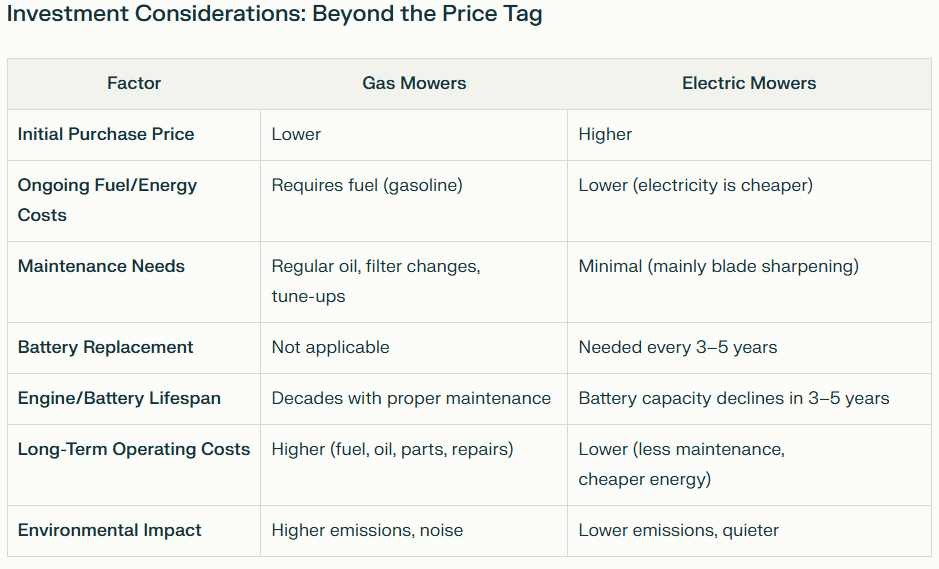
True value assessment requires looking beyond the initial purchase price to consider the complete lifecycle of your mower. Gas mowers typically offer lower upfront costs but incur ongoing expenses for fuel, oil, filters, and maintenance. Electric mowers generally command higher initial prices but reduce yearly operating costs and maintenance needs.
Battery replacement represents a significant consideration for electric models, with most batteries lasting 3-5 years before capacity noticeably declines. Conversely, a well-maintained gas mower engine can function efficiently for decades with proper care.
My approach to this decision has evolved toward viewing it as an ecosystem investment rather than simply a tool purchase. The reduced noise, simpler maintenance, and environmental benefits of electric models may justify their higher initial cost for many gardeners-particularly as battery technology continues to improve and prices gradually decrease.
Cultivating a Healthy Mower: Essential Maintenance Practices
The Cutting Edge: Blade Care and Management
At the heart of every mowing experience is the blade, the component that most directly affects both your lawn’s health and your mower’s performance. A properly maintained blade transforms the act of mowing from destructive cutting to nurturing pruning.
Sharpening should occur at least once per season, though more frequent attention benefits heavily used mowers. I’ve found that examining grass blades after cutting provides a simple test, cleanly sliced ends indicate a sharp blade, while ragged, torn grass suggests dulling.
The technique for blade removal varies by mower model, but basic safety principles remain constant. Always disconnect the spark plug on gas mowers or remove the battery/unplug electric models before accessing the blade. Balancing the blade after sharpening ensures smooth operation and extends the life of the mower’s engine or motor.
Clean Machine: The Importance of Regular Cleaning
Regular cleaning prevents performance issues and extends your mower’s lifespan. The underside of the deck deserves particular attention, as accumulated grass clippings can impede proper airflow, reduce cutting efficiency, and accelerate corrosion.
For gas mowers, cleaning the cooling fins and air intake prevents overheating during operation. Electric models benefit from keeping ventilation pathways clear and terminals clean. I’ve adopted the practice of brief cleaning after each use, with more thorough attention monthly, a rhythm that has noticeably improved my mowers’ performance and longevity.
When cleaning, avoid pressure washers for both gas and electric models, as high-pressure water can damage sensitive components and force moisture into areas designed to remain dry. A brush, a cloth, and compressed air (when available) provide safer and equally effective cleaning options.
Proper Storage: Protecting Your Investment
How we store our mowers when not in use significantly impacts their condition and longevity. Indoor storage protects from weather exposure, while proper positioning prevents fluid leaks in gas models and strain on components for all mower types.
Modern electric mowers often feature folding handles and vertical storage capabilities that minimize their footprint in sheds or garages. Gas mowers typically require horizontal storage unless specifically designed for vertical positioning, an important distinction to prevent oil migration into combustion chambers or fuel systems.
I’ve learned to appreciate the value of clean, dry storage space for garden equipment, having witnessed the accelerated deterioration that occurs when tools remain exposed to moisture, temperature fluctuations, and UV light. The modest effort of proper storage yields substantial benefits in extended equipment life and reliable performance.
Conclusion: Cultivating a Lasting Relationship
Our lawn mowers, like the gardens they help maintain, thrive with attentive care and thoughtful selection. Whether you choose the traditional power of gas, the quiet efficiency of electric, or the autonomous innovation of robotic models, understanding your mower’s needs creates the foundation for years of reliable service.
I’ve come to view lawn mower maintenance not as a burden but as part of the seasonal rhythm of garden care, a series of simple practices that connect me more deeply to my landscape and the tools that help nurture it. The satisfaction of a well-maintained mower extends beyond mechanical performance to the quiet pride of responsible stewardship.
As we consider our choices and care practices, we participate in both immediate garden tending and broader environmental stewardship. The evolution toward cleaner, quieter mowing technology reflects our growing understanding that how we maintain our personal landscapes affects the larger world we all share, a perspective that enriches the simple act of mowing with deeper meaning and purpose