Christmas tree toppers should do two things: finish the look of your tree and stay straight without crushing its top branch. A beautiful star or angel is disappointing if it scrapes the ceiling, leans to one side, needs a cable you cannot hide, or turns out to be twice as big as the tree can support.
The easiest way to choose well is to start with height, weight, mounting style and lighting — then decide whether you want a classic gold star, glowing topper, angel, velvet bow, natural rattan design or something playful.
Below are eight distinct styles for Christmas 2026, real examples you can shop, and the sizing and fitting advice that matters more than the product photographs.

For most 6–7.5-foot trees: start with an approximately 8–12-inch lightweight star or a properly sized bow, then check the actual ceiling clearance and the tree-tip strength. Choose an angel for a traditional theme, a lighted star for an evening focal point, or a mini star for a tabletop tree.
Before you order: measure the vertical space above your assembled tree, allow about 6 inches between the finished topper and ceiling, and verify the topper’s attachment and power requirements.
Shopping disclosure: As an Amazon Associate I earn from qualifying purchases. The recommendations below are editorial matches to specific product listings, not claims of hands-on testing; prices, variants and availability can change.
Christmas Tree Toppers at a Glance: Which Style Fits Your Tree?
8 Beautiful Christmas Tree Topper Styles for 2026
1. Classic Gold Star Christmas Tree Topper

Best for: the majority of traditional green Christmas trees, especially those decorated in red, green, gold or mixed family ornaments.
A simple five-point star is the easiest choice to live with because it does not compete with the decorations underneath. An unlit gold star reflects the lights already on the tree, making it useful when you do not want an extra cable or battery compartment near the ceiling.
What to check: the opening or coil at the bottom, its actual height, and whether the top branch is firm enough to keep the star upright. Glitter and mirrored finishes will look different under warm-white and multicolor LEDs, so choose based on your tree’s existing lighting.
A simple unlit star suited to red-and-gold, vintage, or traditional trees. The 8-inch design is an easier starting point than an oversized starburst.
Before buying: Unlit; it reflects your existing tree lights rather than adding its own.
2. Lighted Christmas Tree Topper

Best for: families who decorate with warm-white lights or want the top of the tree to remain visible in evening photos.
A lighted topper should match the color temperature of the lights below it. A cool-blue star on a warm-white tree tends to look disconnected even if the ornament itself is attractive.
Check whether it uses a wall plug, batteries or USB; whether a plug is included; how long the cord is; and whether the lights are steady or animated. Do not assume it will plug into a pre-lit tree’s existing connector. Tree manufacturers use different connectors and electrical systems.
Watch out for: visible black cords running down the upper branches. Position the star first, route the cord toward the trunk, then conceal it gently behind existing branches without pinching or damaging it.
A traditional illuminated star for a standard-size tree. Check the current listing for plug type, cord length, light color and mounting details before ordering.
Before buying: Lighted: check voltage, cord placement and suitable certification.
3. Traditional Angel Tree Topper

Best for: sentimental, traditional or classic white-and-gold Christmas trees.
An angel looks more substantial than a flat star, which is lovely on a broad tree but can be awkward on a narrow or very tall one. The soft fabric skirt can also conceal the mounting point, giving a more finished appearance.
Measure the complete height, including the angel’s headpiece or halo. Confirm whether the base is an open cone, clip or another mount, and whether lighting requires a separate socket. A twelve-inch angel might be ideal on a 7-foot tree under a tall ceiling and a poor choice on a 7.5-foot tree under an 8-foot ceiling.
Use an angel when you want the topper to feel like the final ornament rather than a bright architectural accent.
A fuller traditional topper with a white-and-silver look. Measure ceiling clearance and confirm whether its skirt/base fits your tree tip.
Before buying: A 12-inch angel can look crowded beneath an 8-foot ceiling.
4. Luxury Champagne-Gold Starburst Topper
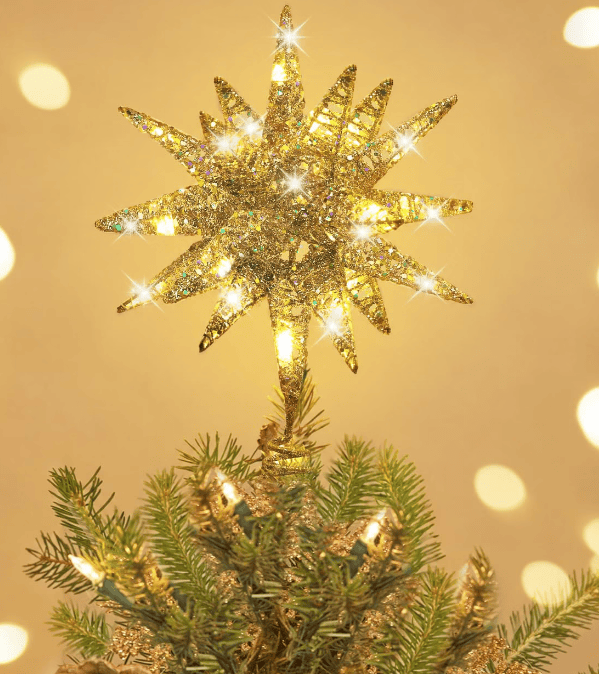
Best for: coordinated, designer-inspired trees with champagne ornaments, glass baubles, metallic picks or velvet ribbon.
Starbursts create drama through shape rather than sheer size. Their thin points extend beyond the central mount, so the topper looks larger than a similarly tall five-point star. On a slim tree, this is usually enough to make the upper third look finished.
Check the overall width and weight, not just the advertised height. Starburst points can be delicate and need careful storage. Keep the rest of the tree restrained; repeating champagne gold in a few ornaments makes the topper feel integrated rather than like an unrelated crown.
A statement topper with a more modern metallic profile. It pairs well with champagne ornaments and small amounts of velvet ribbon.
Before buying: Starbursts can have wide points and may require more support than a simple star.
5. Burgundy or Red Velvet Bow Tree Topper
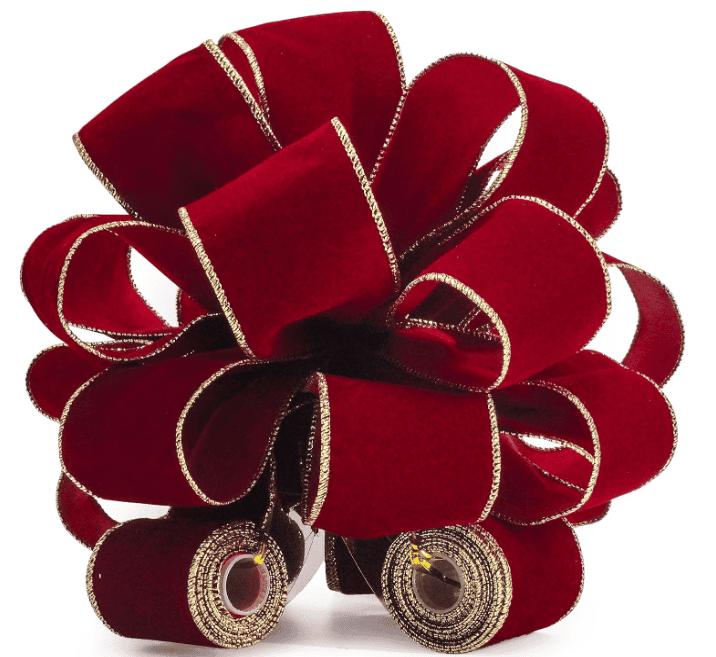
Best for: a soft, elegant 2026 look, especially on trees with a red-and-green or burgundy-and-gold palette.
A velvet bow solves a problem that rigid toppers cannot: it can sit lower on the upper branches and often works better when ceiling clearance is limited. Long tails also lead the eye down the tree, making a narrow or simple tree look more intentionally decorated.
Choose wired edges if you want the loops to keep their shape. For a 6–7.5-foot tree, the bow should look generous but not wider than the top third of the tree; the exact size depends on how full the branches are.
Installation tip: secure the center knot to a strong upper branch or nearby branch junction with soft floral ties. Do not attach it to a light cord. If the bow has extra-long streamers, arrange them in loose vertical curves rather than letting them hang like two flat strips.
A ribbon-based choice for a soft, luxurious look without a rigid star. The long trailing ribbons visually connect the top of the tree to the ornaments below.
Before buying: Buy the right length for your tree; long tails can overwhelm a tabletop tree.
6. Rustic Rattan Star Tree Topper
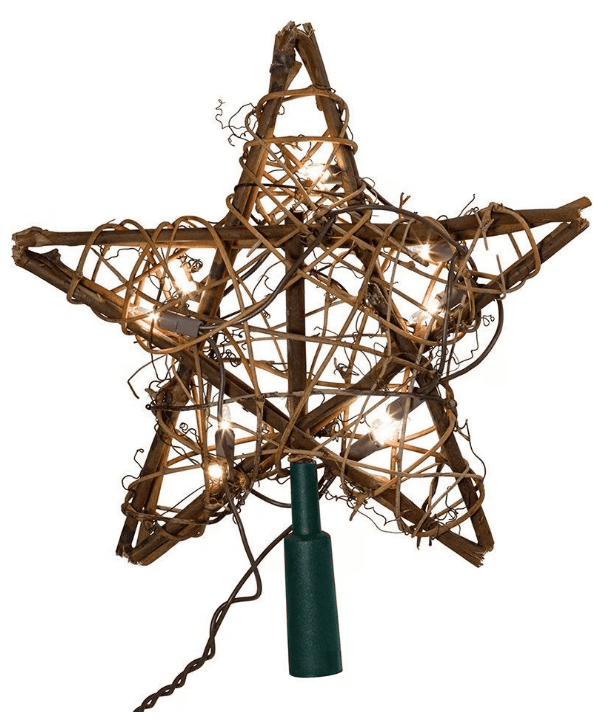
Best for: farmhouse, woodland, Scandinavian and natural Christmas trees.
Woven rattan has enough texture to make a plain tree interesting without glitter. It pairs especially well with wooden ornaments, dried orange slices, pinecones, natural ribbon and warm-white lights.
Because the material is open and often lightweight, a rattan star can visually sit on the tree without dominating it. However, check the bottom mount and cord path on lighted models. Natural-looking does not mean outdoor-safe or moisture-resistant; use the topper only as rated by its manufacturer.
This is my preferred style direction when the Christmas tree sits near a natural-wood table, woven baskets or a simple evergreen wreath.
Natural woven texture suits rustic, woodland and Scandinavian-style trees. The warm lighting adds a gentle glow without glossy metallics.
Before buying: Inspect wiring and use a mounting method suitable for the star and tree.
7. Mini Christmas Tree Topper for Small Trees
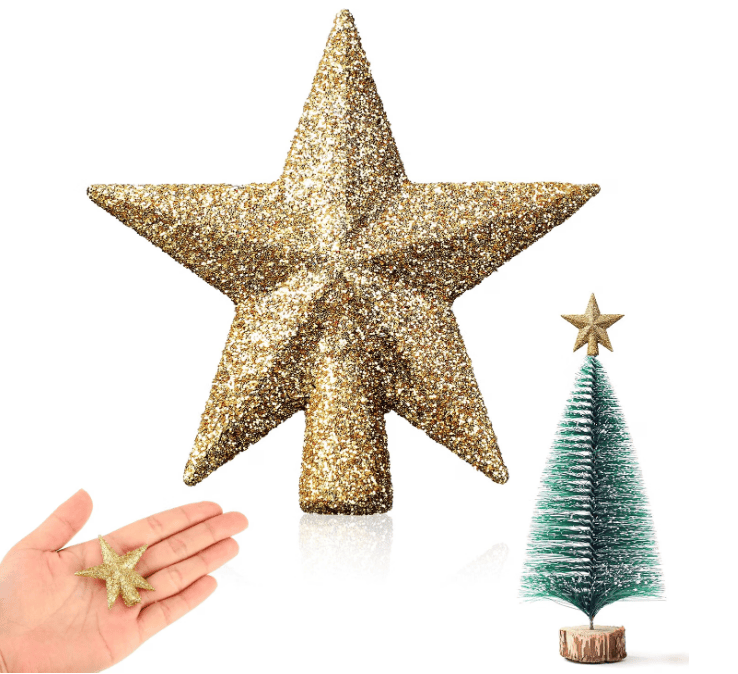
Best for: desk trees, children’s bedroom trees, small apartment trees and miniature holiday displays.
Small trees need a topper that is light and visually small. An 11-inch star on a 3-foot tree can look like a giant decoration balanced on a twig. Instead, consider a 2–5-inch ornament depending on the tree’s shape.
The Hanaive example below is only 1.77 inches — suitable for very small tabletop displays, not a full-size tree. If your tree is closer to 4 feet, you may want a 4–6-inch topper instead. Always measure the star and the diameter of its mounting opening before buying.
If there is almost no vertical room, a small bow tucked slightly below the top branch can look more natural than a star jammed against the ceiling.
A very small decorative star for miniature or tabletop trees. This is intentionally tiny, not a substitute for a standard 6–7.5-foot tree topper.
Before buying: Measure the mini tree tip: a very narrow trunk may need a simple soft tie.
8. Sports Christmas Tree Topper or Fan-Themed Tree
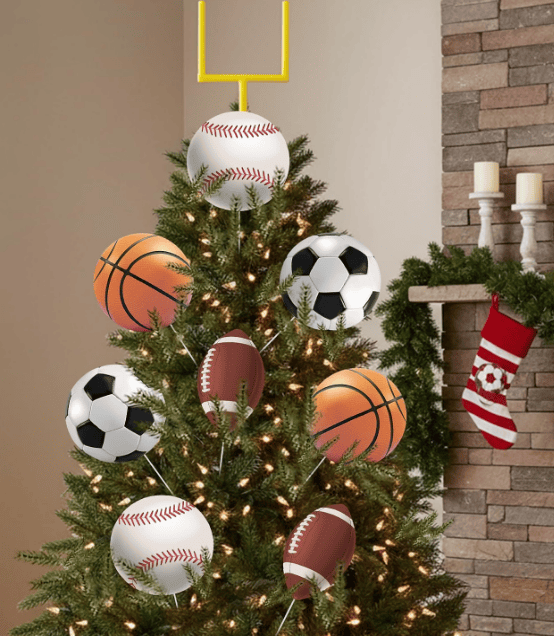
Best for: game rooms, family sports trees, teen bedrooms and dedicated fan displays.
Sports-themed toppers have narrower selection than stars and angels, especially if you want one specific team or sport. A practical alternative is a lightweight bow or star at the top with a few coordinated football, basketball or baseball picks just below it.
For a DIY fan topper, choose one stable lightweight base, gather two or three matching picks around it, and attach them to an upper branch junction with soft ties. Avoid using a heavy ball, helmet or rigid collectible as the actual crown of the tree; those can tip the tree or damage the top branch.
Product distinction: the linked Thyle item is a set of sports-themed picks, not a finished tree topper. It is useful for creating a sports-themed top cluster around a separate bow or star.
Sports-themed picks you can group around a lightweight mini foam or bow topper for a fan-themed tree. This is NOT a finished plug-on tree topper.
Before buying: DIY accessories only: you still need a lightweight base and safe attachment.
How to Choose the Right Size Christmas Tree Topper
Choose the size of a tree topper by actual clearance and tree width, not by tree height alone. A broad, full 6.5-foot tree can carry a more substantial star than a pencil-thin tree of the same height. The figures below are useful starting points, not universal fitting rules.
Important: A 12-inch topper does not necessarily project 12 inches above the highest branch: part of its base may slide over or sit below the tip. Measure the topper’s actual visible extension once mounted.
Balsam Hill’s sizing advice recommends leaving approximately 6 inches between the ceiling and the finished topper. This is a helpful decorating rule of thumb, not a substitute for checking your own room and tree.
Some product listings measure a tree including the stand; others provide separate setup dimensions. Measure the assembled tree in the room rather than guessing from the box.
How to Keep a Christmas Tree Topper Straight and Secure
A tilted star is usually a mounting problem, not a decorating problem. Before buying a different topper, identify which part is moving: the top branch, the mounting cone, or the ornament itself.
- Check the top branch. On an artificial tree, the central stem may be a thin flexible wire. On a real tree, the leader may be weak or too tall. Do not force it to carry more weight than it can support.
- Test the mount. Slide a cone or coil onto the tip, check where it grips, and rotate it gently. If it spins freely, the mount is too large for the stem.
- Reinforce the connection, not the electrical parts. Use soft floral ties or an accessory holder designed for tree toppers around the branch structure, following the product’s instructions. Never fasten through light cords or crush wiring.
- Check from several feet away. Step back, look from the sofa and doorway, and adjust the angle before adding heavy upper-branch ornaments.
- Test stability. Give the tree a very gentle movement at a safe lower point. If the topper shifts, remove it and improve the mounting rather than hoping it will stay in place.
Artificial tree tip: When a thin upper stem bends, a purpose-made topper support or a lightweight topper is preferable to improvising a rigid metal brace that could damage tree wiring.
Fresh tree tip: If the natural leader is very flexible, choose a light bow or star and attach its support around a sturdier nearby junction. Never drive a sharp fastener into electrical wiring or use a method that can split the leader.
Lighted Christmas Tree Toppers: Plug-In vs. Battery vs. USB
For electrical decorations, choose products tested or listed by an appropriate independent safety laboratory, such as UL or ETL, and follow the product instructions. The U.S. Consumer Product Safety Commission emphasizes tested lighting, appropriately rated cords and keeping live trees watered. Never connect a topper to an incompatible power supply or conceal an overheated or damaged cord inside dry greenery.
For an illuminated star, light color matters almost as much as shape: warm-white tree lights usually look most cohesive with a warm-white topper, while multicolor trees can accommodate a more playful colored star.
How to Make a Christmas Bow Tree Topper (Simple DIY Method)
You do not need an expensive oversized topper to get the velvet-bow look. A wire-edged ribbon lets you control the size and direction of the loops, and you can make the bow fit your exact tree.
- Pick a color. Red, burgundy, champagne or dark green velvet all pair naturally with traditional ornaments.
- Make two or three loops on each side. Keep the loops relatively even, or make the lower ones slightly larger for a fuller bow.
- Secure the center. Twist a short piece of floral wire around the folded center, keeping sharp ends tucked safely away from people and wiring.
- Add two tails. Let them fall down the upper third of the tree, then make angled ribbon cuts for a clean finish.
- Attach at a stable branch junction. Use a soft, suitable tie, fluff the loops, and step back to check the proportions.
For more ribbon techniques and coordinating gift wrapping, see our gift-bow ideas. The tree-top bow can use the same ribbon as the wrapped gifts, but there is no need to make every bow identical.
Tree Topper Mistakes That Make a Decorated Tree Look Unfinished
- Buying before measuring the ceiling: check the assembled tree and remember the roughly 6-inch gap to the ceiling.
- Picking a topper that is too heavy: a rigid metal ornament can bend a slim artificial tree tip or pull a natural leader sideways.
- Ignoring the base: a beautiful topper with the wrong coil or cone opening may not stay straight.
- Mixing lighting colors by accident: an icy-blue star can clash with a warm-white tree.
- Using a sports ornament as a structural topper: ordinary ornaments and picks often need a dedicated lightweight support.
- Adding more decorations to hide a leaning topper: fix the mount rather than masking the problem.
- Over-decorating the top third: when the topper is the focal point, cluster smaller ornaments farther down instead of competing with it.
How to Match a Tree Topper With Wreaths, Garlands and Christmas Flowers
A coordinated holiday home does not require identical decorations. Repeat two details — usually ribbon color and one metal or greenery texture — and let the shapes vary.
If you are finishing your front door after decorating the tree, our Christmas wreath hanging tips cover the different mounting methods for common door surfaces. The matching centerpiece can also be built using our step-by-step Christmas flower arrangement tutorial.
Frequently Asked Questions About Christmas Tree Toppers
An 8–12-inch topper is a useful visual starting point for many full 7.5-foot trees, but available ceiling space and the strength of the top branch matter more than that range. Under an 8-foot ceiling, a rigid topper may not fit at all while leaving a comfortable gap.
About 6 inches is a widely used decorating recommendation. Measure the assembled tree, topper extension and actual ceiling before buying.
Check whether the branch bends or the topper base slips. Choose a lighter design or a compatible topper support, then secure the mount to a sturdy branch junction without damaging tree wiring.
Usually yes, if it fits securely. Power compatibility is a separate question: never assume the topper plugs into the tree’s built-in light connector unless both manufacturers confirm compatibility.
A lightweight mini star or bow. Very small tabletop trees often look best with a 2–5-inch topper, while a 4-foot tree may accommodate something larger. Check proportions and branch strength.
A star is versatile and visually simple; an angel suits traditional or heirloom styling. Choose based on size, stability and the look of your ornaments, not a universal rule.
Choose appropriately tested or listed products, inspect the wiring, follow electrical ratings and never use damaged cords or incompatible connectors. Keep real trees well watered and away from heat sources.
Yes. Wire-edged ribbon, securely tied loops and a stable attachment point can make a lightweight topper with tails cascading down the upper branches.
A slim lightweight star, a small angel or a compact bow usually looks more proportional than an extra-wide starburst. Measure the top third of the tree before buying.
Yes, as a lightweight DIY arrangement when attached to a suitable base and stable branch support. Most ornament picks are accessories, not finished structural toppers; do not expect them to stand upright on their own.
Final Recommendation: Start With Fit, Then Choose the Style
For most homes, a lightweight gold star is the safest stylistic starting point: it suits nearly every tree and is easy to pair with ornaments. Choose a warm-white star when you want more glow, a velvet bow for a soft elegant finish, or an angel for a traditional family tree.
If the topper leans or pushes into the ceiling, the solution is not a bigger star. It is a better-sized topper with a stable base. Measure first, check the mounting style, and you will spend less time correcting the top of the tree after every ornament is hung.
Join Garden Frontier for realistic holiday decorating ideas, gardening advice and useful home projects.
100% free. No spam. Unsubscribe anytime.
Affiliate disclosure: As an Amazon Associate I earn from qualifying purchases. Some links above are affiliate links; Garden Frontier may receive a commission at no extra cost to you. Recommendations are based on published product details and design suitability, not independent hands-on testing. Prices, variants and availability can change.
Safety: Only use appropriate electrical decorations and mounting hardware. Check cords, sockets, tree condition, branch support and the manufacturer’s instructions. Keep live trees watered, away from heat sources, and never use unsafe wiring or damaged lights.