















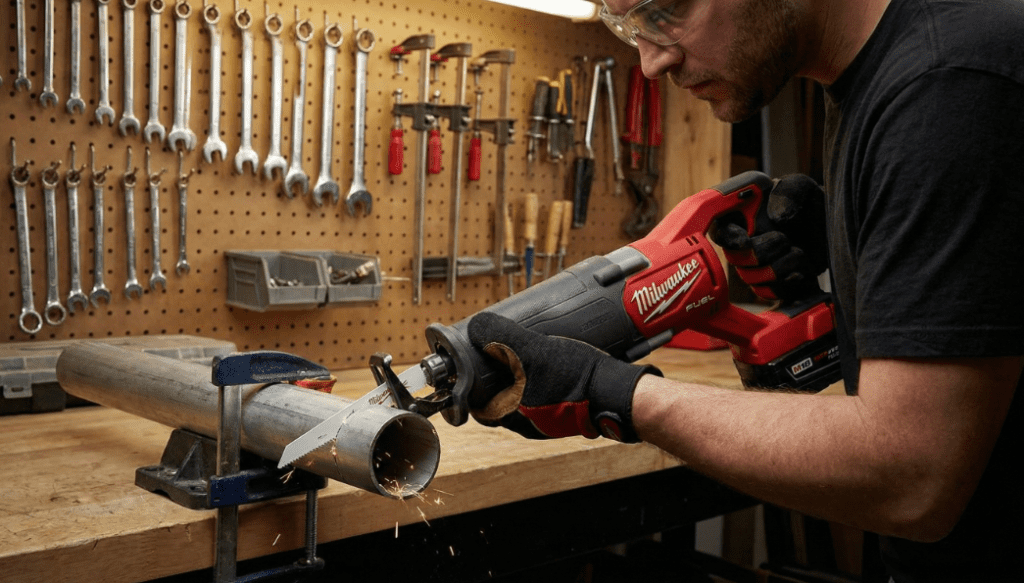
Why your workshop needs precision, not just power—and the 7 saws that actually deliver.
When most people hear “reciprocating saw” or “Sawzall,” they imagine destruction: tearing down drywall, ripping out old plumbing, or demolishing a deck. It is the blunt instrument of the tool world.
But if you run a workshop—whether you are a fabricator, a woodworker reclaiming pallet lumber, or a DIYer maintaining garden equipment—you don’t just need a demolition hammer. You need a scalpel.
The standard reviews you see online focus purely on speed and raw power. But in a workshop environment, vibration control, stroke accuracy, and low-speed modulation are far more important. You need a tool that can cut a rusted bolt off a chassis without damaging the threads, or trim a metal pipe with a square edge.
We tested the market to find the saws that offer the control required for the workshop frontier. Here are the 7 best reciprocating saws that do more than just destroy.
The Workshop Criteria: How We Chose
Before we get to the list, you need to understand the metrics that matter inside a shop (versus on a construction site).
1. Vibration Control (AVT)
If you are using a saw for 20 minutes to reclaim wood or cut steel stock, high vibration isn’t just annoying—it ruins your accuracy. We prioritized saws with active counterbalancing systems.
2. The Adjustable Shoe
This is the most overlooked feature. A pivoting, adjustable shoe allows you to:
-
Control cut depth (so you don’t slice into your workbench).
-
Utilize the entire length of the blade, not just the section near the motor, doubling the life of your consumables.
3. Stroke Length vs. SPM
-
Wood: Needs a long stroke ($32 mm+) to clear chips.
- Metal: Benefits from a shorter stroke but higher torque.We looked for saws that balance these physics or allow you to adjust them.
1. The Precision Specialist (Best Overall)
Milwaukee M18 FUEL SAWZALL w/ One-Key (2722-20)
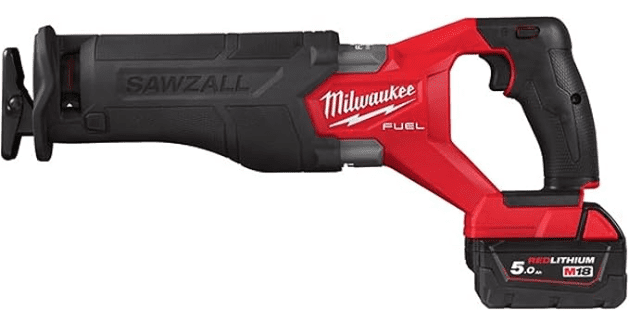
If you are a serious workshop owner, this is the gold standard. While the standard “Fuel” version is great, the One-Key integration makes this specific model a workshop essential.
Why it wins the Workshop:
Through the app, you can program the saw’s behavior. You can set a “soft start” ramp-up duration to ensure the blade engages metal perfectly without jumping. You can limit the max RPMs for cutting stainless steel to prevent burning out your expensive carbide blades. It takes the guesswork out of difficult materials.
-
Best For: Precision metal fabrication and mixed-material use.
-
Key Feature: Bluetooth customization of speed and ramp-up.
-
Workshop Note: The “Cut Brake” feature automatically stops the blade at the end of each cut, preventing you from accidentally nicking material behind your workpiece.
Check Price on Amazon (Note: Often listed around $250-$280 for the tool only)
2. The Metalworker’s Choice (Best Corded)
Makita JR3070CT AVT Reciprocating Saw
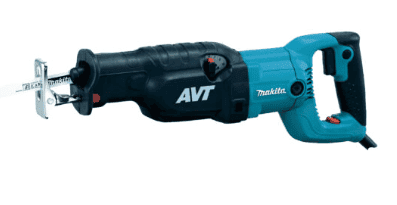
In a stationary workshop, battery convenience sometimes plays second fiddle to endless power. The Makita JR3070CT is a legendary 15-AMP beast that features Anti-Vibration Technology (AVT).
Why it wins the Workshop:
This saw uses an internal counterweight system that moves in the opposite direction of the bolt. The result? You can rest this saw on a steel pipe, pull the trigger, and the saw does the work while your hands feel almost nothing. It is arguably the smoothest cutting experience on the market.
-
Best For: Heavy-duty steel cutting and pipe work.
-
Key Feature: AVT (Anti-Vibration Technology) drastically reduces fatigue.1
-
Workshop Note: It features a 4-position orbital action dial that lets you switch from straight cuts (for metal) to aggressive orbital cuts (for wood) instantly.
Check Price on Amazon (Typically ~$275)
3. The “Surgeon” (Best One-Handed)
DeWalt DCS369 Atomic 20V MAX One-Handed
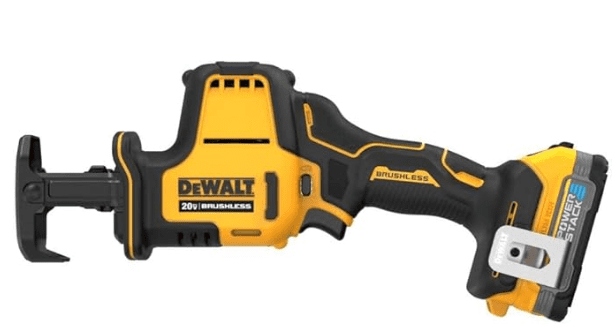
Workshops are often tight spaces. Sometimes you need to hold a workpiece with one hand and cut with the other. A full-size recip saw is dangerous in that scenario; the DeWalt Atomic is not.
Why it wins the Workshop:
It is perfectly balanced for one-handed operation. If you are pruning thick branches in the garden or trimming a dowel inside a cabinet, this tool offers surgical control.
-
Best For: Tight spaces, pruning, and small parts.
-
Key Feature: Lightweight, pivoting shoe.
-
Workshop Note: Don’t let the size fool you; paired with a high-quality Diablo blade, this will cut through 2x4s and PVC pipe effortlessly.
Check Price on Amazon (Great value, often under $130)
4. The Vibration King (Best Value)
Skil PWRCore 20 RS582901
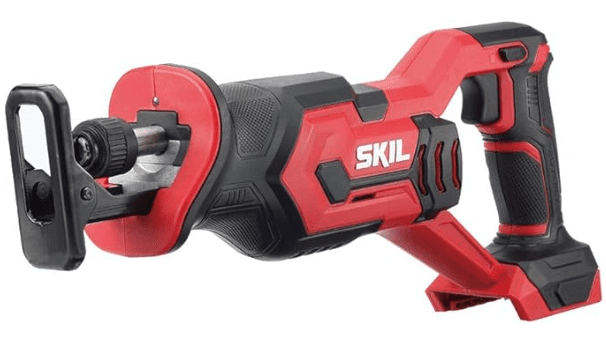
Skil has reinvented itself recently, and this saw is a prime example. It features the “Cushion Vibration Control” system, which rivals saws double the price.
Why it wins the Workshop:
For the DIY workshop on a budget, this is the smartest buy. It includes a linear stroke technology that keeps the cut line cleaner than most budget saws, making it excellent for breaking down pallets for garden projects without shattering the wood.
-
Best For: Pallet reclaiming and general DIY.
-
Key Feature: Best-in-class vibration reduction for the price point.
Check Price on Amazon (Usually under $100)
5. The Convertible (Most Versatile)
Worx WX550L Axis

Space is a premium in many garden sheds and workshops. The Worx Axis is a unique hybrid that solves a storage problem by being two tools in one.
Why it wins the Workshop:
With the push of a button, the head pivots, transforming it from a reciprocating saw into a jigsaw. While it won’t replace a heavy-duty Sawzall for demolition, it is the ultimate “problem solver” for a hobbyist who needs to cut a PVC pipe one minute and cut a curved shape into plywood the next.
-
Best For: Small shops, hobbyists, and intricate cuts.
-
Key Feature: Converts to a jigsaw instantly.
Check Price on Amazon (Approx. $100-$120)
6. The Pneumatic Powerhouse (Best for Auto/Mechanics)
Ingersoll Rand 429 Air Reciprocating Saw

Most blog lists ignore air tools, but many garden frontier workshops have air compressors. The Ingersoll Rand 429 is a distinct animal: it is incredibly small, light, and impossible to overheat.
Why it wins the Workshop:
If you are working on garden tractors, ATVs, or cars, this saw is unrivaled. It can cut intricate shapes in sheet metal and exhaust pipes without the bulk of a battery pack getting in the way.
-
Best For: Automotive repair, sheet metal, and fiberglass.
-
Key Feature: Low profile, high SPM (10,000 strokes per minute), infinite run-time.
Check Price on Amazon (Approx. $150)
7. The Heavy Hitter (Best for Reclaiming Lumber)
Bosch GSA18V-125

If your workshop life involves processing large amounts of timber—perhaps building raised garden beds from reclaimed sleepers—the Bosch is your workhorse.
Why it wins the Workshop:
It has a massive $32mm$ (1.25″) stroke length and a distinct orbital action switch designed specifically for aggressive wood removal. The ergonomic handle is also longer and curved, allowing for better leverage when cutting downward on a sawhorse.
-
Best For: Large timber, landscape construction, demolition.
-
Key Feature: Massive stroke length clears chips faster than competitors.
Check Price on Amazon (Tool only ranges $270-$290)
Technical Comparison: The Specs That Matter
| Model | Primary Role | Vibration Control? | SPM (Speed) | Power Source |
| Milwaukee One-Key | Precision Fabricator | Yes (Internal) | 0-3,000 | 18V Battery |
| Makita JR3070CT2 | Heavy Duty Metal3 | Yes (AVT Best)4 | 0-2,8005 | 15 Amp Corded6 |
| DeWalt Atomic | One-Handed / Tight | Minimal | 0-2,800 | 20V Battery |
| Skil PWRCore | Budget / DIY | Yes (Cushion) | 0-3,000 | 20V Battery |
| Worx Axis | Versatility / Jigsaw | No | 0-3,000 | 20V Battery |
| Ingersoll Rand | Auto / Sheet Metal | No | 10,000 | Pneumatic (Air) |
| Bosch GSA18V | Wood / Timber | Yes | 0-2,500 | 18V Battery |
Technical Deep Dive: Blade Science
A great saw with a cheap blade is a bad saw. To get “workshop quality” cuts, you must match the TPI (Teeth Per Inch) to the material.
The Golden Rule:
At least three teeth must be in contact with the material at all times to prevent snagging.
-
For Wood (Green or Dry): Use 6 to 10 TPI. Lower TPI clears wet sawdust faster.
-
For Metal (Structure/Pipe): Use 14 to 18 TPI.
-
For Sheet Metal: Use 24 TPI to prevent the blade from catching the thin edge and shaking the metal.
Pro-Tip: For the workshop, spend the extra money on Carbide-tipped blades (like Diablo or Milwaukee Torch). They last 50x longer than Bi-Metal blades when cutting hardened screws or nails in pallet wood.
Final Verdict: Which One Should You Buy?
If you want the absolute smartest tool that adapts to every material you bring into the shop, get the Milwaukee M18 FUEL w/ One-Key.
If you have a workbench and deal with heavy steel or pipe, the corded Makita JR3070CT is a lifetime investment that will save your joints from vibration.
And for the general DIYer maintaining a home and garden, the Skil PWRCore offers professional features at a hobbyist price.