














If your lawn suddenly has pinkish-red strands on the grass blades or irregular tan patches that look worse after damp weather, you may be looking at red thread in grass. It is one of those lawn problems that looks alarming at first, but in many home lawns it is more of a warning sign than a disaster.
Red thread is a foliar turf disease, which means it mostly attacks the grass blades rather than the roots. That is why a lawn can look rough, thin, or patchy and still recover once growing conditions improve.
When I see red thread symptoms, I think less about “killing fungus immediately” and more about what the lawn is trying to tell me: slow growth, low fertility, damp conditions, poor airflow, or general stress.
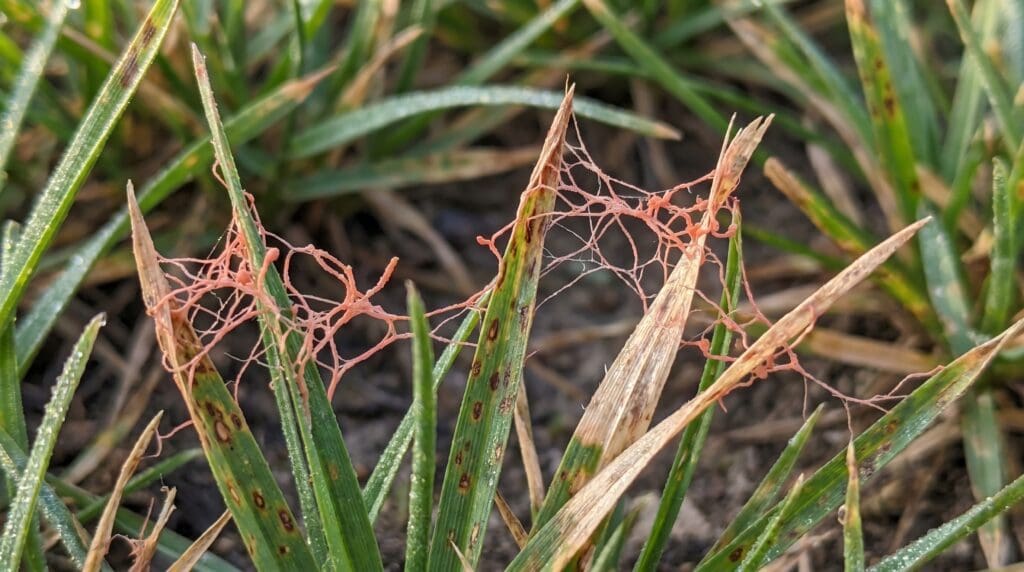
🌱 Quick Answer: What Is Red Thread in Grass?
- Red thread is: A fungal lawn disease caused by Laetisaria fuciformis.
- Main symptoms: Pinkish-red threads on grass blades, tan patches, and reddish lawn discoloration.
- Most affected lawns: Cool-season grasses such as fine fescue, perennial ryegrass, Kentucky bluegrass, and bentgrass.
- Common triggers: Cool, damp weather, slow turf growth, low nitrogen, poor airflow, and lawn stress.
- Good news: Red thread usually affects leaves, not roots, so lawns often recover with better care.
What Is Red Thread in Grass?
Red thread is a turfgrass disease caused by the fungus Laetisaria fuciformis. It creates reddish, pinkish, tan, or straw-colored patches in lawns and may produce thin red or coral-pink threadlike growth on the leaf tips.
Penn State Extension describes red thread as a foliar disease of lawns, parks, low-maintenance athletic fields, golf course roughs, and similar turf areas. It is commonly associated with cool-season grasses, especially where turf is growing slowly or lacks nitrogen.
Red thread is only one reason grass can look red. If you are trying to identify whether you have a lawn disease, red ornamental grass, or red fescue, start with my full red grass guide.
What Does Red Thread Look Like?
The easiest field clue is the name itself. When red thread is active, you may see fine red, pink, or coral-colored strands extending from the tips of infected grass blades. Purdue Extension notes that these red or pink structures can be visible without magnification and are useful for identifying the disease.
Common Red Thread Symptoms
- Irregular tan, brown, pink, or reddish patches in the lawn
- Thin red or coral-pink threads on grass blade tips
- Grass that looks bleached or water-soaked in patches
- Symptoms that appear worse after damp, humid, or rainy weather
- Patchy damage that usually affects leaf blades more than roots
Red Thread vs Other Lawn Problems
Red thread is easy to confuse with drought stress, rust disease, pink patch, fertilizer burn, or general lawn thinning. I always look closely at the grass blades before assuming it is red thread.
| Problem | What You See | Main Clue |
|---|---|---|
| Red Thread | Pinkish-red threads, tan patches, reddish leaf tips | Coral-red strands on grass blades |
| Rust Disease | Orange-red powder on shoes, mowers, or fingers | Powdery spores rub off easily |
| Drought Stress | Gray-green, brown, or straw-colored grass | Footprints remain visible; soil is dry |
| Fertilizer Burn | Brown streaks or patches after fertilizing | Pattern follows the spreader overlap or spill |
What Causes Red Thread in Grass?
Red thread usually appears when grass is growing slowly and weather favors fungal development. NC State Extension notes that red thread can develop across a temperature range of about 40°F to 80°F, but develops most rapidly around 70°F, and it affects grass that is growing slowly because of inadequate fertilization, drought stress, cool weather, low light, traffic, or other stresses.
Common Triggers
- Low nitrogen: Underfed turf is more vulnerable because it grows slowly.
- Cool, damp weather: Long leaf wetness encourages disease development.
- Humid conditions: Moist turf can stay wet for too long.
- Poor airflow: Fences, shade, dense shrubs, and still air can keep grass damp.
- Compacted soil: Weak roots and poor drainage make turf less resilient.
- Too much shade: Shaded grass often grows slowly and dries slowly.
- Low mowing or dull blades: Stressed grass recovers more slowly.
Which Grass Types Get Red Thread?
Red thread is most common on cool-season turfgrasses. University of Illinois Extension lists fine-leaved fescues, perennial ryegrass, Kentucky bluegrass, annual bluegrass, and bentgrass among affected grasses during warm, damp weather in spring and autumn.
The grasses I would watch most closely are:
- Fine fescue
- Creeping red fescue
- Perennial ryegrass
- Kentucky bluegrass
- Bentgrass
- Mixed cool-season lawns
If your lawn contains creeping red fescue, do not confuse the name with the disease. Red fescue grass is a turf type. Red thread is a disease.
Does Red Thread Kill Grass?
Usually, red thread does not kill the entire grass plant because it mostly infects leaves rather than roots or crowns. Iowa State Extension explains that red thread infection occurs on leaves and stems rather than roots, and the pathogen rarely kills plants, though it can weaken turf and contribute to decline under stress.
That is why I treat red thread as a signal of lawn health. The lawn looks bad, but the solution is usually to improve conditions so the grass can grow out of the damaged leaf tissue.
How to Get Rid of Red Thread in Grass
The fastest mistake is reaching for fungicide first. Red thread often improves when the lawn grows more actively, dries faster, and gets balanced nutrition.
Step 1: Confirm the Symptoms
Before treating, look closely at the grass blades. If you see red or pink threadlike growth at the tips, it’s likely red thread. If you see orange powder, it may be rust. If the soil is bone dry, drought may be the main issue.
Step 2: Feed the Lawn Properly
Low nitrogen is one of the most common red thread triggers. A properly timed fertilizer application can help the lawn grow through the disease and replace damaged blades.
Do not dump excessive nitrogen on the lawn. Use a high-quality lawn fertilizer at the label rate for your grass type.
Step 3: Water Early in the Day
Watering at the wrong time can keep grass blades wet for too long. I prefer watering early in the morning so the lawn has time to dry during the day.
Avoid frequent light watering. Deep, less frequent watering is usually better for building stronger turf.
Step 4: Mow at the Right Height
Scalping weakens turf and makes recovery slower. Keep mower blades sharp and mow at the recommended height for your grass type.
When red thread is active, avoid mowing wet grass if you can. Wet mowing spreads clippings and disease material more easily.
Step 5: Improve Airflow and Sunlight
Red thread thrives when grass stays damp. Trim back dense shrubs, remove unnecessary shade, and improve airflow where practical.
This matters especially along fences, under trees, beside hedges, and in tight side yards.
Step 6: Reduce Compaction and Thatch
If the lawn is compacted or slow-draining, core aeration can help. Heavy thatch can also keep the turf canopy damp and stressed.
Do not dethatch aggressively during heat or drought. Time the work when your grass can recover.
Step 7: Use Fungicide Only When Necessary
For many home lawns, fungicide is not the first step. Purdue Extension notes that symptoms create an undesirable appearance, but crowns and roots are not infected, so plants are not killed and turf eventually recovers.
Fungicide may make sense for severe, recurring, or high-value turf, but I would use it only after confirming the diagnosis and checking local extension guidance or a lawn professional’s recommendation.
Red Thread Treatment Plan: Simple Homeowner Checklist
- Confirm red or pink threads on grass blades.
- Apply the right lawn fertilizer at label rates.
- Water early in the morning, not at night.
- Mow at the proper height with sharp blades.
- Improve airflow in shaded or damp areas.
- Aerate compacted soil when conditions are right.
- Use fungicide only for severe or recurring cases.
How to Prevent Red Thread From Coming Back
Prevention is mostly about keeping the grass healthy and avoiding long periods of leaf wetness.
- Feed consistently: Follow a balanced lawn fertilization plan for your grass type.
- Avoid underfeeding: Low fertility is a major red thread trigger.
- Water early: Let blades dry during the day.
- Improve drainage: Fix compacted, soggy, or low areas.
- Prune for airflow: Open up dense shade where practical.
- Mow correctly: Avoid scalping and keep blades sharp.
- Overseed if needed: Use better-adapted grass varieties for your region.
Should You Reseed After Red Thread?
If the lawn is only mildly damaged, you may not need to reseed. Once the disease slows and grass begins growing again, the lawn may fill back in.
If you have thin areas, bare patches, or repeated red thread every year, overseeding can help. Choose a seed mix suited to your climate, sunlight, soil, and traffic level.
Common Mistakes When Treating Red Thread
1. Treating It Like a Dead Lawn
Red thread can make a lawn look terrible, but the crowns and roots are usually still alive. Do not tear out the lawn before improving care and giving it time to recover.
2. Ignoring Fertility
If low nitrogen is part of the problem, fungicide alone will not fix the underlying weakness. Feed the lawn correctly.
3. Watering at Night
Night watering keeps blades wet for hours. That can encourage fungal disease pressure.
4. Mowing Too Short
Short mowing stresses grass and slows recovery. A stronger lawn resists disease better.
5. Assuming Every Red Lawn Patch Is Red Thread
Rust disease, drought, dog urine, fertilizer burn, insects, and poor soil can all create discolored turf. Look closely before treating.
When to Call a Lawn Professional
Call a lawn professional or local extension office if:
- The problem returns every year
- Large parts of the lawn are thinning
- You are unsure whether it is red thread, rust, insects, or drought
- You want a soil test and fertility plan
- You are considering fungicide but do not know what to use
- The lawn has drainage, compaction, or shade problems
Final Verdict: What Is the Best Way to Fix Red Thread?
The best way to fix red thread in grass is to improve the lawn’s growing conditions. Confirm the disease, feed the turf properly, water in the morning, avoid scalping, improve airflow, and reduce compaction.
Fungicide can help in severe or recurring cases, but for many home lawns, the long-term fix is healthier turf. Red thread is usually a sign that the lawn is growing too slowly or staying too damp for too long.
📚 More Lawn & Grass Guides
Trying to identify a grass problem or choose better lawn plants? These guides can help:
Frequently Asked Questions
What is red thread in grass?
Red thread is a fungal lawn disease caused by Laetisaria fuciformis. It creates red or pink threadlike growth on grass blades and can cause tan, pink, or reddish lawn patches.
How do I get rid of red thread in grass?
Improve lawn fertility, water early in the day, mow at the proper height, improve airflow, reduce compaction, and use fungicide only for severe or recurring cases.
Does red thread kill grass?
Red thread usually affects grass leaves rather than roots and crowns, so it rarely kills the entire plant. Lawns often recover when conditions improve.
What causes red thread in lawns?
Red thread is favored by cool, damp weather, slow turf growth, low nitrogen, poor airflow, shade, compaction, and other lawn stresses.
What grass types get red thread?
Red thread commonly affects cool-season grasses such as fine fescue, creeping red fescue, perennial ryegrass, Kentucky bluegrass, annual bluegrass, and bentgrass.
Should I use fungicide for red thread?
Fungicide is not always necessary for home lawns. It may be useful for severe or recurring cases, but cultural fixes such as proper feeding, watering, mowing, and airflow are usually the first steps.
Is red thread the same as red fescue?
No. Red thread is a fungal disease. Red fescue is a type of cool-season turfgrass that is usually green and often used in shade or low-maintenance lawn seed mixes.