













Solar flood lights are one of the easiest ways to light up a dark driveway, garage, backyard, shed, side yard, or fence line without running electrical wiring. I like them because they solve a very practical problem: you need strong outdoor light, but the spot that needs light is often far from an existing outlet or hardwired fixture.
That said, not every solar flood light is worth buying. Some look powerful online but barely light up a walkway. Others have weak batteries, poor motion sensors, cheap plastic housings, or solar panels that cannot charge well in real-world weather.
If I were buying the best solar flood lights for a home, I would focus on six things first: brightness, motion detection, solar panel placement, battery capacity, weather resistance, and whether the light is meant for security, visibility, or general outdoor use.

☀️ Quick Picks: Best Solar Flood Light Types
- Best Overall: Motion sensor solar flood light with separate solar panel
- Best for Driveways: High-lumen solar security flood light
- Best for Garages: Three-head adjustable solar flood light
- Best for Backyards: Wide-angle solar flood light
- Best for Sheds: Compact solar powered flood light
- Best for All-Night Lighting: Dusk-to-dawn solar flood light with large battery
What Is a Solar Flood Light?
A solar flood light is a bright outdoor light powered by a solar panel and rechargeable battery. During the day, the solar panel charges the battery. At night, the light turns on automatically, activates with motion, or runs according to the lighting mode you select.
Unlike small garden lights or decorative solar lanterns, flood lights are designed to cast a wider, stronger beam across larger areas. They are commonly used for garages, driveways, backyards, sheds, alleys, patios, side yards, gates, and security zones.
If you need softer decorative lighting for a porch or patio wall, see my guide to solar outdoor wall lanterns. If you need stronger security lighting, solar flood lights are the better fit.
Solar Flood Light Comparison Table
| Type | Best For | Main Benefit | Watch Out For |
|---|---|---|---|
| Motion Sensor Solar Flood Light | Driveways, garages, side yards | Bright light only when needed | Sensor angle and range matter |
| Three-Head Solar Flood Light | Garage doors and wide areas | Adjustable coverage | Needs strong battery for high output |
| Dusk-to-Dawn Solar Flood Light | All-night visibility | Automatic overnight lighting | Needs strong sun and large battery |
| Remote Panel Solar Flood Light | Shaded walls and sheds | Panel can be placed in better sun | Cable length limits placement |
| Compact Solar Flood Light | Sheds, gates, small yards | Affordable and easy to install | Limited brightness and range |
Best Types of Solar Flood Lights
1. Motion Sensor Solar Flood Lights
For most homes, I would start with a motion sensor solar flood light. It stays off or dim most of the night, then turns bright when it detects movement. That saves battery power and gives you light exactly when someone enters the driveway, walks near the garage, opens a gate, or moves through a side yard.
This type is especially useful for security because sudden bright light can make dark areas feel less hidden.
Best for: Driveways, garages, back doors, side yards, trash areas, gates, and security zones.
- Pros: Saves battery, bright when needed, good for security.
- Cons: Sensor placement must be right, false triggers can drain the
 battery.
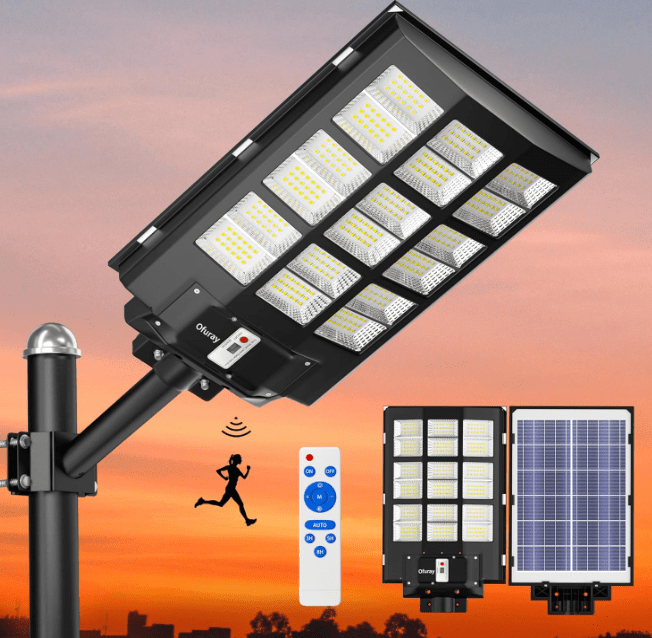
Recommended product type: 3-head outdoor solar motion sensor flood light.
2. Three-Head Solar Flood Lights
A three-head solar flood light is useful when you need wider coverage. The adjustable heads let you aim the light toward a driveway, garage door, walkway, and side wall from one mounting point.
I like this style above garage doors because one head can point down toward the driveway while the others angle left and right. That gives better coverage than a single fixed beam.
Best for: Garages, driveways, wide side yards, patios, and building corners.
- Pros: Adjustable coverage, wide beam spread, practical for large areas.
- Cons: Higher brightness requires better battery and panel performance.

Recommended product type: adjustable 3-head solar garage flood light.
3. Dusk-to-Dawn Solar Flood Lights
A dusk-to-dawn solar flood light turns on automatically at night and stays on until the battery runs out. This is useful when you want steady light rather than motion-only lighting.
The downside is runtime. A flood light that stays on all night needs a larger solar panel, a stronger battery, and realistic brightness settings. If the light is too bright all night, the battery may run down before morning.
Best for: Barns, sheds, gates, walkways, yards, and areas where steady nighttime visibility matters.
- Pros: Automatic all-night lighting, no wiring, useful for visibility.
- Cons: Performance depends heavily on sun exposure and battery size.

4. Solar Flood Lights With Separate Solar Panel
This is one of the most important options if the wall where you need light does not get enough sun. A separate solar panel lets you mount the light under an eave, on a shed wall, or near a garage while placing the solar panel higher or farther away in direct sunlight.
If your garage wall faces shade most of the day, I would strongly consider this type before buying an all-in-one unit.
Best for: Shaded walls, sheds, covered porches, garages with roof overhangs, and north-facing walls.
- Pros: Better charging flexibility, useful in tricky locations.
- Cons: Cable must be routed neatly, panel placement still matters.
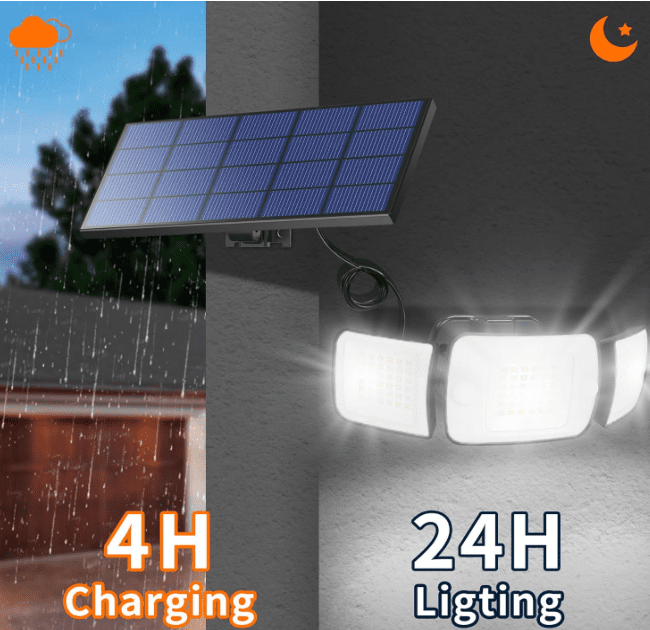
Recommended product type: outdoor solar flood light with remote panel and long cable.
5. Compact Solar Flood Lights
A compact solar flood light is enough for smaller jobs such as lighting a shed door, gate latch, small patio corner, trash bin area, or narrow side path.
I would not expect a small unit to light an entire backyard, but for a focused area, it can be a cheap and easy fix.
Best for: Sheds, gates, small patios, narrow walkways, utility corners, and budget upgrades.
- Pros: Affordable, simple installation, good for small areas.
- Cons: Limited beam spread, lower brightness, smaller battery.
How Many Lumens Do Solar Flood Lights Need?
Lumens measure brightness. This is where many buyers get confused because online listings often make lights sound brighter than they feel in real use.
Here is the simple way I think about it:
- 100 to 300 lumens: Small paths, sheds, gates, and accent lighting.
- 300 to 700 lumens: Side yards, patios, entry areas, and small driveways.
- 700 to 1500 lumens: Garages, wider driveways, backyards, and stronger motion lighting.
- 1500+ lumens: Larger security zones, barns, long driveways, and open yards.
For a typical home garage or driveway, I would usually choose a motion sensor solar flood light in the middle-to-higher range rather than a tiny decorative unit.
Motion Sensor vs Dusk-to-Dawn: Which Is Better?
Choose Motion Sensor If You Want Security
Motion-sensor solar flood lights are better for security because they remain dim or off until movement is detected. This saves battery and creates a sudden burst of light when someone enters the area.
Choose Dusk-to-Dawn If You Want Constant Visibility
Dusk-to-dawn lights are better if you want steady light all night. They work well for gates, barns, pathways, and areas where you do not want complete darkness.
My Recommendation
For most homes, I prefer solar flood lights with multiple modes: low light all night plus bright light on motion. That gives you background visibility and stronger security lighting when needed.
What to Look for Before Buying Solar Flood Lights
1. Solar Panel Size and Placement
The solar panel is the engine of the system. A powerful light with a weak or shaded panel will not perform well. Before buying, check which way the panel will face and how many hours of direct sunlight it will get.
2. Battery Capacity
Battery capacity determines how long the light can run after dark. This matters most for dusk-to-dawn lighting and high-lumen flood lights.
3. Brightness Settings
Look for multiple modes if possible. A light that dims all night and brightens on motion is usually more useful than one with only one setting.
4. Motion Detection Range
For driveways and garages, sensor range matters. A sensor that only detects movement a few feet away may not activate early enough.
5. Adjustable Heads
Adjustable light heads let you aim the beam where you need it. This is especially helpful on garages, building corners, and backyard walls.
6. Weather Resistance
Outdoor solar flood lights should be built for rain, humidity, heat, cold, and UV exposure. Look for outdoor-rated construction and sealed housings.
7. Mounting Surface
Think about whether you are mounting to wood, siding, brick, stucco, metal, or masonry. You may need different anchors depending on the wall surface.
Best Solar Flood Lights by Location
Best for Driveways
Use a high-lumen motion sensor solar flood light with a wide beam and adjustable heads. The goal is to light the driveway when a car or person approaches without draining the battery all night.
Best for Garages
Use a three-head solar flood light above or beside the garage door. Aim one head toward the driveway and the others toward the sides.
Best for Backyards
Use a wide-angle solar flood light with motion detection. If the yard is large, one light may not be enough. Two medium-output lights often work better than one poorly aimed bright light.
Best for Sheds
Use a compact solar flood light or a model with a separate solar panel. Sheds often sit in partial shade, so panel placement is important.
Best for Side Yards
Use a motion sensor solar flood light with a narrow-to-medium beam. Side yards need enough light for walking, trash bins, gates, or utility access.
Do Solar Flood Lights Need Direct Sunlight?
Yes, direct sunlight is strongly recommended. Solar flood lights can charge in partial sun, but brightness and runtime usually suffer.
If the location is shaded, choose a light with a separate solar panel so the panel can be mounted where it actually receives sun.
Do Solar Flood Lights Work in Winter?
Solar flood lights can work in winter, but they usually perform better in summer. Winter brings shorter days, weaker sun, cloudy weather, snow, and colder battery conditions.
For winter use, I would choose a motion sensor model rather than a light that stays bright all night. Motion mode conserves battery and gives better real-world performance during short winter days.
How to Install Solar Flood Lights
Step 1: Test the Location
Before drilling, hold the light and panel where you plan to install them. Check sun exposure and make sure the beam will actually hit the target area.
Step 2: Charge the Light First
Let the solar panel charge for a full sunny day before judging performance. Many lights perform poorly right out of the box because the battery is not fully charged.
Step 3: Mount the Light at the Right Height
Mounting too low can create glare. Mounting too high can reduce motion detection and make the light less useful. For many homes, garage or wall mounting above head height works well.
Step 4: Aim the Sensor and Light Heads
Point the sensor toward the area where people or vehicles will enter. Aim the light heads toward the ground or target area, not directly into a neighbor’s window.
Step 5: Use the Correct Anchors
Use screws for wood, masonry anchors for brick or concrete, and appropriate mounting methods for siding or metal surfaces.
Step 6: Test at Night
After installation, test the light in real darkness. Adjust brightness mode, sensor angle, and light direction if needed.
Common Mistakes to Avoid
1. Buying Based Only on “LED Count”
More LEDs do not always mean better lighting. Lumens, battery quality, beam angle, and panel performance matter more.
2. Mounting the Panel in Shade
This is the biggest mistake. A shaded panel cannot charge the battery properly, even if the light itself is high quality.
3. Expecting One Light to Cover Everything
A single flood light may not cover a large backyard well. Sometimes two smaller lights aimed properly work better than one oversized light.
4. Using Dusk-to-Dawn Mode in Low Sun Areas
If the panel only gets a few hours of sun, dusk-to-dawn mode may drain the battery early. Motion mode is usually better in lower-sun locations.
5. Ignoring Neighbors
Flood lights can be annoying if aimed poorly. Point the beam downward and avoid shining directly into windows or neighboring properties.
6. Not Cleaning the Solar Panel
Dust, pollen, leaves, bird droppings, and snow can reduce charging. Wipe the panel occasionally for better performance.
Solar Flood Lights vs Solar Wall Lanterns
Solar flood lights and solar wall lanterns solve different problems.
| Lighting Type | Best For | Main Purpose |
|---|---|---|
| Solar Flood Lights | Driveways, garages, backyards, sheds, side yards | Brightness, visibility, and security |
| Solar Wall Lanterns | Porches, patios, entryways, exterior walls | Curb appeal, ambiance, and light visibility |
If you want a decorative fixture near a front door or patio, choose a solar wall lantern. If you need stronger light for security or coverage, choose a solar flood light.
Are Solar Flood Lights Worth It?
Yes, solar flood lights are worth it when you need outdoor lighting in a place where hardwiring is inconvenient, expensive, or unnecessary. They are especially useful for garages, driveways, sheds, gates, side yards, and backyards.
They are not perfect for every situation. If you need guaranteed bright light all night in a shaded location, a hardwired fixture may be better. But for many homes, a well-placed solar flood light is a practical and affordable upgrade.
Final Verdict: What Are the Best Solar Flood Lights?
The best solar flood lights are not always the brightest lights on paper. The best option is the one that matches your location, sun exposure, and lighting goal.
For most homeowners, I would choose a motion sensor solar flood light with adjustable heads and a separate solar panel. That combination gives you better charging flexibility, better coverage, and longer real-world battery performance.
For garages and driveways, choose higher lumens and motion detection. For sheds and side yards, choose a compact or remote-panel model. For all-night lighting, choose dusk-to-dawn only if the panel gets strong direct sun.
📚 More Outdoor Lighting & Home Improvement Guides
Planning more practical upgrades around the house? Start here:
Frequently Asked Questions
What are the best solar flood lights for home security?
The best solar flood lights for home security are motion sensor models with high lumens, adjustable heads, good battery capacity, and a solar panel that receives strong direct sunlight.
How many lumens should a solar flood light have?
For small areas, 100 to 300 lumens may be enough. For garages, driveways, and backyards, 700 to 1500 lumens is more practical. Larger security areas may need 1500 lumens or more.
Do solar flood lights work without direct sunlight?
They can charge in partial sun, but performance will be weaker. For shaded walls, choose a solar flood light with a separate solar panel that can be placed in direct sunlight.
Are solar flood lights good for driveways?
Yes. Solar flood lights are good for driveways when they have enough brightness, motion detection, and proper panel placement. A three-head adjustable model usually works well over garage doors.
Do solar flood lights work in winter?
Yes, but they usually run for less time in winter because days are shorter and sunlight is weaker. Motion sensor mode is usually better than all-night mode during winter.
How long do solar flood lights stay on?
Runtime depends on battery size, sunlight, brightness setting, and motion activity. Motion sensor lights can last much longer than lights running continuously at full brightness.
Where should I install solar flood lights?
Install them where the light can cover the target area and the solar panel can receive strong sun. Good locations include garage doors, driveways, sheds, gates, side yards, backyards, and dark entry points.