















PEX crimp vs clamp is one of the first choices homeowners run into when buying tools for a PEX plumbing repair. Both systems can make strong water-line connections, but they do not use the same rings, the same tool, or the same checking method.
If you are still choosing your main tool kit, start with our full PEX crimp tool guide. That article covers the best kits, sizes, Go/No-Go gauges, and basic crimping steps. This page focuses specifically on the difference between copper crimp rings and stainless steel clamp rings, also called cinch clamps.
The short version: PEX crimp is the classic copper-ring method. PEX clamp uses stainless pinch clamps and often works across multiple pipe sizes with one cinch tool. Neither system is automatically better for every job. The better choice depends on your pipe, fittings, tool access, local code, and how many connections you need to make.
- Best for most standard DIY repairs: PEX crimp with copper crimp rings, especially if you buy a 1/2-inch and 3/4-inch kit with a Go/No-Go gauge.
- Best for mixed pipe sizes: PEX clamp or cinch, because one clamp tool often works with several clamp sizes.
- Best for tight spaces: Clamp tools can be easier in some awkward spots, but compact or angle-head crimp tools can also help.
- Best verification method: Crimp connections should be checked with a Go/No-Go gauge. Clamp systems use the clamp tool’s ratcheting action and manufacturer-specific checking guidance.
- Biggest rule: Do not mix systems. Copper crimp rings need a PEX crimp tool. Stainless cinch clamps need a PEX clamp or cinch tool.
PEX Crimp vs Clamp: The Basic Difference
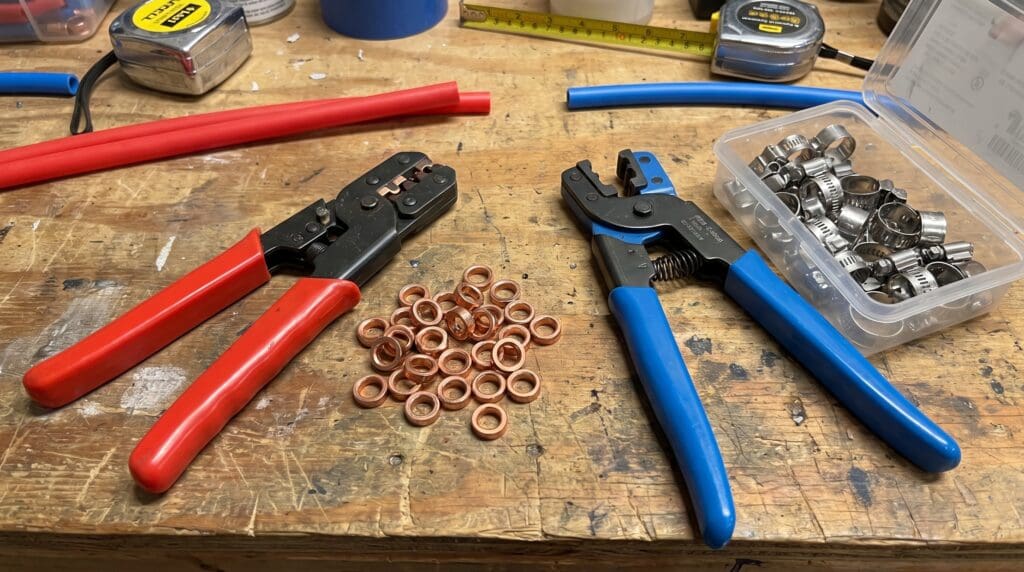
A PEX crimp connection uses a copper crimp ring. The ring slides over the PEX pipe, the insert fitting goes into the pipe, and a crimp tool compresses the copper ring around the pipe and fitting barb.
A PEX clamp connection uses a stainless steel pinch clamp, also called a cinch clamp. The clamp slides over the PEX pipe and is tightened with a cinch or clamp tool at the clamp’s raised ear.
Both methods usually work with compatible ASTM-style insert fittings, but the ring system and tool are different. That is the part beginners often miss.
| Feature | PEX Crimp | PEX Clamp / Cinch |
|---|---|---|
| Ring type | Copper crimp ring | Stainless steel pinch clamp |
| Tool type | Size-specific crimp jaws or multi-head crimp tool | Cinch or clamp tool |
| Common sizes | 1/2-inch and 3/4-inch are most common for DIY | Many clamp tools work across several clamp sizes |
| Checking method | Go/No-Go gauge | Tool ratchet completion and manufacturer guidance |
| Tight spaces | Can be awkward with long straight tools | Often easier because the tool pinches one clamp ear |
| Best for | Standard repairs, clear gauge verification, common PEX-B work | Mixed sizes, awkward access, homeowners who prefer one clamp tool |
PEX Crimp Pros and Cons
PEX crimp is the system many homeowners see first because copper crimp rings and crimp tools are widely available. It is also easy to understand: ring, fitting, tool, gauge.
PEX Crimp Pros
- Easy to verify: A Go/No-Go gauge gives a simple pass/fail check.
- Widely available: Copper crimp rings, fittings, and tools are easy to find.
- Good for standard repairs: Especially common in 1/2-inch and 3/4-inch residential PEX work.
- Simple concept: Beginners can understand the system quickly when they follow the instructions.
- Strong connection when done correctly: A properly positioned and verified crimp is a proven PEX connection method.
PEX Crimp Cons
- Size-specific: The crimp jaw or tool size must match the ring and pipe size.
- Tool clearance: Long-handled crimp tools can be awkward in tight cabinet, stud bay, and joist spaces.
- Gauge required: Skipping the Go/No-Go check turns the repair into guesswork.
- Ring position matters: A ring too close to the pipe end or too far from the fitting shoulder can fail.
PEX Clamp Pros and Cons
PEX clamp, also called cinch, uses stainless steel clamps instead of copper rings. The tool pinches the clamp ear to tighten the connection around the PEX and insert fitting.
PEX Clamp Pros
- One tool can cover multiple sizes: Many cinch tools work with several clamp sizes.
- Useful in tight spaces: The tool often only needs access to the clamp ear.
- Stainless steel clamp material: Stainless clamps are attractive for certain damp or corrosion-prone areas when compatible with the system.
- Good for mixed-size repairs: Helpful when you are not sure whether you will run into 3/8-inch, 1/2-inch, 3/4-inch, or 1-inch PEX.
PEX Clamp Cons
- Different checking method: You do not use the same Go/No-Go gauge approach as copper crimp rings.
- Clamp ear placement matters: You need enough tool access to pinch the ear correctly.
- Not the same as crimp: Beginners sometimes buy copper rings and a clamp tool by mistake.
- Tool quality still matters: A cheap cinch tool that does not complete the clamp properly is not a bargain.
Which Connection Is Stronger?
When installed correctly with compatible pipe, fittings, rings, and tools, both PEX crimp and PEX clamp systems can make reliable residential water-line connections. In real DIY work, the bigger issue is usually not theoretical strength. It is installation quality.
A well-made clamp connection is better than a poorly made crimp connection. A properly gauged crimp connection is better than a poorly cinched clamp connection. The system is only as good as the cut, fitting insertion, ring placement, tool calibration, and final inspection.
For homeowners, crimp has one big advantage: the Go/No-Go gauge makes verification simple. Clamp has one big advantage: one cinch tool may handle several sizes and may be easier to use in awkward locations.
Which One Is Easier for DIY?
For a first-time DIYer working in an open area, PEX crimp is often easier to learn because the steps are straightforward and the gauge gives clear feedback.
For a homeowner working in a tight cabinet, between joists, or near existing pipes, PEX clamp may feel easier because the tool can be positioned around the clamp ear rather than around the entire copper ring.
If you are repairing one visible line and can comfortably fit the tool around the pipe, crimp is a safe starting point. If you are repairing several sizes or working in awkward spaces, clamp deserves a serious look.
Choose crimp if you want a familiar copper-ring system with a gauge check. Choose clamp if you want one tool for several sizes or need better access in tight spaces. Either way, do not mix rings, tools, or fitting systems.
PEX Crimp Rings vs Cinch Clamps
The ring is where many buying mistakes happen. The pipe may be the same size. The fitting may look similar. But the ring system is different.
Copper Crimp Rings
Copper crimp rings are round rings that slide over the pipe. A crimp tool compresses the entire ring around the PEX and fitting. After crimping, the connection should be checked with the correct Go/No-Go gauge.
Stainless Steel Cinch Clamps
Stainless cinch clamps have a raised ear. A clamp tool pinches that ear to tighten the clamp around the pipe and fitting. The clamp tool should complete its ratcheting action according to the manufacturer’s instructions.
The wrong ring can ruin the job before you even start. Do not buy copper crimp rings for a cinch tool. Do not buy stainless clamps for a copper-ring crimp tool.
PEX Crimp vs Clamp for Tight Spaces
Tight spaces are where clamp tools often get praised. Under a sink, behind a vanity, between joists, or near a bundle of existing pipes, a long crimp tool can be frustrating. You need enough room to place the jaws squarely around the copper ring and close the handles fully.
A cinch clamp tool often needs access to the clamp ear, which can be easier in certain positions. That does not mean clamp is always better. It means the work area should influence the tool choice.
If you already prefer copper crimp rings, consider an angle-head crimp tool for tight spots. If you want maximum flexibility, compare both a compact crimp tool and a cinch clamp tool before buying.
PEX Crimp vs Clamp Cost
For one small repair, cost differences are usually minor. Both systems are affordable compared with hiring a plumber for a simple accessible connection. The difference shows up when you need multiple sizes or many fittings.
A basic crimp setup may require separate jaws or tools for different pipe sizes unless you buy a combo kit. A clamp setup often uses one cinch tool across multiple clamp sizes, which can save money if your home has mixed-size PEX.
That said, do not choose only by the lowest tool price. A cheap tool that makes questionable connections is more expensive than a better kit that crimps or clamps correctly.
PEX Crimp vs Clamp for Long-Term Repairs
Both systems can be used for long-term plumbing repairs when installed according to the pipe, fitting, ring, and tool manufacturer’s instructions. The long-term reliability depends on more than the ring type.
Pay attention to:
- Clean, square pipe cuts.
- Correct pipe, fitting, and ring compatibility.
- Proper ring or clamp position.
- Fully seated insert fittings.
- Correct tool size and calibration.
- Pressure testing before closing walls or cabinets.
- Local code and manufacturer approval.
If a connection will be hidden behind drywall, under a floor, or inside a ceiling, be stricter. A visible leak under a sink is annoying. A hidden leak inside a wall can become mold, rot, and expensive damage.
Can You Use Crimp and Clamp Together?
You should not use both systems on the same fitting connection. A single connection should use one approved method: either a copper crimp ring with a crimp tool or a stainless cinch clamp with a clamp tool.
However, a home can have both types of connections in different places if they are installed correctly and approved for the pipe and fittings being used. For example, an older repair might use copper crimp rings while a later repair uses stainless cinch clamps. That does not automatically mean the system is wrong.
The key is not to mix parts on the same joint. Do not try to double up a crimp ring and clamp. Do not crimp a stainless clamp. Do not cinch a copper ring.
What About PEX-A Expansion?
PEX-A expansion is a different connection system. It uses an expansion tool and expansion rings to enlarge the pipe end before inserting the fitting. The pipe then contracts around the fitting.
Some PEX-A pipe may also be approved for crimp or clamp-style insert fittings, depending on the manufacturer. But that does not make a crimp tool the same as an expansion tool.
If you have PEX-A and want to use expansion fittings, you need the proper expansion tool and compatible expansion rings. If you want to use crimp or clamp fittings on approved pipe, follow the pipe and fitting manufacturer’s instructions.
Best Choice by Situation
Choose PEX Crimp If…
- You want a simple Go/No-Go gauge check.
- You mainly work with 1/2-inch and 3/4-inch PEX.
- You already have copper crimp rings and crimp fittings.
- You have enough room to close the crimp tool squarely.
- You want the most familiar DIY PEX connection method.
Choose PEX Clamp If…
- You want one tool for several clamp sizes.
- You are working in tight or awkward spaces.
- You already have stainless cinch clamps.
- You prefer the clamp-ear tightening method.
- You are doing mixed-size repairs around the house.
Common Mistakes That Cause PEX Leaks
Most PEX failures blamed on “crimp vs clamp” are really installation mistakes. Watch for these:
- Wrong ring type: Copper crimp rings and stainless cinch clamps need different tools.
- Wrong size: Match ring, pipe, fitting, and tool size.
- Crooked pipe cut: Use a proper PEX cutter for a clean square end.
- Ring too close to the edge: The ring must sit over the correct fitting barb area.
- Ring too far back: A ring too far from the fitting shoulder may not seal properly.
- Tool not fully closed: Partial crimps and partial clamps are leak risks.
- No inspection: Crimp connections should be checked with a gauge, and all connections should be pressure tested.
- Hidden untested connection: Never close a wall over a connection you have not tested.
When to Call a Plumber
DIY PEX tools are useful, but not every job should be handled with a first-time tool purchase. Call a licensed plumber if the repair involves a main line, slab, water heater, manifold, hidden wall, ceiling cavity, permit question, or any connection you are not confident testing.
Also call a pro if the existing plumbing is old, mixed, corroded, poorly labeled, or missing a reliable shutoff valve. Cutting into the wrong line can quickly turn a cheap tool purchase into a larger repair.
If the job is inside a wall, near a water heater, under a slab, or tied to an active leak, comparing local plumbing pros can be safer than guessing between crimp and clamp.
Final Verdict: PEX Crimp or Clamp?
For most homeowners making common 1/2-inch and 3/4-inch repairs, PEX crimp is the easiest system to recommend because the tools are common and the finished ring can be checked with a Go/No-Go gauge.
For homeowners who want one tool for multiple sizes or need better access in tight spaces, PEX clamp can be the better choice. It is especially convenient when working around cabinets, joists, and existing plumbing where a long crimp tool is hard to close squarely.
The real answer is simple: use the system you can install correctly, verify properly, and match to your pipe and fittings. A correct clamp beats a bad crimp. A correct crimp beats a bad clamp.
Need the full tool-kit breakdown? Read our main PEX crimp tool buying guide before ordering your kit.
PEX Crimp vs Clamp FAQ
Is PEX crimp or clamp better?
PEX crimp is often better for homeowners who want a simple copper-ring system with a Go/No-Go gauge check. PEX clamp can be better for mixed-size repairs and tight spaces. Both can work when installed correctly with compatible parts.
Are PEX crimp rings and clamp rings the same?
No. Copper crimp rings are used with a PEX crimp tool. Stainless steel clamp rings, also called cinch clamps, are used with a PEX clamp or cinch tool.
Can I use a clamp tool on copper crimp rings?
No. A clamp tool is not designed to compress copper crimp rings. Use a proper PEX crimp tool for copper crimp rings.
Can I use a crimp tool on stainless steel clamps?
No. Stainless steel cinch clamps require a clamp or cinch tool. Do not try to crimp them with a copper-ring crimp tool.
Do PEX clamps need a Go/No-Go gauge?
PEX clamp systems generally rely on the clamp tool’s ratcheting action and manufacturer-specific checking guidance. Copper crimp ring connections should be checked with a Go/No-Go gauge.
Which is easier in tight spaces, PEX crimp or clamp?
PEX clamp is often easier in tight spaces because the tool pinches the clamp ear. However, compact or angle-head PEX crimp tools can also help where a standard straight crimp tool is difficult to use.
Can PEX crimp and clamp fittings be used on the same plumbing system?
A home can contain both types of connections if each one is installed correctly with compatible parts. Do not mix crimp and clamp parts on the same joint.
Which lasts longer, PEX crimp or clamp?
Both systems can last when installed correctly and approved for the pipe and fittings being used. Long-term reliability depends heavily on correct installation, tool quality, pressure testing, and following manufacturer instructions.
Join Garden Frontier for practical plumbing, home repair, lawn care, gardening tools, and homeowner maintenance tips.
100% free. No spam. Unsubscribe anytime.