
















A pull out pantry is one of the smartest kitchen storage upgrades you can make if your cabinets are deep, narrow, cluttered, or hard to reach. Instead of digging through dark shelves and losing cans in the back, you pull the entire pantry forward and see everything at once.
I like pull out pantry cabinets because they solve one of the most annoying kitchen problems: wasted space. A narrow gap beside the refrigerator, a tall pantry cabinet, or a deep base cabinet can become valuable storage if you choose the right slide-out system.
The mistake many homeowners make is buying a pull out pantry rack based only on width. Width matters, but it is not enough. You also need to think about cabinet depth, door clearance, shelf height, slide quality, weight capacity, and whether you want a full pantry cabinet or just internal slide-out shelves.
🔥 Quick Picks: Best Pull Out Pantry Options
- Best Overall: Tall pull out pantry cabinet
- Best for Small Kitchens: Narrow pull out pantry rack
- Best Budget Upgrade: Slide out pantry organizer
- Best for Existing Cabinets: Pantry roll out shelves
- Best Freestanding Option: Freestanding pantry cabinet with pull out shelves
- Best Custom Look: Built-in pullout pantry system
What Is a Pull Out Pantry?
A pull out pantry is a cabinet, rack, or organizer that slides forward so you can access stored items from the front or sides. Instead of fixed shelves, the storage moves toward you.
Some pull out pantries are full-height cabinets built into the kitchen. Others are narrow racks that fit into tight spaces. Some are installed inside existing pantry cabinets, while others are freestanding cabinets with sliding shelves.
The main benefit is simple: you can reach everything. In a normal deep cabinet, the back half often becomes a storage graveyard. With a slide out pantry, cans, jars, oils, spices, snacks, and dry goods are visible and accessible.
Pull Out Pantry vs. Pull Out Drawers: What Is the Difference?
A pull out pantry and pull out pantry drawers sound similar, but they solve different problems.
A pull out pantry usually refers to a taller slide-out cabinet, rack, or full pantry system. It is designed to store many pantry items vertically in one moving unit.
Pull out drawers for pantry cabinets are individual sliding shelves installed inside an existing pantry cabinet. They are better if you already have a pantry and simply want the shelves to slide forward.
If you already have a pantry cabinet and only want to upgrade the inside shelves, read our full guide to pull out drawers for pantry cabinets.
| Option | Best For | Main Advantage | Main Limitation |
|---|---|---|---|
| Pull Out Pantry | Tall cabinets, narrow spaces, full pantry systems | Uses vertical storage efficiently | Needs careful sizing and strong hardware |
| Pull Out Pantry Drawers | Existing pantry cabinets and deep shelves | Easier to install one shelf at a time | Does not create a full vertical pantry tower |
Best Types of Pull Out Pantry Systems
1. Tall Pull Out Pantry Cabinet
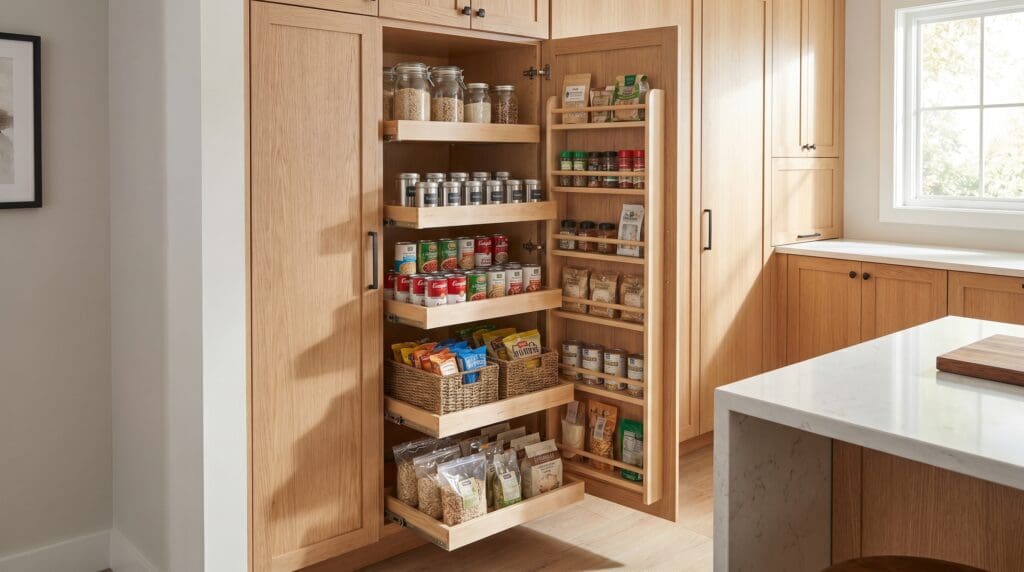
A tall pull out pantry cabinet is the classic built-in option. It usually fits inside a tall cabinet and slides forward as one vertical unit. Some models feature adjustable shelves, chrome baskets, wood trays, or side rails to securely hold jars and cans.
This is one of the best options if you are remodeling a kitchen or replacing cabinets. It can turn a narrow vertical cabinet into a full pantry tower.
Best for: Kitchen remodels, tall pantry cabinets, narrow vertical storage, and homeowners who want a built-in look.
- Pros: Excellent vertical storage, clean built-in appearance, ideal for narrow spaces.
- Cons: More expensive, requires precise cabinet sizing, and is harder to retrofit than simple drawers.
2. Narrow Pull Out Pantry Rack
A narrow pull out pantry rack is perfect for the skinny spaces that are usually wasted in kitchens. These racks can fit beside a refrigerator, between cabinets, beside a stove, or in a slim pantry opening.
They work especially well for spices, oils, baking extracts, canned goods, jars, snacks, and small bottles. If your kitchen has a narrow gap that feels useless, a rack is often the easiest way to turn it into storage.
Best for: Small kitchens, apartment kitchens, narrow cabinet gaps, spice storage, and bottle storage.
- Pros: Uses narrow wasted space, great for bottles and spices, easy to access from both sides.
- Cons: Limited width, not ideal for bulky boxes or large appliances.
3. Base Cabinet Slide Out Pantry
A base cabinet slide out pantry is shorter than a full-height pantry but still very useful. It usually fits inside a lower cabinet and pulls forward like a deep rack or basket system.
This is a strong option for heavy pantry items because the storage is low. Canned goods, oil bottles, potatoes, onions, rice bags, pet food, and cleaning supplies are easier to manage in a lower slide-out system.
Best for: Lower kitchen cabinets, heavy pantry items, canned goods, oils, pet food, and everyday supplies.
- Pros: Safer for heavy items, easier to load, good for existing base cabinets.
- Cons: Less vertical storage than a tall pull out pantry.
4. Freestanding Pantry Cabinet With Pull Out Shelves
A freestanding pantry cabinet with pull out shelves is useful if you rent, do not want to modify built-in cabinets, or need extra pantry space outside the main kitchen cabinets.
These cabinets can work in kitchens, laundry rooms, mudrooms, garages, dining rooms, or small apartments. They do not look as custom as built-in cabinetry, but they are easier to move and often require less installation work.
Best for: Renters, apartments, laundry rooms, extra pantry storage, and homes without built-in pantry cabinets.
- Pros: No built-in cabinet remodel required, movable, good for extra storage.
- Cons: Takes floor space, may need wall anchoring for safety.
5. Custom Pullout Pantry System
A custom pullout pantry system is the premium option. It is designed to fit your exact cabinet opening, pantry height, and storage needs. These systems are common in higher-end kitchen remodels because they look clean and make every inch of cabinet space usable.
Custom systems are not always necessary, but they make sense if you have unusual cabinet dimensions, a tall pantry tower, a narrow opening, or a kitchen remodel where storage matters as much as appearance.
Best for: Kitchen remodels, custom cabinetry, awkward spaces, and homeowners who want a premium built-in result.
- Pros: Best fit, strongest design options, premium appearance.
- Cons: Highest cost, may require professional installation.
If you want to upgrade regular lower cabinets instead of installing a full pantry system, see our guide to pull out cabinet drawers.
How to Choose the Right Pull Out Pantry Size
Choosing the right size is where most mistakes happen. A pull out pantry needs to fit the cabinet, clear the door, carry the weight, and slide smoothly without rubbing.
Measure the Cabinet Opening
Measure the clear opening, not just the inside cabinet width. Face frames, hinges, and door hardware can reduce the usable opening.
Measure Cabinet Depth
Depth is just as important as width. A rack that is too deep may hit the back of the cabinet or prevent the door from closing properly.
Check Height Clearance
For tall pull out pantry cabinets, measure the full height carefully. Also think about what you plan to store. Tall cereal boxes, oil bottles, and bulk containers need more shelf spacing.
Check Door Swing and Hinge Clearance
Open the cabinet door fully and check whether hinges block the slide path. This is especially important in face-frame cabinets.
Match the Weight Rating to Your Storage
Cans, jars, flour, sugar, rice, and bottles get heavy quickly. If you want to store heavy pantry goods, choose a stronger rack or slide system.
Measure the opening in at least three places: top, middle, and bottom. Older cabinets are not always perfectly square. Use the smallest measurement when choosing a pull out pantry system.
Best Places to Use a Pull Out Pantry
Beside the Refrigerator
The narrow gap beside a refrigerator is one of the best places for a slim pull out pantry rack. It works well for spices, oils, snacks, canned goods, and bottles.
Inside a Tall Pantry Cabinet
A tall cabinet with a full slide-out pantry system can hold a surprising amount of food. This is one of the best built-in options for modern kitchens.
Inside a Lower Base Cabinet
Lower slide out pantry organizers are excellent for heavy items. They are safer than storing heavy jars or appliances at shoulder height.
In a Pantry Closet
If you have a pantry closet with fixed shelves, you may not need a full pull out pantry cabinet. In that case, pantry roll out shelves or slide-out drawers may be a better fit.
In a Laundry Room or Mudroom
A freestanding pantry with pull out shelves can store bulk food, paper goods, pet supplies, cleaning products, or overflow kitchen items.
Pull Out Pantry Cabinet vs. Traditional Pantry Shelves
Traditional pantry shelves are cheaper and simple, but they waste space in deep cabinets. A pull out pantry costs more, but it makes the entire depth usable.
| Feature | Traditional Pantry Shelves | Pull Out Pantry |
|---|---|---|
| Access | Harder to reach items in the back | Slides forward for easy access |
| Cost | Lower cost | Higher cost |
| Organization | Can become cluttered quickly | Easier to separate categories |
| Deep Cabinet Use | Back space often gets wasted | Uses full cabinet depth |
What to Store in a Pull Out Pantry
A pull out pantry works best when items are grouped by category. Do not just load everything randomly. The more organized the layout, the more useful the system becomes.
- Top shelves: Lightweight snacks, paper goods, backup pantry items.
- Middle shelves: Everyday cans, jars, sauces, pasta, grains, and breakfast items.
- Lower shelves: Heavy items like oil bottles, flour, sugar, rice, pet food, and bulk goods.
- Narrow racks: Spices, oils, vinegar, extracts, small cans, and bottles.
- Base cabinet pull outs: Potatoes, onions, canned goods, cleaning supplies, and heavy containers.
Common Mistakes to Avoid
1. Buying the Rack Before Measuring the Opening
Always measure first. Product photos can be misleading, and cabinet openings vary more than people expect.
2. Ignoring Door Hinges
A pull out pantry needs a clear path forward. Hinges, door thickness, and face frames can block the organizer.
3. Choosing a Weak System for Heavy Food
Canned goods and bottles are heavy. A flimsy rack may sag, wobble, or become hard to slide when fully loaded.
4. Using a Tall Pull Out Pantry for Only Small Items
Small items can get messy in a tall pantry if shelves are too deep or too far apart. Use bins, dividers, or smaller racks when needed.
5. Forgetting Wall Anchoring for Freestanding Cabinets
A freestanding pantry cabinet with pull out shelves can become front-heavy when open. Follow the manufacturer’s anti-tip instructions and anchor it when required.
6. Overloading Upper Shelves
Heavy items should stay low. This makes the pantry safer, easier to use, and less likely to strain the slides.
7. Choosing Style Over Function
A beautiful pull out pantry is useless if it does not fit your real food storage. Choose shelf spacing and weight capacity before focusing on finish and style.
How to Install a Pull Out Pantry Organizer
Installation depends on the type of system you buy. A full-height pull out pantry cabinet is more involved than a simple base cabinet organizer, but the basic process is similar.
- Empty the cabinet: Remove all food, shelves, and loose items.
- Check the cabinet floor: Make sure the base is solid, level, and strong enough.
- Test fit the organizer: Slide the system into place before drilling.
- Mark screw locations: Use a pencil and level to keep the frame straight.
- Pre-drill holes: This helps prevent splitting and crooked screws.
- Secure the slide frame: Attach the base or side frame according to the instructions.
- Install shelves or baskets: Attach adjustable shelves, racks, or baskets.
- Test the slide action: Pull it out several times before loading it.
- Load gradually: Add weight slowly and check for rubbing, sagging, or tipping.
Tall and freestanding pantry cabinets can become front-heavy when fully extended. Follow the manufacturer’s instructions for anchoring, weight limits, and installation. When in doubt, ask a cabinet installer or handyman for help.
DIY Pull Out Pantry vs. Pre-Made System
You can build a DIY pull out pantry with plywood, drawer slides, shelves, and a face frame, but it requires accurate measuring and strong hardware. A tall pantry full of food puts a lot of stress on the slides.
For most homeowners, a pre-made pull out pantry rack or cabinet organizer is easier and safer. DIY makes sense if you have unusual dimensions, woodworking tools, and confidence installing heavy-duty slides.
| Option | Best For | Main Advantage | Main Drawback |
|---|---|---|---|
| DIY Pull Out Pantry | Custom sizes and experienced DIYers | Can be built to exact dimensions | Requires tools, strong slides, and accurate construction |
| Pre-Made Pull Out Pantry System | Most homeowners | Faster and easier to install | Must match available sizes |
Is a Pull Out Pantry Worth It?
Yes, a pull out pantry is worth it if you have deep cabinets, narrow unused space, a cluttered pantry, or trouble reaching items in the back. It is one of those upgrades you notice every day because it makes the kitchen easier to use.
It is especially worth it in small kitchens, where every inch of storage matters. A narrow pull out pantry rack can turn a useless gap into storage for spices, oils, cans, and dry goods.
The only time I would skip it is if your cabinet is too shallow, the door clearance is poor, or the cabinet structure is too weak to support a loaded pull out system.
Final Verdict: What Is the Best Pull Out Pantry?
The best pull out pantry depends on your kitchen layout. For a remodel or built-in upgrade, a tall pull out pantry cabinet gives the cleanest and most useful result. For small kitchens, a narrow pull out pantry rack can turn wasted space into valuable storage. For existing lower cabinets, a base cabinet slide out pantry organizer is usually the easiest upgrade.
If you already have a pantry cabinet with fixed shelves, you may not need a full slide-out tower. Individual pull out drawers for pantry shelves may be cheaper, easier, and more flexible.
My simple rule is this: use a full pull out pantry when you want a vertical cabinet system, use a narrow rack when space is tight, and use pantry roll out shelves when you already have a cabinet that just needs better access.
📚 More Kitchen & Home Improvement Guides
Planning more practical kitchen storage upgrades? Start here:
Frequently Asked Questions
What is a pull out pantry?
A pull out pantry is a pantry cabinet, rack, or organizer that slides forward so you can access stored items more easily. It is commonly used in tall cabinets, narrow kitchen gaps, and deep pantry spaces.
Is a pull out pantry worth it?
Yes. A pull out pantry is worth it if you have deep cabinets, narrow unused space, or pantry items that are hard to reach. It makes food easier to see, organize, and access.
What is the difference between a pull out pantry and pull out pantry drawers?
A pull out pantry is usually a larger slide-out cabinet or rack system, while pull out pantry drawers are individual sliding shelves installed inside an existing pantry cabinet.
Can I add a pull out pantry to an existing cabinet?
Yes, many slide out pantry organizers and pantry roll out shelves are designed for existing cabinets. You must measure the cabinet opening, depth, height, hinge clearance, and weight capacity before buying.
What size pull out pantry do I need?
Measure the clear cabinet opening width, cabinet depth, available height, and door clearance. Use the smallest measurement if the cabinet is not perfectly square.
What should I store in a pull out pantry?
A pull out pantry is ideal for cans, jars, spices, oils, snacks, pasta, grains, baking supplies, and dry goods. Store heavier items on lower shelves for safety.
Are tall pull out pantry cabinets safe?
Tall pull out pantry cabinets can be safe when installed correctly and loaded within the manufacturer’s weight limits. Freestanding pantry cabinets may need wall anchoring to prevent tipping.
Can I build a DIY pull out pantry?
Yes, you can build a DIY pull out pantry with wood, shelves, and heavy-duty slides. However, pre-made pull out pantry systems are easier for most homeowners and reduce the risk of sizing or slide alignment problems.
What is the best pull out pantry for small kitchens?
A narrow pull out pantry rack is usually best for small kitchens because it uses slim spaces beside refrigerators, cabinets, or appliances without taking up much floor area.