


















If your AC compressor is not turning on, your air conditioner may blow warm air, hum outside, click without starting, trip the breaker, or sit completely silent while the thermostat calls for cooling. It feels like a major failure — and sometimes it is — but not every compressor problem means the compressor itself is dead.
In many cases, an air conditioner compressor that will not turn on is caused by a bad capacitor, a failed contactor, a tripped breaker, a thermostat problem, a dirty condenser coil, low refrigerant, a wiring issue, a safety switch, or an overheated compressor. Some checks are safe for homeowners, but electrical testing, refrigerant diagnosis, capacitor replacement, and compressor repair should be handled by a licensed HVAC technician.
This guide explains what to check first, the most common reasons an AC compressor will not kick on, what different sounds mean, what not to touch, and when to call for professional HVAC repair.
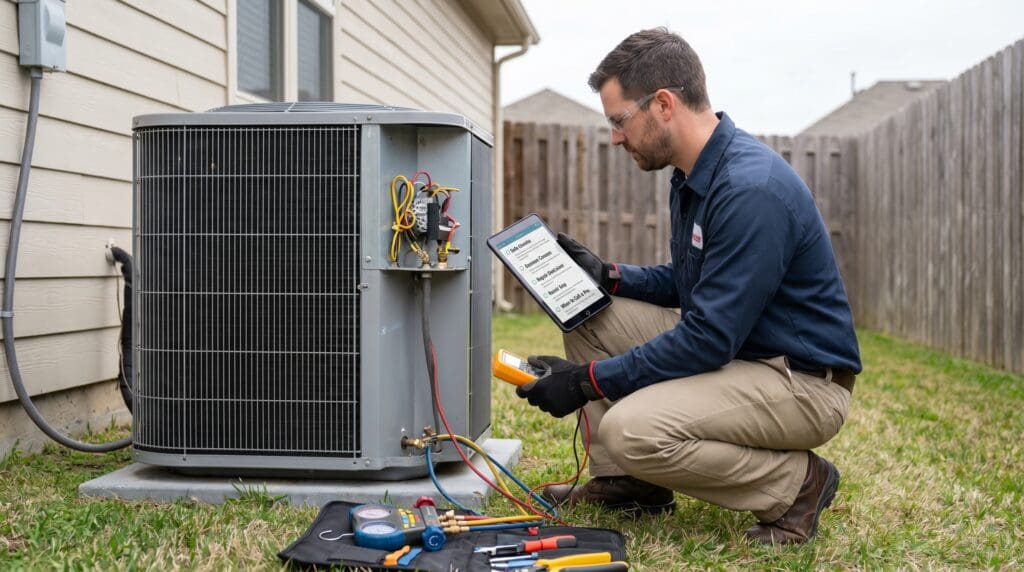
Quick Answer: Why Is My AC Compressor Not Turning On?
An AC compressor may not turn on because of a thermostat issue, tripped breaker, blown fuse, bad capacitor, failed contactor, low refrigerant, dirty condenser coil, overheating, wiring problem, safety switch, or failed compressor. Homeowners can check thermostat settings, breakers, filters, and outdoor airflow. High-voltage electrical parts and refrigerant issues should be diagnosed by an HVAC technician.
AC Compressor Still Not Kicking On?
If the outside unit is humming, clicking, silent, or tripping the breaker, compare local HVAC technicians who can diagnose the capacitor, contactor, compressor, refrigerant system, and electrical circuit.
Sponsored affiliate link. Contractor availability varies by location.
First: Is the Compressor the Part That Is Not Turning On?
Many homeowners use “outside AC unit” and “compressor” interchangeably, but they are not exactly the same thing. The outdoor unit contains several parts, including the compressor, condenser coil, outdoor fan motor, capacitor, contactor, electrical wiring, and refrigerant lines.
That means the phrase “AC compressor not turning on” can describe several different situations:
- The entire outdoor unit is silent.
- The outdoor fan is running, but the compressor is not.
- The compressor hums but does not start.
- The unit clicks but shuts off immediately.
- The breaker trips when the AC tries to start.
- The indoor blower runs, but the outside unit does nothing.
- The AC runs but blows warm air.
Each symptom points to a different set of possible causes. That is why proper diagnosis matters before assuming you need a new compressor.
For a broader guide to compressor troubleshooting and repair decisions, see our pillar article: Fix Compressor Air Conditioner: What to Check Before Calling an HVAC Tech.
Safe Checks Before Calling an HVAC Technician
Before you call for service, you can do a few safe checks. These steps do not require opening electrical panels on the outdoor unit, touching capacitors, or handling refrigerant.
1. Check the Thermostat
Make sure the thermostat is set to Cool and the temperature is set several degrees below the current room temperature. If your thermostat has batteries, replace them. Also check that the system is not set to fan-only mode.
If the thermostat screen is blank, the AC may not be receiving a cooling signal.
2. Check the Air Filter
A clogged filter can reduce airflow, contribute to freezing, strain the system, and make the AC behave strangely. Replace a dirty filter and give the system time to stabilize.
The U.S. Department of Energy notes that regular maintenance of filters, coils, fins, and refrigerant lines is essential for efficient and effective AC performance; neglected maintenance reduces performance and increases energy use. :contentReference[oaicite:0]{index=0}
3. Check the Breaker
Find the AC breaker in your electrical panel. If it has tripped, you can reset it once. If it trips again, stop. Repeated breaker trips can mean a serious electrical problem, shorted component, locked compressor, or failing motor.
4. Check the Outdoor Disconnect
The outdoor condenser usually has a disconnect box mounted near it. If someone recently worked around the unit, the disconnect may have been pulled or switched off. You can visually check whether it appears to be in place, but do not open unsafe electrical compartments.
5. Clear Debris Around the Outdoor Unit
Make sure weeds, leaves, grass clippings, mulch, or cottonwood fluff are not blocking airflow around the condenser. A blocked or dirty outdoor unit can overheat and stress the compressor.
6. Check the Condensate Safety Switch
Some systems have a float switch that shuts the AC off if the condensate drain backs up. If your indoor unit or drain pan has water around it, the safety switch may be stopping the cooling call to prevent water damage.
7. Listen to the Outdoor Unit
Do not remove panels. Just listen from a safe distance. Is it silent? Humming? Clicking? Buzzing? Does the fan start? Does it shut off right away? These clues help a technician diagnose the problem faster.
10 Common Reasons Your AC Compressor Is Not Turning On
1. Bad Capacitor
A bad capacitor is one of the most common reasons an AC compressor will not start. The capacitor gives the compressor and outdoor fan motor the electrical boost they need to start and run.
Signs of a bad capacitor may include:
- Outdoor unit humming but not starting
- Fan not spinning
- Compressor struggling to start
- AC clicking or buzzing
- System shutting down shortly after startup
Capacitors can hold a dangerous electrical charge even after power is shut off. Do not touch or replace one unless you are trained.
2. Failed Contactor
The contactor is an electrical switch inside the outdoor unit. When your thermostat calls for cooling, the contactor closes and sends power to the condenser components.
If the contactor is burned, pitted, stuck, or failed, the compressor may not receive power. A failed contactor can make the outdoor unit act completely dead even when the thermostat is working.
3. Tripped Breaker or Blown Fuse
If the compressor tries to start and draws too much current, the breaker may trip. This can happen because of a bad capacitor, shorted wiring, compressor failure, overheating, or a locked rotor.
Reset the breaker only once. If it trips again, call a technician.
4. Thermostat or Control Signal Problem
If the thermostat is not sending a cooling signal, the outdoor unit may never start. Causes can include dead thermostat batteries, incorrect settings, bad wiring, control board issues, or a failed low-voltage circuit.
5. Low Refrigerant or Refrigerant Leak
Low refrigerant can prevent proper cooling, cause freezing, reduce efficiency, and stress the compressor. Refrigerant does not get used up like gas in a car; low refrigerant usually means there is a leak.
EPA regulations under Section 608 require technicians who maintain, service, repair, or dispose of equipment that could release refrigerants into the atmosphere to be certified. :contentReference[oaicite:1]{index=1}
6. Dirty Condenser Coil
If the outdoor coil is clogged with dirt and debris, the system cannot release heat properly. This can cause high pressure, overheating, reduced cooling, and compressor stress.
Dirty filters and coils can also cause air conditioners to malfunction and may contribute to premature compressor or fan failure, according to the Department of Energy. :contentReference[oaicite:2]{index=2}
7. Compressor Overheating
A compressor may shut itself off if it overheats. Causes can include dirty coils, poor airflow, low refrigerant, electrical problems, extreme outdoor heat, or long run times.
If the system starts again after cooling down, do not ignore it. Overheating usually has an underlying cause.
8. Locked Rotor
A locked rotor means the compressor motor cannot start turning. You may hear humming, buzzing, or see the breaker trip when the system tries to start.
Sometimes a technician may recommend a hard-start kit if the compressor is weak but still usable. If the compressor is mechanically locked or electrically failed, replacement may be needed.
9. Wiring or Electrical Connection Problem
Loose wires, burned terminals, damaged insulation, corroded connections, or control board problems can stop the compressor from receiving power. Electrical problems should be taken seriously because they can damage parts or create safety hazards.
10. Failed Compressor
A failed compressor is the expensive possibility everyone worries about. But it should be confirmed only after testing the capacitor, contactor, voltage, wiring, refrigerant conditions, and system pressures.
If the compressor has internal electrical or mechanical failure, replacement may be required. On an older AC system, full system replacement may be more practical than compressor replacement alone.
What Different Symptoms Usually Mean
| Symptom | Possible Cause | What to Do |
|---|---|---|
| Outdoor unit completely silent | Thermostat, breaker, disconnect, control signal, contactor | Check thermostat and breaker; call HVAC if still dead |
| Humming but not starting | Bad capacitor, locked rotor, compressor problem | Turn system off and call technician |
| Clicking but no startup | Contactor, capacitor, control board, safety switch | Needs electrical diagnosis |
| Fan runs but no cooling | Compressor not running, low refrigerant, capacitor, wiring | Call HVAC for testing |
| Breaker trips when AC starts | Short, bad capacitor, locked compressor, electrical fault | Do not keep resetting breaker |
| Warm air from vents | Compressor issue, refrigerant leak, frozen coil, airflow problem | Check filter; call if not resolved |
Should You Turn Off the AC?
Yes, in many cases. If your compressor is humming, buzzing, clicking repeatedly, tripping the breaker, or blowing warm air for an extended period, turn the system off and call for service.
Running an AC system when the compressor is not starting correctly can make the damage worse. It can also overheat electrical parts, trip breakers, or place stress on the compressor.
Why You Should Not Add Refrigerant Yourself
Low refrigerant is a common suspect when an AC does not cool, but adding refrigerant is not a homeowner fix. First, low refrigerant usually means there is a leak. Second, too much or too little refrigerant can reduce efficiency and shorten equipment life. ENERGY STAR lists checking refrigerant level and adjusting if necessary as part of professional cooling maintenance. :contentReference[oaicite:3]{index=3}
Refrigerant work also requires certification and proper equipment. A technician needs to find the leak, repair it when appropriate, recover or add refrigerant correctly, and verify system operation.
Can a Bad Capacitor Make It Look Like the Compressor Is Dead?
Yes. A bad capacitor can make a perfectly usable compressor fail to start. That is why a proper diagnosis matters before approving a compressor replacement.
If a technician says the compressor is bad, ask whether they tested:
- Run capacitor
- Start capacitor or hard-start kit, if present
- Contactor
- Voltage at the compressor
- Compressor winding resistance
- Ground fault
- Refrigerant pressures
- Outdoor fan motor operation
You do not need to understand every test, but you do want confirmation that the cheaper causes were ruled out.
How Much Does It Cost When the Compressor Will Not Turn On?
The cost depends on the actual failure. A thermostat setting or dirty filter may cost almost nothing. A capacitor or contactor repair is usually much less than a compressor replacement. A true compressor replacement can be one of the most expensive AC repairs.
| Problem | Typical Cost Direction | Repair Notes |
|---|---|---|
| Thermostat setting or dirty filter | Lowest | Often homeowner-checkable |
| Bad capacitor | Lower repair cost | Common cause of humming and hard starting |
| Failed contactor | Lower to moderate | Electrical switch problem |
| Refrigerant leak | Moderate to high | Requires leak diagnosis and certified refrigerant work |
| Failed compressor | Highest | Repair vs replacement decision depends on system age and warranty |
Get a Real Diagnosis Before Replacing the Compressor
A local HVAC technician can confirm whether your AC needs a capacitor, contactor, refrigerant repair, hard-start kit, wiring repair, or compressor replacement.
Repair vs Replace: What If the Compressor Is Actually Bad?
If the compressor has truly failed, the next question is whether replacing it is worth the money. The answer depends on system age, warranty status, refrigerant type, repair cost, and overall condition.
Compressor replacement may make sense if:
- The AC system is relatively new.
- The compressor is still under parts warranty.
- The indoor coil and outdoor unit are otherwise in good condition.
- The repair cost is far lower than full replacement.
- The refrigerant type is practical to service.
Full AC replacement may make more sense if:
- The system is 10 to 15+ years old.
- The compressor is out of warranty.
- You have repeated breakdowns.
- The system is inefficient or undersized.
- The repair cost is close to replacement cost.
- There are refrigerant leaks, coil problems, or major electrical issues too.
How to Prevent Compressor Startup Problems
Not every failure can be prevented, but maintenance can reduce stress on the compressor and other outdoor unit components.
- Change air filters regularly.
- Keep outdoor coils clean and clear.
- Trim shrubs and weeds around the condenser.
- Schedule annual HVAC maintenance before cooling season.
- Do not ignore humming, buzzing, or hard-start symptoms.
- Fix refrigerant leaks instead of repeatedly topping off refrigerant.
- Keep vents open and returns unobstructed.
- Use a reasonable thermostat setting during extreme heat.
ENERGY STAR also notes that dirty AC coils reduce the system’s ability to cool your home, increase run time, raise energy costs, and reduce equipment life. :contentReference[oaicite:4]{index=4}
When to Call HVAC Help Immediately
Call an HVAC technician right away if:
- The compressor hums but does not start.
- The breaker trips more than once.
- You smell burning.
- The outdoor unit clicks repeatedly but will not run.
- The fan runs but the AC blows warm air.
- The refrigerant line is frozen.
- The unit makes grinding, rattling, or loud buzzing noises.
- You see oil stains near refrigerant lines.
- The unit starts and stops rapidly.
- You are not comfortable checking the system safely.
Need AC Compressor Diagnosis?
Do not keep resetting breakers or running a humming compressor. Compare local HVAC pros and get the system checked before more damage occurs.
Final Thoughts
If your AC compressor is not turning on, do not assume the compressor is automatically dead. Thermostat settings, a tripped breaker, dirty filter, blocked condenser, bad capacitor, failed contactor, refrigerant leak, wiring issue, or safety switch can all stop the system from starting correctly.
Start with the safe checks: thermostat, filter, breaker, outdoor airflow, and obvious power issues. If the unit hums, clicks, trips the breaker, or still does not cool, turn the system off and call an HVAC technician.
The right diagnosis can save you from replacing a compressor when the real problem is a smaller electrical or airflow issue.
Frequently Asked Questions About an AC Compressor Not Turning On
Why is my AC compressor not turning on?
Your AC compressor may not turn on because of a bad capacitor, failed contactor, tripped breaker, thermostat issue, low refrigerant, dirty condenser coil, wiring problem, safety switch, overheating, or failed compressor.
What should I check first if my AC compressor will not start?
Check the thermostat settings, thermostat batteries, air filter, breaker, outdoor disconnect, and outdoor unit airflow. If those are fine and the unit still will not start, call an HVAC technician.
Why is my AC compressor humming but not starting?
A humming compressor may point to a bad capacitor, hard-start problem, locked rotor, low voltage, wiring issue, or failing compressor. Turn the system off and schedule service.
Why does my outside AC unit click but not turn on?
Clicking can come from a contactor, relay, control board, thermostat signal, capacitor issue, or safety switch. If it clicks repeatedly but does not start, the unit needs electrical diagnosis.
Can a bad capacitor stop the compressor from turning on?
Yes. A weak or failed capacitor is one of the most common reasons a compressor will hum, struggle, or fail to start.
Can I replace my AC capacitor myself?
It is not recommended unless you are trained. Capacitors can store a dangerous electrical charge even when the power is off.
Why does my breaker trip when the compressor tries to start?
Repeated breaker trips can indicate a bad capacitor, shorted wiring, locked compressor, failed motor, or electrical fault. Do not keep resetting the breaker.
Can low refrigerant stop the compressor from turning on?
Low refrigerant or a refrigerant pressure safety switch may prevent proper operation. Low refrigerant usually means there is a leak that should be diagnosed by a certified technician.
Should I turn off the AC if the compressor is not turning on?
Yes. If the unit hums, clicks, trips the breaker, or blows warm air for an extended time, turn it off to avoid further damage and call for service.
Is it always the compressor if the outside unit will not turn on?
No. A silent or non-starting outside unit may be caused by thermostat issues, breakers, disconnects, contactors, capacitors, control wiring, safety switches, or fan motor problems.