Say you have 5,000 square feet of bare yard and a contractor advertises hydroseeding at 24 cents per square foot. You do the math and set aside $1,200. Then the estimate comes back at $2,500. Both numbers can be correct. One prices the area covered by seed. The other reflects the smallest job the company will send a truck to do.
Hydroseeding is a way to sow a lawn by spraying grass seed, water and mulch onto prepared soil. It can be a good buy for a broad, bare yard where spreading seed and mulch by hand would take considerable time. Before booking, get three figures in writing: the square footage to be sprayed, the minimum job charge and the price of any soil preparation. Those figures tell you more about your bill than the color of the lawn on spray day.
HomeGuide reports a U.S. reference range of $0.12–$0.35 per square foot and gives $1,000–$1,750 for a 5,000-square-foot lawn in its size-specific table. Two local examples show how far an actual bill can move: a West Michigan contractor illustrates that same area at $400–$1,000, while a Gulf Coast provider publishes a $2,500 minimum. Ask local crews what their prices include before setting your budget. U.S. cost guide · West Michigan pricing · Gulf Coast estimator
What is hydroseeding, and what does the green coating do?
A hydroseeding crew mixes seed and water with mulch fibers, then applies the mixture through a hose or spray nozzle. Depending on the site, it can include fertilizer and a tackifier, a material that helps the fibers stay in place. The mulch helps protect the seedbed. A tracking dye can show where the crew has sprayed. That blue-green finish across a new subdivision is the covering. The blades of grass emerge later. Caltrans guide to hydroseed and hydromulch
You still have a choice of grass. Ask for the species and varieties that will go in the tank. A sunny front yard and a shaded back yard may deserve different blends even if the installer can reach both with one hose. If a quote lists only “premium green lawn mix,” ask for the seed label before comparing it with a more expensive bid. For help matching a grass to your yard, see our grass seed buying guide.
Also check what the company means by hydromulching. Mulch can be sprayed over seed that was sown earlier, and some erosion-control jobs apply mulch without any seed at all. Either arrangement can be appropriate. For a homeowner expecting a lawn, the estimate should identify who supplies the seed, how it will be applied and exactly which ground the price covers.
Hydroseeding cost by lawn size
| Area to seed | Published project range | What to check locally |
|---|---|---|
| 2,000 sq ft | $500–$700 | Does the contractor’s minimum exceed this budget? |
| 5,000 sq ft | $1,000–$1,750 | Is the ground ready to spray, or does it need a separate prep visit? |
| ¼ acre (10,890 sq ft) | $1,900–$2,800 | Is the entire quarter acre lawn, or does it include the house and drive? |
| 1 acre (43,560 sq ft) | $5,000–$8,500 | Ask for an acreage rate and the cost of water access or additional trips. |
These are the source’s project-size estimates. Its broad per-foot range covers different sizes of work, so simply multiplying the lowest national rate by your small lawn can produce an unrealistically low expectation. Use the row closest to your measured area, then compare it with a written price from a crew serving your address. Source and cost factors
Two published contractor prices for the same 5,000-square-foot yard
West Michigan. Christian Brothers Outdoor Services gives a worked range of $400–$1,000 for 5,000 square feet. Its page describes grass seed, mulch, fertilizer, tackifier and professional application. If your yard is rutted after a house build, ask what grading or topsoil would cost in addition to spraying. The company’s estimate covers its own market. Christian Brothers’ pricing and inclusions
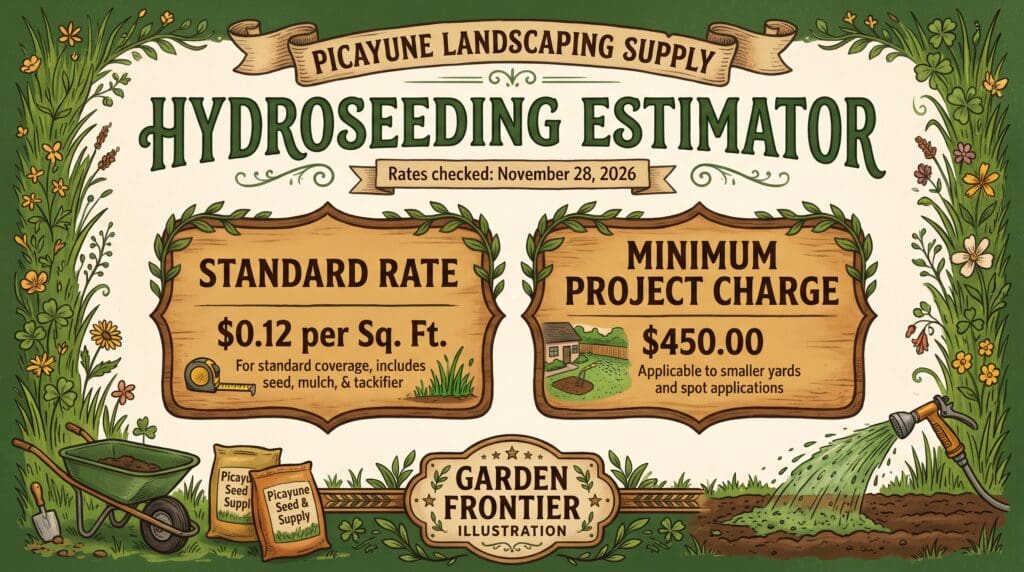
Northshore and Gulf Coast. Picayune Landscaping Supply’s estimator starts at $0.24 per square foot for its standard service and shows a $2,500 minimum. At the published starting rate, 5,000 square feet produces a $1,200 base calculation, and the minimum brings the starting budget to $2,500 before any applicable extras. The page has separate options for prep, travel and water access. Its lower large-job rate depends on the job qualifying. Picayune’s pricing calculator
That’s why a neighbor’s “price per foot” is only useful if you know the job size. A $2,500 job covering 5,000 square feet has an effective rate of 50 cents per foot. If the same minimum covered 10,000 square feet, the effective rate would be 25 cents. Nothing about the grass changed. The crew spread the cost of coming out over twice as much ground.
How to estimate your own yard before calling
- Measure the ground that will actually receive seed. Split an irregular lawn into rectangles and triangles. Multiply length by width for a rectangle. For a triangle, halve the product of its base and perpendicular height. Subtract a patio or bed only if you counted it inside one of your shapes.
- Apply the rate to that area. If the company gives a rate per 1,000 square feet, divide your area by 1,000 first. Round the final cost after doing the multiplication.
- Check the minimum and add agreed extras. A common estimate is the greater of the minimum or the area charge, plus separately quoted work. Ask which services count toward that company’s minimum. Some firms give one inclusive project price.
For example, picture a 50-by-70-foot back lawn and a separate 30-by-50-foot front lawn. Together those rectangles cover 5,000 square feet. A 10-by-20-foot patio inside the back rectangle brings the spray area down to 4,800. At an illustrative 20 cents per foot, the application comes to $960. If that bidder has a $1,100 application minimum and quotes $350 separately for prep, the estimate becomes $1,450. A second bidder offering $1,300 with the same prep included would be cheaper, even if its advertised unit rate were higher.
Send both companies the same sketch. Mark the gate, the outside faucet, any slope, and which side of the drive is accessible to a truck. A handful of pictures from ground level will show things that an aerial measurement misses, including steps down to a back lawn and wet wheel tracks where the last delivery truck sank into the soil.
Hydroseeding, dry seeding or sod?
| Situation | First option to price | Reason |
|---|---|---|
| A few bare patches in an otherwise healthy lawn | Dry seed or targeted overseeding | You can prepare and water each patch without paying for an entire crew visit. |
| A large, newly graded yard with dependable irrigation | Professional hydroseeding | One crew can distribute seed and mulch over a broad prepared area. |
| A small, highly visible front yard needed for an upcoming event | Sod | It provides visible turf on installation day. Budget for watering and time for rooting before traffic. |
| A sloping lawn crossed by water flowing from a downspout | Drainage work, then an establishment method | Moving water can carry away soil and seed regardless of how the seed was applied. |
The speed advantage of hydroseeding is easiest to see on the day of installation. A crew covers a large area quickly. Afterward the grass still follows the timetable of the species in the tank. A bag of tall fescue sown into good soil and kept moist can perform well, too. Where an established lawn is only thinning, our overseeding guide can help you decide whether to keep the existing turf.
Sod changes the household calculation. A small yard might be the dog’s only route outdoors, or visitors might be arriving before grass seed can fill in. Sod buys immediate visual coverage, although fresh rolls still need care and traffic restrictions. Ask for sod and hydroseed prices on the same measured area with the same soil preparation. Our tall fescue sod guide covers what installing rolls involves. Purdue Extension on establishing turf from seed
What the crew needs before spray day
Agree on what “ready to seed” means. If a builder has left a rough grade, find out who will remove debris, break up compacted areas and create the final surface. Photograph the yard after rain. A puddle against the patio and a channel down the side yard are easier to discuss while everyone can see them. A layer of mulch can hide either feature long enough for the crew to leave. It won’t redirect the next downpour.
Ask whether the crew expects topsoil and, if so, where and how deep. A useful way to check a delivery allowance is to convert the requested depth to cubic yards. For 5,000 square feet, an even one-inch layer is roughly 15.4 cubic yards before any allowance for settling. That’s a volume example rather than a recommended depth. It explains why two estimates differ substantially when one includes imported soil and the other assumes a finished bed.
Check your watering arrangements before booking. Connect your hoses and run the sprinkler where it will actually sit. Watch the back corners and the sunny strip beside the driveway. If you must drag a hose across soft ground to reach a second zone, move it into position before spraying. Decide who will water during work hours or if you’re away. The best seed mix on the bid still needs someone available during the first dry spell.
If the surface is mostly established grass with a few compacted paths, the preparation is different. Look at how much bare soil the new seed can contact. Read our lawn aeration guide before paying to spray over a dense mat, and ask whether a slit seeder or a targeted repair would get the seed into better contact with soil. UMass guidance on establishment and renovation
When should you hydroseed?
Book around the grass and local growing season. For cool-season grasses in climates like Indiana’s, late summer to early fall generally offers an establishment window before winter. Work backward from local extension guidance and leave time for slower-germinating seed in a blend. A crew that can fit you in tomorrow is only an advantage if tomorrow is a sensible seeding date. Purdue’s seeding calendar and care guidance
Seeded bermudagrass belongs on a different calendar. University of California guidance puts its planting window in late spring or early summer. Some warm-season grasses and named hybrids are established from sod, plugs or sprigs. If you want to match a neighbor’s lawn, identify the variety before requesting a seed quote. UC guidance on turf planting times · University of Florida bermudagrass guide
How long does hydroseeding take to grow?
Ask which species you are waiting for. University of Maryland Extension gives approximate germination windows of 5–10 days for perennial ryegrass, 7–14 days for turf-type tall fescue and 14–21 days for Kentucky bluegrass. These figures describe seed germination under suitable conditions. The wait to visible coverage can be longer, especially in cool soil or where moisture is inconsistent. Maryland Extension’s turfgrass comparison
Take one picture from the same spot every few days. In a blend, early patches of ryegrass can give the impression that the rest has failed. Check the seed label and the slowest expected component before buying more seed. If the thin patches follow sprinkler arcs or sit beside a hot driveway, look at coverage. If they’re narrow ribbons at the bottom of a slope after a storm, send the installer a photograph before disturbing the surface.
Water lightly enough to keep the seedbed moist without making puddles or moving the coating. A single timer setting will not behave the same way on a sunny slope and a flat, shaded side yard. As the seedlings develop, shift toward deeper, less frequent watering. For the first mow, use the grass’s recommended height, a sharp blade and ground firm enough to support the mower. Remove no more than a third of the blade height at a pass. First sprouts, first mowing and a lawn ready for regular play are three different milestones. Purdue’s watering and first-mowing guidance
Is do-it-yourself hydroseeding worth it?
Get the rental company’s total for the period you would actually need. Include pickup or delivery, the compatible mulch, seed, any binder, water access and equipment return. Ask what one tank covers with the specified mix and whether supplies come in full bales or bags. On a small yard it is quite possible to have materials left over and still pay for a full rental day.
Then price a simpler DIY approach: prepare the same seedbed, use an appropriate spreader, apply the recommended protective cover and water it yourself. A retail hose-end kit may appeal for a bare strip beside a driveway. Read its label for the grass species, actual seed content and coverage before comparing the package with a contractor’s truck-applied mix. The cost per square foot only makes sense when both prices buy the same materials and work.
What to ask a hydroseeding company near you
- What area did you measure? Confirm the front, back and side strips separately and mark any section to leave alone.
- Which seed blend and application rate are in the price? Request the label and ask how the shaded portions will be handled.
- Who prepares the ground? Identify the party responsible for old turf, fine grading, topsoil, drainage corrections and cleanup.
- What could change the price? Check the minimum, water supply, travel, extra hose runs and access to fenced sections.
- What happens after the truck leaves? Ask for watering and mowing instructions, a contact for bare spots and written terms for any return visit after washout.
Send these questions to each bidder in one message. When the replies arrive, put a mark next to every line that says “owner to supply.” A homeowner supplying water, moving soil and handling all touch-ups is buying a different service from the owner who gets a crew for both preparation and establishment checks. Comparing the totals becomes much easier once those obligations are visible.
Hydroseeding FAQ
Can you hydroseed over an existing lawn?
It depends on how much soil is exposed. If existing grass and thatch cover most of the ground, seed can lodge above the soil where establishment is poor. For a lawn worth saving, identify why it thinned and compare overseeding methods that create seed-to-soil contact.
Does a slope automatically make hydroseeding the best choice?
No. Hydraulic application can help a crew cover awkward ground, and suitable mulch can protect the surface during establishment. A slope carrying concentrated runoff may need drainage corrections or additional erosion protection. Ask what is holding the soil in place before roots develop and what the bid allows for heavy rain. Caltrans erosion-control guidance
How much does it cost to hydroseed half an acre?
Half an acre of actual seedbed is 21,780 square feet. HomeGuide’s published half-acre example is $3,500–$5,500. If the property listing says “half an acre,” deduct the house, driveway, mature beds and any lawn you intend to keep before using that range. Half-acre price reference
What would you choose for a 5,000-square-foot yard?
For a prepared, bare yard with working irrigation and time for the grass to grow, I’d get two hydroseeding quotes. For a yard that is already mostly healthy, I’d spend the first dollars finding the cause of the bare patches. The useful number to take home is the price to establish the lawn you need, including the work that happens before and after spray day.
Join the free Garden Frontier list for shrub picks, landscaping ideas, pruning tips, curb appeal projects, and practical garden advice that saves money later.
100% free. No spam. Unsubscribe anytime.