















Persicaria care is easy once you understand the plant’s personality: generous, colorful, moisture-loving, and sometimes a little too enthusiastic about taking up space. That last part is not a dealbreaker. It just means you need to choose the right variety, plant it in the right place, and divide or edge vigorous clumps before they start acting like they own the border.
Gardeners grow Persicaria for two main reasons. Many varieties produce elegant flower spikes in pink, red, rose, white, or deep crimson from summer into fall, exactly when earlier perennials are starting to fade. Others are grown for foliage, with green, burgundy, silver-splashed, chocolate-toned, or patterned leaves that look good long before flowers appear.
The old common name “knotweed” can make gardeners nervous, and fair enough. Some knotweed relatives are serious invasive plants. But many ornamental Persicaria varieties are useful, garden-worthy perennials when chosen carefully and kept in bounds. This guide focuses on ornamental garden types, how to grow them well, and how to control the spreaders before they become a headache.

Light: Full sun to partial shade. More sun usually means heavier flowering if the soil stays moist.
Soil: Moist, fertile, well-draining soil is ideal. Many types tolerate heavier soil better than drought.
Water: Keep evenly moist during dry spells, especially in the first season and in containers.
Maintenance: Cut back old stems, divide vigorous clumps every few years, and edge spreading forms where needed.
Best use: Moist borders, pond edges, rain gardens, naturalistic plantings, cottage gardens, ground cover, and pollinator-friendly perennial beds.
Before buying Persicaria, check the exact variety, mature size, spreading habit, and whether it is clump-forming or a roaming ground-cover type. The right plant is beautiful. The wrong one in a tiny bed can become weekend work.
What Is Persicaria?
Persicaria is a group of flowering plants that includes many hardy perennials used in ornamental gardens. Gardeners often grow them for slender flower spikes, long bloom season, useful foliage, and their ability to fill moist planting spaces.
Some Persicaria were formerly grouped under names gardeners still recognize, including knotweed, bistort, and fleeceflower. That naming history can make the plant sound scarier than it needs to be, but it also explains why identification matters.
Depending on the species and cultivar, Persicaria can behave like a refined clump-forming border perennial, a spreading ground cover, a moisture-loving pond-edge plant, or a foliage accent for partial shade. That variety is why it can be brilliant in one garden and too pushy in another.
Persicaria Plant Profile
Common names: Persicaria, ornamental knotweed, bistort, fleeceflower, red bistort, jumpseed, depending on type.
Plant type: Mostly herbaceous perennials, with some annual or semi-evergreen forms depending on climate.
Flower colors: Pink, red, rose, white, crimson, and softer pale shades.
Best light: Full sun to partial shade.
Best soil: Moist, fertile, well-draining soil.
Bloom season: Often summer into autumn, depending on species, cultivar, and climate.
Best Persicaria Varieties to Know
Not all Persicaria behaves the same way. Some varieties are refined border plants. Others are spreading ground covers. Some are grown mainly for foliage. When buying, look at the mature size and spreading habit before falling in love with the flower color.
1. Persicaria amplexicaulis — Best Border Persicaria
Best for: mixed borders, naturalistic planting, late-season color, and flower spikes that weave through grasses and perennials.
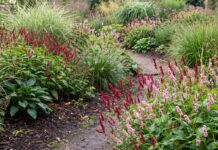
This is the Persicaria group many gardeners want when they picture elegant red, pink, rose, or white bottlebrush-style flower spikes from summer into fall.
Good cultivars to research: ‘Firetail’, ‘Blackfield’, ‘Alba’, ‘Rosea’, ‘Fat Domino’, ‘Orange Field’, and ‘Golden Arrow’.
Control note: usually easier to manage than aggressive knotweed relatives, but mature clumps still benefit from division and space.
2. Persicaria bistorta — Best for Moist Meadow and Cottage Garden Texture
Best for: moist meadows, pond edges, cottage gardens, and softer naturalistic planting.
Persicaria bistorta, often called bistort, is valued for upright pink flower spikes and a looser meadow feeling.
Control note: it can spread where happy, so give it room or divide it before it crowds delicate neighbors.
3. Persicaria affinis — Best Ground Cover Persicaria
Best for: slopes, path edges, rock garden edges, and larger areas where a spreading mat is useful.
Persicaria affinis stays lower than many border types and can form attractive mats with pink-red flower spikes.
Control note: this is a spreader. Use it where spreading is the job, not where you need a perfectly behaved specimen in a cramped bed.
4. Persicaria virginiana — Best Foliage Persicaria for Partial Shade
Best for: woodland-style borders, foliage contrast, shade edges, and burgundy-marked leaves.
Persicaria virginiana is often grown for foliage rather than showy flower spikes. Some forms have attractive markings that brighten partial shade.
Control note: some forms can self-seed or spread in favorable conditions. Remove unwanted seedlings early.
5. Persicaria polymorpha — Best Large Garden Statement Plant
Best for: large borders, back-of-border structure, dramatic white plumes, and shrub-like perennial presence.
Persicaria polymorpha, often called giant fleeceflower, can become a large, impressive perennial with creamy white plumes and strong summer structure.
Control note: it needs space. Treat it as a specimen or large-border anchor, not a small-bed filler.
Where to Plant Persicaria
Persicaria is at its best where the soil stays reasonably moist. That does not mean stagnant bog conditions for every type, but this is not the first plant I would choose for a hot, dry gravel strip.
Think of Persicaria as a plant for generous borders, rain gardens, pond edges, moist cottage gardens, and naturalistic plantings where its flower spikes can move through other perennials.
Good Planting Sites
- Moist perennial borders: especially with grasses, asters, rudbeckia, echinacea, and late-season flowers.
- Pond edges: many Persicaria appreciate the consistent moisture near water features.
- Rain gardens: useful where soil is damp but not permanently stagnant.
- Woodland edges: foliage-focused varieties can brighten partial shade.
- Naturalistic plantings: flower spikes weave beautifully through grasses and loose perennial drifts.
- Containers: compact types can work in pots if you keep them watered.
Plant Persicaria where you can reach it with a spade, fork, or hori hori knife. The easiest time to control a vigorous perennial is before it has woven itself through three neighboring plants.
How to Plant Persicaria
- Choose the right spot: pick full sun to partial shade with moisture-retentive soil.
- Prepare the soil: mix in compost if the soil is poor, sandy, compacted, or dries too quickly.
- Check mature size: give vigorous types more room than the nursery pot suggests.
- Plant at the same depth: set the crown level with the surrounding soil.
- Water deeply: settle the roots and keep evenly moist during establishment.
- Mulch lightly: conserve moisture, but do not bury the crown.
Persicaria Care: Sun, Soil, Water and Fertilizer
Light
Most Persicaria grow well in full sun to partial shade. In cooler climates, full sun usually gives the best flowering. In hotter regions, afternoon shade can keep foliage fresher and reduce watering stress.
Soil
Moist, fertile, well-draining soil is ideal. Persicaria can often handle heavier soil better than many perennials, but it does not need sour, stagnant conditions. Improve poor soil with compost before planting.
Water
Water newly planted Persicaria consistently during the first season. Established plants are tougher, but flowering and foliage quality improve when the soil does not dry out completely for long periods.
Fertilizer
Persicaria usually does not need heavy feeding. Compost in spring is often enough. If growth is weak, use a balanced slow-release perennial fertilizer lightly. Too much nitrogen can create leafy, floppy growth.
Compost or Soil Conditioner
Persicaria likes fertile soil that holds moisture without staying stagnant. Compost helps improve poor, sandy, or tired garden soil.
Hori Hori Garden Knife
A hori hori knife is useful for planting, edging, lifting, slicing, and dividing dense perennial clumps.
Garden Edging
Edging helps keep spreading Persicaria types out of lawns, paths, and delicate neighboring plants.
Pruning Persicaria
Persicaria does not need complicated pruning. The main jobs are tidying old growth, encouraging a cleaner look, reducing self-seeding in some types, and keeping vigorous plants from overwhelming nearby perennials.
- Spring cleanup: cut back dead stems before new growth gets too far along.
- Deadheading: optional, but useful if you want to reduce self-seeding or tidy spent flower spikes.
- Midseason tidy: trim lightly if plants look tired, then water well.
- Fall cleanup: leave stems for winter texture if they look good, or cut back after frost.
How to Divide Persicaria
Dividing Persicaria keeps vigorous clumps under control and rejuvenates older plants. For many garden types, every three to four years is a reasonable rhythm. Aggressive spreaders may need attention sooner.
- Divide in spring or early fall: choose cool weather and avoid extreme heat.
- Water the plant first: moist soil makes lifting easier.
- Lift the clump: use a border fork, spade, or hori hori knife.
- Split into sections: keep strong roots and healthy shoots on each division.
- Discard tired centers: replant the vigorous outer pieces.
- Replant and water: set divisions at the same depth and water deeply.
How to Control Spreading Persicaria
This is the section that matters if you have a small garden. Some Persicaria are polite clumpers. Others creep, seed, or expand faster than expected. The solution is not panic. It is placement and routine control.
- Choose clump-forming varieties for small beds: avoid vigorous ground-cover types in tight borders.
- Use edging: physical edging can help keep spreading forms out of lawns and paths.
- Divide on schedule: lift and reduce clumps before they crowd neighbors.
- Remove unwanted seedlings: pull them while small.
- Do not plant near wild areas: avoid vigorous ornamental types near streams, wetlands, or natural habitats where escape could be a problem.
- Check local restrictions: some knotweed relatives are invasive or regulated in certain regions.
Persicaria Companion Plants
Persicaria is a brilliant weaving plant because the flower spikes rise above the foliage without feeling stiff. It looks best with plants that either contrast its texture or share its love of steady moisture.
- Ornamental grasses: miscanthus, panicum, and molinia give vertical movement and autumn structure.
- Asters: perfect late-season partners for pink, red, or white Persicaria spikes.
- Rudbeckia: yellow flowers create warm contrast with red or rose Persicaria.
- Echinacea: strong daisy-shaped flowers balance the fine flower spikes.
- Hostas: excellent with foliage-focused Persicaria in partial shade.
- Ferns: soft woodland texture for moist shade.
- Golden sedges: bright foliage contrasts beautifully with dark-leaved Persicaria.
- Joe Pye weed: a strong moisture-loving partner for naturalistic borders.
For a bold grass pairing, see our guide to Miscanthus sinensis, one of the best structural companions for late-season perennial borders.
Can You Grow Persicaria in Containers?
Yes, compact Persicaria varieties can grow in containers, especially foliage-focused types or smaller flowering forms. The main challenge is water. Pots dry out faster than garden soil, and Persicaria does not like drought stress.
Use a large pot with drainage holes, moisture-retentive potting mix, and regular watering during hot weather. Avoid tiny containers unless you enjoy watering every five minutes like a hostage negotiator for thirsty plants.
Large Planters for Perennials
Compact Persicaria types can work in containers if the pot is large enough and has reliable drainage.
Moisture Meter
A simple moisture meter can help container gardeners avoid letting Persicaria dry out completely in hot weather.
Persicaria Pests and Problems
Persicaria is usually low-drama, but no plant is bulletproof. Most problems come from drought, poor placement, overcrowding, too much shade, too much fertilizer, or confusion with more aggressive relatives.
Wilting or Crispy Leaves
Likely cause: dry soil, hot sun, or container stress.
Fix: water deeply, mulch, and consider afternoon shade in hot climates.
Lots of Leaves, Few Flowers
Likely cause: too much shade, too much nitrogen, or an immature plant.
Fix: increase light, reduce feeding, and give the clump time to establish.
Spreading Too Far
Likely cause: vigorous variety in rich moist soil.
Fix: divide, edge, relocate, or replace with a clump-forming type.
Floppy Growth
Likely cause: too much fertility, shade, or crowding.
Fix: reduce fertilizer, divide crowded clumps, and improve light.
Leaf Spots or Mildew
Likely cause: poor airflow, wet foliage, or overcrowding.
Fix: thin crowded plants, water at soil level, and remove badly affected leaves.
Is Persicaria Invasive?
The honest answer is: it depends on the species, cultivar, and location. Some ornamental Persicaria are manageable garden perennials. Some knotweed relatives are aggressive invasive plants. A plant that behaves politely in one climate may spread more strongly in a moist, mild region.
Before planting, check the exact botanical name, mature spread, and local invasive plant guidance. Avoid planting vigorous spreaders near waterways, wild edges, or places where fragments or seedlings could move off-site. If your goal is a tidy small border, choose clump-forming garden cultivars rather than roaming ground-cover types.
Common Persicaria Care Mistakes
Mistake 1: Planting a Spreading Type in a Tiny Bed
Match the plant’s vigor to the available space. A ground cover Persicaria in a small mixed border can become a constant editing job.
Mistake 2: Letting Clumps Go Too Long
Divide Persicaria before it crowds neighboring plants. Waiting until it is tangled through the border makes the job harder.
Mistake 3: Growing It Too Dry
Many Persicaria sulk when moisture disappears. Crispy leaves and weak flowering usually mean the site is too dry or too hot.
Mistake 4: Using Too Much Fertilizer
Rich feeding can lead to floppy, leafy growth. Compost and steady moisture are often more useful than heavy fertilizer.
Mistake 5: Confusing Ornamental Persicaria With Invasive Knotweed
Identify the plant before moving, sharing, composting, or planting near wild spaces. Do not assume every “knotweed” behaves the same way.
Mistake 6: Skipping Edging
Ground-cover types need boundaries. Edge them before they creep into paths, lawns, and delicate neighboring plants.
Mistake 7: Planting in Deep Shade
Foliage may survive in shade, but flowering usually improves with more light, provided the soil stays moist.
Final Takeaway
Persicaria is one of the best late-season perennials for gardeners who want movement, color, and moisture-loving texture. It can light up a border when spring flowers are long gone, soften pond edges, weave through ornamental grasses, and add bold foliage to partial shade.
The only real trick is choosing the right type. If you want a refined border plant, choose clump-forming varieties. If you want ground cover, give spreading forms room and edge them. If you garden near wild spaces or waterways, be extra careful with identification and control.
Plant Persicaria in moist, fertile soil, water during dry spells, cut back old stems, divide vigorous clumps, and enjoy the late-season show. This is a plant with personality, and with a little discipline, that personality is exactly what makes it worth growing.
Persicaria Care FAQ
What is Persicaria?
Persicaria is a group of flowering plants that includes many ornamental perennials grown for flower spikes, colorful foliage, and ground-cover texture. Some types were formerly known by common names such as knotweed, bistort, or fleeceflower.
Is Persicaria easy to grow?
Yes. Persicaria is generally easy to grow in moist, fertile soil with full sun to partial shade. The main care issue is controlling vigorous varieties before they spread too far.
Does Persicaria like sun or shade?
Most Persicaria grow in full sun to partial shade. Full sun usually gives stronger flowering if the soil stays moist, while partial shade can help foliage stay fresh in hot climates.
Does Persicaria need moist soil?
Persicaria usually performs best in consistently moist soil. It can tolerate ordinary garden soil, but prolonged drought can reduce flowering and cause wilting or crispy leaves.
When does Persicaria bloom?
Many ornamental Persicaria varieties bloom from midsummer into autumn, making them useful late-season perennials for borders and naturalistic plantings.
Should Persicaria be cut back?
Yes. Cut back old stems in late winter or early spring before new growth becomes too tall. You can also lightly tidy tired plants during the growing season.
How do you divide Persicaria?
Lift the clump in spring or early fall, split it into healthy rooted sections with a spade or hori hori knife, discard weak centers, and replant the vigorous divisions at the same depth.
Is Persicaria invasive?
Some Persicaria and knotweed relatives can be vigorous or invasive depending on species and region. Many ornamental garden cultivars are manageable, but you should check the exact plant and local guidance before planting.
Can Persicaria grow near a pond?
Yes, many Persicaria are excellent near pond edges because they enjoy moist soil. Avoid planting aggressive types where they can escape into natural waterways.
Can Persicaria grow in pots?
Compact Persicaria varieties can grow in pots if the container is large enough, has drainage, and is watered regularly. Containers dry out faster than garden beds, so moisture management is important.
What plants go well with Persicaria?
Persicaria pairs well with ornamental grasses, asters, rudbeckia, echinacea, hostas, ferns, golden sedges, Joe Pye weed, and other moisture-loving perennials.
Why is my Persicaria not flowering?
Low light, too much nitrogen, drought stress, immature plants, or overcrowding can reduce flowering. Move the plant to brighter moist soil, reduce feeding, and divide crowded clumps if needed.
Does Persicaria attract pollinators?
Many flowering Persicaria varieties attract bees and other pollinators, especially because they bloom into the later part of the growing season.
Can Persicaria tolerate clay soil?
Many Persicaria handle heavier soil better than drought, especially if the site drains reasonably well and does not stay sour or stagnant.
How often should Persicaria be divided?
Many garden types can be divided every three to four years. Vigorous spreaders may need edging or division more often.
Is Persicaria the same as Japanese knotweed?
No. Ornamental Persicaria used in gardens should not be automatically confused with Japanese knotweed. However, because the names and relatives can be confusing, identification and local guidance matter.
Can Persicaria grow in a rain garden?
Yes, many Persicaria varieties work well in rain gardens or damp borders, provided the soil is not permanently stagnant around the roots.
Why are my Persicaria leaves crispy?
Crispy leaves usually point to dry soil, hot sun, container stress, or a plant that has not established enough root mass yet.
Does Persicaria need fertilizer?
Usually not much. Compost in spring is often enough. Too much nitrogen can produce floppy foliage-heavy growth.
What is the biggest mistake with Persicaria care?
The biggest mistake is planting the wrong type in the wrong place. A clump-forming border Persicaria and a spreading ground-cover Persicaria are not used the same way.
Join Garden Frontier for practical plant care guides, perennial design ideas, seasonal reminders, gardening tools, and outdoor growing tips.
100% free. No spam. Unsubscribe anytime.








Comments are closed.