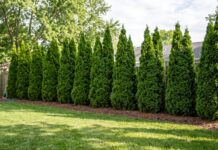











Emerald Green arborvitae is one of those plants that looks almost too perfect at the nursery: narrow, dense, evergreen, deep green, and seemingly made for turning an exposed backyard into a private space.
The trouble usually starts after planting.
Homeowners space them too close because they want instant privacy, plant them too deep, water the surrounding soil while the original root ball stays dry, assume every brown branch means disease, or expect a slow-to-moderate grower to create a solid 12-foot wall in two summers.
Emerald Green arborvitae can make an excellent privacy screen, but it works best when you plan around its real mature size, realistic growth rate, root establishment, deer pressure, winter exposure, and long-term spacing.
It is especially useful where a Green Giant arborvitae would eventually become far too large.

Botanical name: Thuja occidentalis ‘Smaragd’, commonly sold in the United States as Emerald Green arborvitae or Emerald arborvitae.
Mature size: commonly about 10–15 feet tall and 3–4 feet wide when allowed to grow naturally.
Growth rate: plan around roughly 6–12 inches of annual growth in many landscapes after establishment. Strong young plants in excellent conditions can grow faster, but Emerald Green is not the arborvitae to choose when maximum speed is the priority.
Privacy spacing: about 3–4 feet center-to-center is a useful long-term range for many single-row screens. Planting around 2.5–3 feet apart closes faster but creates more competition later.
Light: full sun is best for dense growth, though it can tolerate some partial sun.
Soil: moist but well-drained soil is ideal. Constantly soggy soil and severe drought stress can both cause decline.
Biggest weakness: deer browsing can be severe. Winter burn, drought stress, poor drainage, salt exposure, and bagworms are also common problems.
Best use: a narrow evergreen privacy screen where you need approximately 10–15 feet of height without the enormous mature width of Green Giant arborvitae.
Emerald Green is an excellent arborvitae when your yard needs a narrow, controlled evergreen screen.
It is a less convincing choice if you need 20 feet of privacy quickly, have severe deer pressure, regularly salted roadside soil, standing water, or enough room for a much larger and faster privacy tree.
Choose it because its mature proportions fit your yard — not because the small nursery plants happen to fit in your car.
What Is Emerald Green Arborvitae?
Emerald Green arborvitae is a narrow cultivar of American arborvitae, Thuja occidentalis.
You may also see it labeled Emerald arborvitae, Emerald Green Thuja, or Thuja occidentalis ‘Smaragd’.
“Smaragd” is the cultivar name. Emerald Green is the name most U.S. homeowners recognize.
Unlike the much larger straight species of American arborvitae, Emerald Green was selected for a compact, narrow pyramidal form. That makes it useful in suburban yards where a massive evergreen would eventually overwhelm the available space.
Common landscape uses include:
- Privacy screens
- Property-line plantings
- Narrow evergreen hedges
- Patio screening
- Pool-area screening where permitted and appropriate
- Foundation accents with adequate clearance
- Pairs beside entrances or gates
- Evergreen backdrops for flowering shrubs and perennials
- Winter structure in mixed borders
Its biggest advantage is simple: it gets tall enough to create useful privacy without getting nearly as wide as many fast-growing screening trees.
Emerald Green Arborvitae Size: How Big Does It Really Get?
A realistic mature size for Emerald Green arborvitae is approximately 10–15 feet tall and 3–4 feet wide.
That narrow footprint is one of the main reasons the cultivar remains popular.
But mature-size labels should never be treated like a precision measurement. Climate, soil, sunlight, moisture, plant genetics, pruning, competition, winter damage, and age all influence the final plant.
Mature Height
Typical expectation: about 10–15 feet. Do not plant it under low utility lines or where a 12–15-foot evergreen will eventually block windows or views you want to keep.
Mature Width
Typical expectation: about 3–4 feet. Allow roughly 1.5–2 feet of canopy growth outward from the centerline, plus maintenance clearance.
Shape
Emerald Green naturally grows in a narrow pyramidal to columnar form and usually needs less width-control pruning than larger arborvitae.
How Tall Do Emerald Green Arborvitae Get?
Most homeowners should design around approximately 10–15 feet of eventual height.
That means a mature row can block many first-story windows, standard backyard fences, neighboring patios, parked vehicles, street-level sightlines, and utility areas.
It may not be tall enough if you need to block a second-story view or hide a substantially taller structure.
How Wide Do Emerald Green Arborvitae Get?
Expect approximately 3–4 feet of mature spread under normal landscape conditions.
This is where people make an expensive mistake. A 24-inch-wide plant at the garden center does not stay 24 inches wide.
If you plant the trunk 12 inches from a fence, wall, walkway, or driveway, much of the mature canopy has nowhere to go.
Plan from the mature centerline, not from the nursery pot.
Emerald Green Arborvitae Growth Rate: The Realistic Answer
Search for Emerald Green arborvitae growth rate and you will find surprisingly different numbers.
Some nursery listings advertise one to two feet of growth per year. Other horticultural sources classify Emerald Green as slow-growing and report annual growth closer to several inches.
Both can describe individual plants under different conditions.
For homeowner planning, a safer expectation is approximately 6–12 inches of annual height growth once the plant is established, with faster growth possible when young plants have excellent sun, moisture, soil, root development, and a long growing season.
Do not design an expensive privacy project around the most aggressive growth number on a sales page.
Buying a taller Emerald Green does not mean it will immediately grow fast after planting. Large nursery plants often spend their first season rebuilding and expanding roots.
The first year may look disappointingly quiet above ground. That does not automatically mean the plant is failing.
What Makes Emerald Green Arborvitae Grow Faster?
- Full sun or strong partial sun
- Consistent moisture without saturated soil
- Correct planting depth
- A healthy root ball
- Mulch over the root zone
- Little competition from turf
- Adequate spacing between plants
- Protection from repeated deer browsing
- Protection from severe drought during establishment
What Slows Growth Down?
- Planting too deep
- Dry root balls
- Waterlogged clay
- Heavy shade
- Root competition
- Planting too close together
- Deer damage
- Winter burn
- Salt exposure
- Bagworm defoliation
- Severe pruning
- Poor-quality nursery stock
Emerald Green Arborvitae Growth Timeline
Year 1: Establishment
Root recovery and root expansion matter more than dramatic top growth. Consistent watering is more important than fertilizer.
Years 2–3: Visible Growth
Healthy trees usually begin adding more noticeable height and width. Gaps between properly spaced plants start looking smaller.
Years 4–6: Screen Development
A well-spaced row can begin reading as one continuous evergreen screen, especially when larger plants were installed initially.
Years 7 and Beyond: Mature Structure
Height and width continue developing, but the planting increasingly behaves like a mature hedge. Plants spaced too tightly may now show crowding, interior thinning, or uneven growth.
Important: this is a planning framework, not a growth guarantee. Starting plant size, climate, soil, irrigation, sunlight, and establishment can shift the timeline substantially.
Emerald Green Arborvitae Spacing for Privacy
Emerald Green arborvitae spacing is probably the most important decision you will make before planting.
Too far apart and you wait longer for privacy. Too close and the hedge may look fantastic for the first few years but become crowded as every plant approaches mature width.
A useful single-row range is approximately 3–4 feet center-to-center for many residential screens.
2.5 Feet Apart
Best for: very fast visual closure. Expect a dense early screen but more long-term competition and crowding.
3 Feet Apart
Best for: a dense privacy hedge where quicker closure matters.
3.5 Feet Apart
Best for: a strong balance between privacy speed and long-term mature width.
4 Feet Apart
Best for: a long-term natural screen with more room for each plant to develop.
Spacing mistake to avoid: do not move mature-size plants closer together simply because the small nursery trees look lonely. A hedge is a long-term planting. Design around what each plant becomes.
How Far Apart Should You Plant Emerald Green Arborvitae?
For most residential privacy rows, 3 to 4 feet apart measured center-to-center is the useful planning range.
- Choose about 3 feet when privacy speed matters more and you accept a denser mature hedge.
- Choose about 3.5 feet for a strong balance of closure and long-term room.
- Choose about 4 feet when you can wait longer and want each tree to retain more natural space.
A row planted at 4-foot centers can still develop into a continuous Emerald Green screen. Moving every plant closer is not automatically better.
How Many Emerald Green Arborvitae Do I Need?
Measure the total planting length first, then divide the distance by your intended center-to-center spacing.
20-foot hedge: about 7 plants at 3-foot spacing, 6 at 3.5-foot spacing, or 5 at 4-foot spacing.
30-foot hedge: about 10 plants at 3-foot spacing, 9 at 3.5-foot spacing, or 8 at 4-foot spacing.
50-foot hedge: about 17 plants at 3-foot spacing, 15 at 3.5-foot spacing, or 13 at 4-foot spacing.
100-foot hedge: about 34 plants at 3-foot spacing, 29 at 3.5-foot spacing, or 25 at 4-foot spacing.
These are planning estimates. Final plant count depends on where the first and last trunks are positioned, gates, corners, utilities, property boundaries, and whether you leave extra clearance at each end.
50-Foot Privacy Screen Example
Suppose you want to screen a 50-foot property line.
At 3-foot centers, you need roughly 17 Emerald Greens. At 3.5-foot centers, roughly 15. At 4-foot centers, roughly 13.
That two-to-four-tree difference matters when you are buying large nursery stock, digging every hole, installing irrigation, mulching, and maintaining the planting for years.
How Far Should Emerald Green Arborvitae Be From a Fence?
Because Emerald Green arborvitae commonly matures about 3–4 feet wide, its foliage can eventually extend roughly 1.5–2 feet outward from the trunk center.
For most fences, planting the trunk approximately 2.5–3 feet from the fence gives a much more comfortable maintenance zone than squeezing the plant directly against it.
That extra room helps with air movement, fence maintenance, mulching, watering, pruning, pest inspection, snow accumulation, and keeping branches from being permanently compressed against the fence.
Can I Plant Emerald Green Arborvitae 2 Feet From a Fence?
You can physically fit a narrow Emerald Green near a fence, but 2 feet from the trunk center leaves little extra room once a 4-foot-wide plant matures.
Where space allows, a little more setback makes maintenance easier.
How Far From a House or Foundation?
Emerald Green is much easier to use near a house than a massive Green Giant, but that does not make it a tiny foundation shrub.
As a practical starting point, allow the trunk center roughly 3 feet or more from the wall where possible, and increase clearance when you need access to windows, siding, utility meters, HVAC equipment, gutters, walkways, or foundation drainage.
If your main goal is landscaping directly below windows, Emerald Green may simply be too tall.
For shorter alternatives, see our foundation hedges article.
How Far From a Driveway or Sidewalk?
Remember both mature width and winter maintenance.
An Emerald Green planted too close to pavement can grow into a walkway, interfere with vehicle doors, be buried by plowed snow, receive de-icing salt spray, dry out from reflected heat, or be damaged by shovels and snowblowers.
In cold climates where road salt is common, extra setback is useful.
Best Place to Plant Emerald Green Arborvitae
Sunlight
Emerald Green arborvitae performs best in full sun to strong partial sun.
More sun usually encourages denser growth. Too much shade can produce thinner foliage, slower growth, and a less convincing privacy screen.
Soil
The sweet spot is moist, reasonably fertile, well-drained soil.
Emerald Green does not want to alternate constantly between bone-dry roots and standing water.
Heavy clay is not automatically a deal-breaker, but drainage matters.
Wind
Cold winter wind can pull moisture from evergreen foliage while frozen soil limits the plant’s ability to replace it.
Newly planted arborvitae are especially vulnerable because their roots have not expanded far beyond the original root ball.
Road Salt
Avoid locations that receive regular salt spray or salty plowed snow when possible.
How to Plant Emerald Green Arborvitae
Step 1: Mark the Entire Hedge Before Digging
Use stakes, string, marking paint, or a garden hose. Measure every center point before digging.
Step back and look at the row from the house, patio, street, driveway, and neighbor-facing side before making the layout permanent.
Step 2: Find the Root Flare
Do not assume the top of the nursery soil is automatically the correct planting depth.
The point where the trunk begins widening into the root system should end up approximately at grade level or slightly above it.
Step 3: Dig Wide, Not Deep
A planting hole roughly twice the width of the root ball gives roots loosened soil to expand into.
The hole should not be substantially deeper than the root ball.
Step 4: Inspect Container Roots
Container-grown arborvitae may have circling or densely matted roots. Loosen obvious circling roots carefully rather than dropping a pot-shaped root mass into the ground untouched.
Step 5: Position the Tree Straight
Before backfilling, check the plant from several directions. A slightly leaning tree becomes much more obvious when fifteen straight trees stand beside it.
Step 6: Backfill With the Existing Soil
Use the excavated native soil unless a site-specific soil test or drainage correction tells you otherwise.
Step 7: Water Thoroughly
Slowly saturate the root ball and surrounding backfill after planting.
Step 8: Add Mulch
Apply approximately 2–3 inches of organic mulch over the root area and keep it away from the trunk.
No mulch volcano: piling mulch against arborvitae trunks holds moisture against the bark and can contribute to long-term problems. Think wide mulch ring, not mulch mountain.
When Is the Best Time to Plant Emerald Green Arborvitae?
Spring and early fall are usually the easiest planting windows because temperatures are moderate and the plant can establish roots without immediate summer heat stress.
Container-grown plants can be installed at other times when soil can be worked, but planting during hot, dry weather demands much more careful irrigation.
Emerald Green Arborvitae Watering Schedule
Watering is where many otherwise good arborvitae plantings fail.
The original root ball can become dry even when nearby soil looks damp. At the same time, heavy clay can stay saturated long after the surface looks dry.
Water according to root-zone moisture plus weather, not a rigid calendar forever.
First 1–2 Weeks
Check moisture very frequently. Newly planted stock may need daily watering during warm, dry, or windy conditions when rainfall is insufficient.
Weeks 3–12
Water deeply as needed, often every few days depending on rainfall, soil, heat, wind, and plant size. Check the root zone before automatically adding water.
After Establishment Begins
Deep weekly watering may be appropriate while roots continue spreading, adjusted for rainfall and soil moisture.
Established Plants
Established Emerald Greens need less frequent irrigation, but extended hot, dry periods can still cause stress. Deep watering is better than repeated shallow sprinkling.
How Do I Know If My Arborvitae Needs Water?
Push a finger or narrow trowel into the soil near the root zone rather than judging by the surface alone.
You want moisture, not swamp conditions.
Soil Moisture Meter
A basic soil moisture meter can help compare moisture around individual root balls in a long hedge. Treat it as another clue, not as a replacement for physically checking the soil.
Soaker Hose or Drip Irrigation
A long row is easier to water consistently with slow irrigation than by standing over every tree with a hose. Check output at several points so the last tree receives as much attention as the first.
Should You Fertilize Emerald Green Arborvitae?
Do not automatically fertilize a stressed newly planted arborvitae because you want it to grow faster.
Transplant stress is usually a root, moisture, planting-depth, weather, or site problem before it is a fertilizer problem.
Established plants growing normally in reasonable soil may need little supplemental fertilizer.
A soil test is more useful than guessing.
How to Prune Emerald Green Arborvitae
Emerald Green naturally develops a tidy narrow form, so it normally needs less pruning than many hedge plants.
Good reasons to prune include removing dead branches, correcting storm damage, lightly shaping a privacy screen, keeping foliage clear of a walkway, or maintaining a desired height before the plant greatly exceeds it.
Can You Top Emerald Green Arborvitae?
You can reduce height, but severe topping is rarely the best-looking solution.
Cutting deeply into a mature plant may expose bare interior stems and create an unnatural flat top.
Will Arborvitae Grow Back From Bare Wood?
Do not count on old bare interior wood filling rapidly or evenly.
Light trimming of green outer growth is much safer aesthetically than carving deep holes into the hedge.
Bypass Pruning Shears
Sharp bypass pruners are useful for dead tips, small branches, light shaping, and removing individual damaged shoots without shearing the entire plant.
Why Is My Emerald Green Arborvitae Turning Brown?
Brown foliage is a symptom, not a diagnosis.
An Emerald Green arborvitae can turn brown because of drought, transplant shock, waterlogged roots, winter burn, road salt, bagworms, spider mites, twig disease, root problems, physical damage, or normal interior foliage shedding.
Before spraying, fertilizing, or removing the plant, look at where the browning starts, which side of the tree is affected, when it appeared, and what happened before it started.
Brown Tips After Winter
Possible cause: winter burn. Check wind exposure, winter sun, dry fall conditions, and reflected sunlight.
Browning Toward the Road or Driveway
Possible cause: de-icing salt. Check for salt spray, salted runoff, and salty plowed snow.
Whole Plant Declines After Planting
Possible cause: root-zone trouble. Check for a dry root ball, excessive planting depth, circling roots, or waterlogged soil.
Small Brown Bags Hanging From Branches
Possible cause: bagworms. Inspect the entire canopy closely.
Older Interior Foliage Browns but Tips Stay Green
Possible cause: normal seasonal foliage shedding rather than whole-plant decline.
Emerald Green Arborvitae Winter Burn
Winter burn is one of the most common reasons an arborvitae looks frightening in early spring.
Evergreen foliage continues losing moisture during winter. When the ground is frozen, roots may not be able to replace that moisture quickly enough.
Cold wind and bright winter sun make the problem worse.
How to Reduce Winter Burn
- Keep young arborvitae properly watered during dry weather before the ground freezes.
- Maintain a proper mulch layer over the root zone.
- Avoid late-season practices that create excessive tender growth.
- Use a temporary wind barrier in extremely exposed locations.
- Do not pile de-icing salt or salty snow around the root zone.
Do not immediately cut every brown tip in late winter. Wait until active spring growth shows clearly which tissue is alive and which is dead.
Is My Emerald Green Arborvitae Dead?
A completely brown arborvitae with dry, brittle branches and no living tissue may be beyond recovery.
A plant with isolated browned areas can still survive.
One simple check is to lightly scratch a tiny section of bark on a questionable branch. Living tissue beneath the bark is generally moist and greenish rather than dry and brown.
Bagworms on Emerald Green Arborvitae
Bagworms deserve attention because arborvitae are one of their favorite hosts.
The bags resemble small brown cones or pieces of plant debris hanging from branches. Their camouflage allows a growing infestation to go unnoticed until substantial foliage has disappeared.
Heavy infestations can permanently damage or kill evergreen plants.
What to Do About Bagworms
- Inspect arborvitae closely rather than viewing the hedge only from a distance.
- Hand-remove accessible bags when practical.
- Dispose of removed bags rather than dropping them beneath the tree.
- Treatment timing matters because young larvae are easier to manage than mature larvae protected inside larger bags.
- For severe infestations or uncertain pesticide timing, contact a local Extension office or qualified landscape professional.
Long arborvitae rows get expensive quickly. A landscaper can help with layout, grading, soil preparation, irrigation, delivery, planting depth, and spacing before dozens of plants are in the wrong location.
Do Deer Eat Emerald Green Arborvitae?
Yes. If deer regularly enter your yard, this is one of the most important facts to know before buying Emerald Green arborvitae.
American arborvitae can be heavily browsed.
A familiar result is a privacy screen with dense green tops and stripped lower sections at deer height.
How to Protect Young Emerald Green Arborvitae From Deer
- Temporary deer fencing
- Individual protective cages
- Seasonal netting installed so animals cannot become entangled
- Properly applied deer repellents as supplemental protection
Repellents can help, but heavy deer pressure can overwhelm scent and taste deterrents.
Deer Protection for Young Arborvitae
Young Emerald Greens can lose years of privacy growth in a winter of repeated browsing. Physical protection is especially useful while the screen is still short enough for deer to reach much of the canopy.
Emerald Green Arborvitae vs Green Giant
The key difference: Green Giant is not simply a faster Emerald Green. It is a fundamentally larger landscape tree.
Emerald Green Arborvitae
- About 10–15 feet tall
- About 3–4 feet wide
- Slow-to-moderate growth
- Excellent for narrow suburban lots
- Good for controlled medium-height privacy
Green Giant Arborvitae
- Can become roughly 50–60 feet tall
- Becomes substantially wider
- Fast growth
- Better suited to large properties
- Useful for tall screens and windbreaks
Do not trade a few years of waiting for decades of pruning a tree that never belonged in the available space.
Emerald Green vs Mission Arborvitae
Mission arborvitae, also commonly sold as Techny arborvitae, is another cold-hardy privacy option.
Emerald Green is generally the better choice when a narrow footprint is the priority. Mission Arborvitae develops a broader, heavier screen and is useful where additional width is not a problem.
See our complete Mission Arborvitae care and hedge guide.
Emerald Green Arborvitae vs Viburnum Hedge
Not every privacy screen needs to be a straight row of conifers.
Emerald Green is stronger when you want narrow evergreen structure, a formal repeated shape, year-round screening, and cold-climate evergreen performance.
Viburnum can be more interesting when you want flowers, berries on suitable varieties, seasonal change, or a softer mixed-border look.
See our viburnum hedge guide for spacing, privacy varieties, planting, and pruning options.
Pros and Cons of Emerald Green Arborvitae
Advantages
- Narrow mature width
- Useful 10–15 ft. privacy height
- Evergreen foliage
- Dense pyramidal form
- Good fit for suburban yards
- Less pruning than huge screening trees
- Strong formal appearance
- Cold-hardy compared with many broadleaf screens
Disadvantages
- Not especially fast
- Deer can browse it heavily
- Can develop winter burn
- Sensitive to poor establishment
- Does not like prolonged drought
- Does not like chronically saturated roots
- Bagworms can cause serious damage
- Too short for some second-story privacy needs
Should You Fertilize Emerald Green Arborvitae?
Do not automatically fertilize a stressed newly planted arborvitae because you want it to grow faster.
Transplant stress is usually a root, moisture, planting-depth, weather, or site problem before it is a fertilizer problem.
Established plants growing normally in reasonable soil may need little supplemental fertilizer.
A soil test is more useful than guessing.
How to Prune Emerald Green Arborvitae
Emerald Green naturally develops a tidy narrow form, so it normally needs less pruning than many hedge plants.
Good reasons to prune include removing dead branches, correcting storm damage, lightly shaping a privacy screen, keeping foliage clear of a walkway, or maintaining a desired height before the plant greatly exceeds it.
Can You Top Emerald Green Arborvitae?
You can reduce height, but severe topping is rarely the best-looking solution.
Cutting deeply into a mature plant may expose bare interior stems and create an unnatural flat top.
Will Arborvitae Grow Back From Bare Wood?
Do not count on old bare interior wood filling rapidly or evenly.
Light trimming of green outer growth is much safer aesthetically than carving deep holes into the hedge.
Bypass Pruning Shears
Sharp bypass pruners are useful for dead tips, small branches, light shaping, and removing individual damaged shoots without shearing the entire plant.
Why Is My Emerald Green Arborvitae Turning Brown?
Brown foliage is a symptom, not a diagnosis.
An Emerald Green arborvitae can turn brown because of drought, transplant shock, waterlogged roots, winter burn, road salt, bagworms, spider mites, twig disease, root problems, physical damage, or normal interior foliage shedding.
Before spraying, fertilizing, or removing the plant, look at where the browning starts, which side of the tree is affected, when it appeared, and what happened before it started.
Brown Tips After Winter
Possible cause: winter burn. Check wind exposure, winter sun, dry fall conditions, and reflected sunlight.
Browning Toward the Road or Driveway
Possible cause: de-icing salt. Check for salt spray, salted runoff, and salty plowed snow.
Whole Plant Declines After Planting
Possible cause: root-zone trouble. Check for a dry root ball, excessive planting depth, circling roots, or waterlogged soil.
Small Brown Bags Hanging From Branches
Possible cause: bagworms. Inspect the entire canopy closely.
Older Interior Foliage Browns but Tips Stay Green
Possible cause: normal seasonal foliage shedding rather than whole-plant decline.
Emerald Green Arborvitae Winter Burn
Winter burn is one of the most common reasons an arborvitae looks frightening in early spring.
Evergreen foliage continues losing moisture during winter. When the ground is frozen, roots may not be able to replace that moisture quickly enough.
Cold wind and bright winter sun make the problem worse.
How to Reduce Winter Burn
- Keep young arborvitae properly watered during dry weather before the ground freezes.
- Maintain a proper mulch layer over the root zone.
- Avoid late-season practices that create excessive tender growth.
- Use a temporary wind barrier in extremely exposed locations.
- Do not pile de-icing salt or salty snow around the root zone.
Do not immediately cut every brown tip in late winter. Wait until active spring growth shows clearly which tissue is alive and which is dead.
Is My Emerald Green Arborvitae Dead?
A completely brown arborvitae with dry, brittle branches and no living tissue may be beyond recovery.
A plant with isolated browned areas can still survive.
One simple check is to lightly scratch a tiny section of bark on a questionable branch. Living tissue beneath the bark is generally moist and greenish rather than dry and brown.
Bagworms on Emerald Green Arborvitae
Bagworms deserve attention because arborvitae are one of their favorite hosts.
The bags resemble small brown cones or pieces of plant debris hanging from branches. Their camouflage allows a growing infestation to go unnoticed until substantial foliage has disappeared.
Heavy infestations can permanently damage or kill evergreen plants.
What to Do About Bagworms
- Inspect arborvitae closely rather than viewing the hedge only from a distance.
- Hand-remove accessible bags when practical.
- Dispose of removed bags rather than dropping them beneath the tree.
- Treatment timing matters because young larvae are easier to manage than mature larvae protected inside larger bags.
- For severe infestations or uncertain pesticide timing, contact a local Extension office or qualified landscape professional.
Long arborvitae rows get expensive quickly. A landscaper can help with layout, grading, soil preparation, irrigation, delivery, planting depth, and spacing before dozens of plants are in the wrong location.
Do Deer Eat Emerald Green Arborvitae?
Yes. If deer regularly enter your yard, this is one of the most important facts to know before buying Emerald Green arborvitae.
American arborvitae can be heavily browsed.
A familiar result is a privacy screen with dense green tops and stripped lower sections at deer height.
How to Protect Young Emerald Green Arborvitae From Deer
- Temporary deer fencing
- Individual protective cages
- Seasonal netting installed so animals cannot become entangled
- Properly applied deer repellents as supplemental protection
Repellents can help, but heavy deer pressure can overwhelm scent and taste deterrents.
Deer Protection for Young Arborvitae
Young Emerald Greens can lose years of privacy growth in a winter of repeated browsing. Physical protection is especially useful while the screen is still short enough for deer to reach much of the canopy.
Emerald Green Arborvitae vs Green Giant
The key difference: Green Giant is not simply a faster Emerald Green. It is a fundamentally larger landscape tree.
Emerald Green Arborvitae
- About 10–15 feet tall
- About 3–4 feet wide
- Slow-to-moderate growth
- Excellent for narrow suburban lots
- Good for controlled medium-height privacy
Green Giant Arborvitae
- Can become roughly 50–60 feet tall
- Becomes substantially wider
- Fast growth
- Better suited to large properties
- Useful for tall screens and windbreaks
Do not trade a few years of waiting for decades of pruning a tree that never belonged in the available space.
Emerald Green vs Mission Arborvitae
Mission arborvitae, also commonly sold as Techny arborvitae, is another cold-hardy privacy option.
Emerald Green is generally the better choice when a narrow footprint is the priority. Mission Arborvitae develops a broader, heavier screen and is useful where additional width is not a problem.
See our complete Mission Arborvitae care and hedge guide.
Emerald Green Arborvitae vs Viburnum Hedge
Not every privacy screen needs to be a straight row of conifers.
Emerald Green is stronger when you want narrow evergreen structure, a formal repeated shape, year-round screening, and cold-climate evergreen performance.
Viburnum can be more interesting when you want flowers, berries on suitable varieties, seasonal change, or a softer mixed-border look.
See our viburnum hedge guide for spacing, privacy varieties, planting, and pruning options.
Pros and Cons of Emerald Green Arborvitae
Advantages
- Narrow mature width
- Useful 10–15 ft. privacy height
- Evergreen foliage
- Dense pyramidal form
- Good fit for suburban yards
- Less pruning than huge screening trees
- Strong formal appearance
- Cold-hardy compared with many broadleaf screens
Disadvantages
- Not especially fast
- Deer can browse it heavily
- Can develop winter burn
- Sensitive to poor establishment
- Does not like prolonged drought
- Does not like chronically saturated roots
- Bagworms can cause serious damage
- Too short for some second-story privacy needs
When Emerald Green Arborvitae Is the Wrong Choice
Emerald Green is popular enough that people sometimes use it automatically.
That is a mistake.
Consider another plant when:
- You need 20–30 feet of screening quickly.
- Deer regularly browse your yard every winter.
- The planting area stays waterlogged.
- The site receives heavy road-salt spray.
- You need a privacy plant for deep shade.
- You only have one foot of bed width.
- You need a shrub under a low window.
- You want flowers, fruit, or major seasonal color.
- You cannot provide supplemental water during establishment.
Sometimes the most useful plant advice is knowing when not to buy the plant.
10 Emerald Green Arborvitae Mistakes to Avoid
Mistake 1: Planting Too Close Together
Tighter spacing produces quicker privacy, but planting every tree as close as physically possible can create long-term crowding and thinning.
Mistake 2: Planting Too Deep
The trunk flare should not disappear several inches below soil and mulch.
Mistake 3: Watering the Yard but Missing the Root Ball
During establishment, the original root mass can dry while surrounding soil appears adequately moist.
Mistake 4: Keeping Heavy Clay Constantly Wet
More water is not always better. Saturated soil can deprive roots of oxygen and produce decline that looks confusingly similar to drought stress.
Mistake 5: Fertilizing Transplant Shock
A stressed new root system usually needs correct moisture and time more than a blast of fertilizer.
Mistake 6: Ignoring Deer Until Winter
A few nights of heavy browsing can remove years of lower privacy growth.
Mistake 7: Assuming Every Brown Tip Is Disease
Winter burn, salt, drought, excess moisture, and transplant problems are often more useful starting points than immediately reaching for a fungicide.
Mistake 8: Missing Bagworms
Their bags blend into arborvitae foliage. By the time the hedge looks obviously thin, substantial feeding may already have occurred.
Mistake 9: Topping an Oversized Hedge
If you need to remove several feet every year just to make the planting fit, the plant was probably wrong for the site from the beginning.
Mistake 10: Choosing Emerald Green When You Really Need Green Giant
Emerald Green is about controlled size. If the property can accommodate a huge screen and you need rapid height, a faster larger tree may make more sense.
How to Choose Healthy Emerald Green Arborvitae at the Nursery
The cheapest plant is expensive if it dies six weeks later.
Before buying, inspect each tree individually.
- Dense green foliage
- Healthy growth around the entire plant
- No obvious bagworm cases
- No large dead sections
- No badly split central leaders
- A root ball that is moist but not foul or waterlogged
- No major trunk damage
- No severe leaning
- Similar height and width when buying a formal row
Should You Buy Small or Large Emerald Green Arborvitae?
Advantages of Smaller Plants
- Lower purchase price
- Easier transportation
- Easier planting
- Often easier establishment
- Less weight and equipment required
Advantages of Larger Plants
- More immediate screening
- Greater starting height
- Stronger visual impact immediately after installation
The best value is often not the tallest plant you can afford. It is the healthiest plant size you can plant correctly, water reliably, and protect while it establishes.
Can Emerald Green Arborvitae Grow in Shade?
It can tolerate partial sun, but a privacy hedge grown in too much shade may become thinner and slower.
If the goal is a dense living wall, sunlight matters.
Do Emerald Green Arborvitae Have Invasive Roots?
Emerald Green arborvitae are not generally planted with the same foundation concerns associated with large aggressive-rooted shade trees.
The more immediate issue around structures is canopy clearance, moisture, access, and giving the root zone enough uncompacted soil.
Do not interpret “non-aggressive roots” as permission to plant the trunk directly against a foundation, retaining wall, drainage system, or utility.
Can You Plant Emerald Green Arborvitae in a Double Row?
Yes, a staggered double row can create a deeper screen, but it requires substantially more width.
For most narrow suburban lots, one correctly spaced row is usually enough.
Can You Keep Emerald Green Arborvitae at 6 Feet?
It is possible to maintain an arborvitae below its natural mature height with regular pruning, but that creates permanent maintenance.
If you want a 5–6-foot hedge forever, a naturally smaller evergreen may be easier.
Are Emerald Green Arborvitae Good for Privacy?
Yes — within the right height range.
They are especially good when you need evergreen coverage, a relatively narrow screen, 10–15 feet of eventual height, a clean formal look, and cold-climate performance.
They are less ideal when you need instant privacy or substantial second-story screening.
Final Verdict: Is Emerald Green Arborvitae Worth Planting?
For the right yard, absolutely.
Emerald Green arborvitae remains popular because very few evergreens combine a narrow 3–4-foot footprint with roughly 10–15 feet of height and dense year-round foliage.
That makes it unusually useful along suburban property lines, patios, fences, and backyards where Green Giant and other massive privacy trees simply become too large.
The key is patience and planning.
Space the plants for their mature width. Do not bury the root flare. Keep the root ball consistently moist during establishment without turning the planting hole into a swamp. Protect young plants from deer. Watch for bagworms. Expect some winter stress in exposed locations.
Most importantly, choose Emerald Green because its final size matches your yard — not because a nursery label promises instant privacy.
Emerald Green Arborvitae FAQ
How fast do Emerald Green arborvitae grow?
A realistic planning range is roughly 6–12 inches per year after establishment in many landscapes. Healthy young plants under excellent conditions may grow faster, while newly planted or stressed trees may grow much less.
How tall do Emerald Green arborvitae get?
Emerald Green arborvitae commonly mature around 10–15 feet tall.
How wide do Emerald Green arborvitae get?
A mature Emerald Green is commonly about 3–4 feet wide.
How far apart should Emerald Green arborvitae be planted?
About 3–4 feet center-to-center works well for many residential privacy screens. Spacing around 3 feet closes more quickly, while 4 feet gives each tree more individual room.
Can I plant Emerald Green arborvitae 2 feet apart?
You can, but 2-foot spacing is tighter than the mature width of the plants justifies for most long-term single-row hedges. The row may close quickly but can become unnecessarily crowded later.
Is 4 feet too far apart for Emerald Green arborvitae?
No. Four-foot center spacing can develop into a continuous privacy screen as the trees mature, although the gaps take longer to close than with tighter spacing.
How many Emerald Green arborvitae do I need for 50 feet?
Approximately 17 plants at 3-foot spacing, 15 at 3.5-foot spacing, or 13 at 4-foot spacing. Exact count depends on how you position the first and last plants.
How many Emerald Green arborvitae do I need for 100 feet?
Approximately 34 at 3-foot spacing, 29 at 3.5-foot spacing, or 25 at 4-foot spacing, adjusted for the final layout.
How close can Emerald Green arborvitae be planted to a fence?
Because mature plants can reach approximately 3–4 feet wide, allowing roughly 2.5–3 feet from the trunk center to a fence gives more practical clearance for mature foliage and maintenance.
How close can Emerald Green arborvitae be planted to a house?
Allow enough room for approximately 3–4 feet of mature plant width plus maintenance access. Around 3 feet or more from the wall is a useful starting point in many landscapes.
Do Emerald Green arborvitae need full sun?
They grow densest in full sun but can tolerate some partial sun. Heavy shade can reduce density and growth rate.
How often should newly planted Emerald Green arborvitae be watered?
Newly planted trees need frequent moisture checks. During early establishment they may require water daily or every few days depending on heat, wind, rainfall, soil, and plant size.
Can you overwater Emerald Green arborvitae?
Yes. Constantly saturated soil reduces oxygen around the roots and can cause decline, especially in heavy clay or poorly drained planting sites.
Why is my Emerald Green arborvitae turning brown?
Common causes include drought, winter burn, salt exposure, transplant stress, saturated roots, bagworms, spider mites, twig disease, and physical damage.
Will a brown Emerald Green arborvitae come back?
It depends on whether the branch tissue is still alive and what caused the damage. Partially damaged plants can recover, but completely dry dead branches will not turn green again.
Why did my Emerald Green arborvitae turn brown after winter?
Winter burn is common. Bright winter sun, cold wind, dry soil, and frozen ground can cause evergreen foliage to lose more moisture than the roots can replace.
Do deer eat Emerald Green arborvitae?
Yes. Deer can browse Emerald Green arborvitae heavily, particularly in winter. Physical protection is useful in areas with regular deer pressure.
Are Emerald Green arborvitae deer resistant?
No. They should not be considered reliably deer resistant.
What are the little brown bags hanging from my arborvitae?
They may be bagworms. Bagworms feed on arborvitae foliage and severe infestations can cause permanent damage or kill evergreen plants.
Does Emerald Green arborvitae need fertilizer?
Not automatically. Healthy plants in suitable soil may need little supplemental fertilizer. Soil testing and correcting watering or planting problems are more useful than fertilizing a stressed new tree blindly.
Can Emerald Green arborvitae be topped?
They can be height-pruned, but severe topping can leave an unattractive flat or bare appearance. It is easier to begin light height control before plants become dramatically oversized.
Can Emerald Green arborvitae grow back after deer damage?
Lightly browsed green growth may recover, but severe browsing that exposes old bare stems can leave permanent thin areas.
What is the difference between Emerald Green and Green Giant arborvitae?
Emerald Green is a narrow, slower-growing arborvitae that commonly reaches about 10–15 feet tall and 3–4 feet wide. Green Giant grows much faster and can become roughly 50–60 feet tall, so it requires considerably more space.
Is Smaragd the same as Emerald Green arborvitae?
Yes. Emerald Green arborvitae is commonly sold under the cultivar name Thuja occidentalis ‘Smaragd’.
How long does it take Emerald Green arborvitae to create privacy?
It depends on starting size and spacing. A row of larger plants on 3–4-foot centers may begin knitting together within several growing seasons, while small plants naturally take longer.
What is the best spacing for an Emerald Green privacy hedge?
For many homeowners, approximately 3.5 feet center-to-center is an excellent compromise between relatively quick closure and giving mature plants reasonable space.
Do Emerald Green arborvitae have invasive roots?
They are not generally considered aggressive-rooted landscape trees, but they still need adequate soil volume and sensible clearance from structures, utilities, and hardscape.
Can Emerald Green arborvitae grow in clay soil?
They can grow in clay if drainage is adequate. Constantly saturated compacted clay creates a much more serious problem than clay texture by itself.
Can Emerald Green arborvitae grow in pots?
Young plants can be grown temporarily in large containers, but a cultivar that eventually reaches approximately 10–15 feet is usually better suited to the ground for long-term growth.
What should I plant instead of Emerald Green arborvitae?
Green Giant arborvitae can work where much greater height and width are acceptable. Mission or Techny arborvitae can provide a broader cold-hardy screen. Viburnum and other shrubs may be better where you want flowers, berries, a mixed hedge, or a less formal appearance.
Join Garden Frontier for practical gardening, privacy hedge, landscaping, plant care, pest control, home improvement, tools, and seasonal homeowner advice.
100% free. No spam. Unsubscribe anytime.