


















When people search for fix compressor air conditioner, they usually have one urgent problem: the AC is running, but the house is not cooling. Sometimes the outdoor unit hums. Sometimes the fan spins, but cold air never comes. Sometimes the breaker trips. And occasionally the whole outside unit sits silent while the indoor blower keeps pushing warm air through the vents.
The compressor is one of the most important parts of a central air conditioner. It pressurizes refrigerant and helps move heat out of your home. But here is the good news: not every “bad compressor” is actually a failed compressor. Many AC compressor symptoms are caused by smaller parts, such as a bad capacitor, a failed contactor, a tripped breaker, a dirty condenser coil, a clogged air filter, a thermostat issue, or a refrigerant problem.
This article explains what you can safely check yourself, what usually requires a licensed HVAC technician, how much AC compressor repair may cost, and when replacing the whole air conditioner may make more sense than trying to fix the compressor.
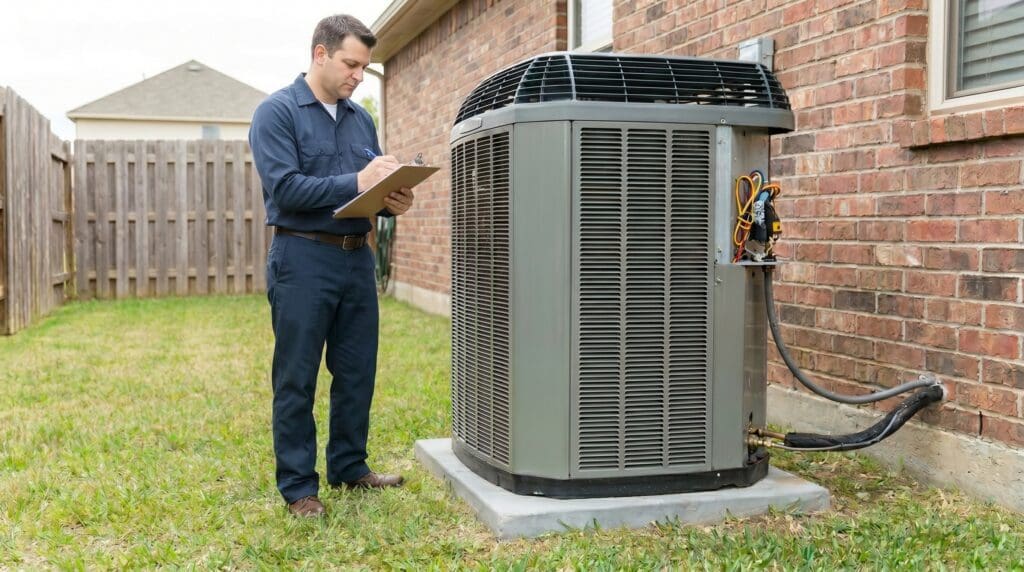
Quick Answer: Can You Fix an Air Conditioner Compressor Yourself?
You usually cannot fix the internal compressor itself as a DIY repair. Homeowners can safely check the thermostat, breaker, air filter, outdoor unit airflow, and obvious debris around the condenser. But compressor diagnostics, capacitors, contactors, electrical testing, refrigerant work, and compressor replacement should be handled by a qualified HVAC technician.
AC Compressor Not Turning On?
If your outdoor unit is humming, clicking, tripping the breaker, blowing warm air, or not cooling the house, compare local HVAC technicians before the problem gets worse.
Sponsored affiliate link. Contractor availability and service options vary by location.
What Does the AC Compressor Do?
The AC compressor is often called the heart of the air conditioning system. It sits inside the outdoor condenser unit and helps move refrigerant through the system. That refrigerant absorbs heat from inside your home and releases it outdoors.
In simple terms, the compressor helps create the pressure changes that allow the cooling cycle to work. If the compressor cannot start, cannot stay running, or cannot compress refrigerant properly, your air conditioner may blow warm air, run constantly, trip breakers, or fail to cool the house.
However, the compressor does not work alone. It depends on electrical components, airflow, refrigerant charge, clean coils, and proper system pressure. That is why a compressor symptom does not automatically mean the compressor itself is dead.
Signs Your AC Compressor May Be Failing
Compressor problems can show up in several ways. Some symptoms point to the compressor itself, while others may point to supporting components around it.
- Warm air from vents: The indoor blower runs, but the air does not cool.
- Outdoor unit humming: The compressor may be trying to start but cannot.
- Clicking sound outside: The system may be calling for cooling, but a part is not engaging correctly.
- Breaker keeps tripping: The compressor or another electrical part may be drawing too much current.
- Outdoor fan runs but compressor does not: This can happen with capacitor, contactor, wiring, or compressor failure.
- AC short cycles: The system turns on and off quickly without cooling properly.
- Loud buzzing, grinding, or rattling: Unusual compressor sounds should be inspected quickly.
- System runs constantly: The compressor may be struggling, or the system may have airflow or refrigerant issues.
- Ice on refrigerant lines: This may point to airflow restriction, refrigerant issues, or other system problems.
If you hear a loud electrical buzz, smell burning, or the breaker repeatedly trips, shut the system off and call an HVAC technician.
Safe Things to Check Before Calling an HVAC Technician
Before assuming you need a new compressor, there are several safe checks homeowners can do. These checks do not require opening electrical panels, touching refrigerant lines, or removing compressor components.
1. Check the Thermostat
Make sure the thermostat is set to cooling mode and the temperature is set lower than the current room temperature. If the thermostat has batteries, replace them. Also check that the fan setting is not confusing the issue. If the fan is set to “On,” the indoor blower may run even when the outdoor AC unit is not cooling.
2. Check the Air Filter
A clogged air filter can reduce airflow and cause the system to work harder. In severe cases, restricted airflow can contribute to frozen coils, poor cooling, and system stress. Replace a dirty filter and give the system time to recover.
3. Check the Breaker
Look at your electrical panel to see if the AC breaker has tripped. If it has, reset it once. If it trips again, do not keep resetting it. Repeated breaker trips can signal a serious electrical issue, compressor problem, short, or failing component.
4. Check the Outdoor Disconnect
Many outdoor condenser units have a disconnect box mounted nearby. Make sure it has not been accidentally switched off or pulled out. Do not open or touch internal electrical components.
5. Clear Debris Around the Outdoor Unit
Leaves, grass clippings, weeds, cottonwood fluff, and debris can block airflow around the condenser. Keep the area around the outdoor unit clear. Do not pressure wash the unit or bend the fins. Gentle cleaning and airflow clearance can help the system breathe.
6. Listen to the Outdoor Unit
Stand safely near the outdoor unit and listen. Does it click? Hum? Buzz? Try to start and stop? Does the fan run while the compressor stays silent? These details can help the HVAC technician diagnose the issue faster.
7. Check for Ice
If you see ice on refrigerant lines or the indoor coil area, turn the system off and let it thaw. Ice often points to airflow or refrigerant problems. Do not scrape ice off the system.
Safety Warning
Do not open the outdoor unit’s electrical compartment, touch capacitors, bypass safety switches, add refrigerant, or attempt compressor wiring repairs unless you are trained and qualified. AC systems involve high voltage, pressurized refrigerant, and components that can cause serious injury.
Common Reasons an AC Compressor Won’t Turn On
If the compressor is not starting, the cause may be simple, moderate, or serious. Here are the most common possibilities.
Bad Capacitor
The capacitor helps the compressor and outdoor fan motor start and run. A failing capacitor can cause humming, hard starting, clicking, or a compressor that will not kick on. This is one of the most common “compressor won’t start” problems, and it is usually far cheaper than replacing the compressor.
Failed Contactor
The contactor is an electrical switch that sends power to the outdoor unit. If it fails, the compressor may not receive power even though the thermostat is calling for cooling.
Tripped Breaker
A breaker can trip because of overheating, a power surge, a short, a failing motor, or a compressor drawing too much current. Resetting once is reasonable. Repeated tripping means the system needs diagnosis.
Dirty Condenser Coil
The outdoor coil releases heat from your home. If it is clogged with dirt or debris, the system runs hotter and works harder. According to ENERGY STAR, dirty coils can reduce cooling performance, make the system run longer, increase energy costs, and reduce equipment life.
Low Refrigerant or Refrigerant Leak
Low refrigerant usually means there is a leak. Refrigerant does not get “used up” like gasoline. Low refrigerant can cause poor cooling, ice, high compressor stress, and eventual compressor damage. Refrigerant diagnosis and charging should be handled by certified technicians.
Overheated Compressor
A compressor can overheat because of dirty coils, poor airflow, low refrigerant, electrical problems, or running under heavy load for too long. Some systems shut down temporarily to protect the compressor.
Locked Rotor
A locked rotor means the compressor motor is stuck and cannot start properly. This can cause humming, high amp draw, and breaker trips. Sometimes a technician may test whether a hard-start kit is appropriate, but a locked compressor often points toward major repair or replacement.
Failed Compressor
If the internal compressor motor or mechanical parts have failed, the compressor usually cannot be repaired internally in the field. The typical repair is compressor replacement, and in older systems, full AC replacement may be the smarter choice.
Can You Fix an AC Compressor, or Does It Need Replacement?
This is where homeowners often get confused. In many cases, technicians do not “repair” the internal compressor. Instead, they diagnose whether the compressor is truly bad or whether a related part is causing compressor symptoms.
Repairable issues around the compressor may include:
- Bad capacitor
- Failed contactor
- Loose electrical connection
- Blown fuse
- Dirty coil
- Thermostat issue
- Outdoor fan motor problem
- Refrigerant leak repair, depending on location and severity
Issues that may require compressor replacement or system replacement include:
- Burned-out compressor motor
- Locked compressor
- Internal mechanical failure
- Severe contamination after compressor burnout
- Major refrigerant leak in an aging system
- Compressor failure on an old, inefficient AC unit
Not Sure If It’s Really the Compressor?
Many compressor symptoms are caused by smaller parts like capacitors, contactors, fan motors, airflow restrictions, or refrigerant issues. A local HVAC pro can inspect the system and explain repair versus replacement options.
How Much Does It Cost to Fix an Air Conditioner Compressor?
The cost to fix an air conditioner compressor depends on what is actually wrong. A “compressor problem” may turn out to be a relatively inexpensive electrical part, or it may require full compressor replacement.
| Possible Issue | Typical Repair Type | General Cost Level |
|---|---|---|
| Clogged air filter | Replace filter | Low |
| Bad capacitor | Replace capacitor | Low to moderate |
| Failed contactor | Replace contactor | Low to moderate |
| Refrigerant leak | Leak detection, repair, recharge | Moderate to high |
| Failed compressor | Compressor replacement | High |
| Old system with compressor failure | Full AC replacement may be recommended | Highest |
As a broad 2026 planning range, AC compressor replacement often lands in the high hundreds to several thousand dollars depending on system size, brand, refrigerant type, warranty status, labor, and local market. If the system is old, out of warranty, or uses an older refrigerant, replacement of the entire AC unit may be worth comparing.
AC Compressor Repair vs Replacement
The big decision is whether to repair the surrounding issue, replace only the compressor, or replace the entire AC system.
Repair may make sense if:
- The compressor itself is not actually failed.
- The issue is a capacitor, contactor, thermostat, or fan problem.
- The AC system is relatively new.
- The compressor is still under warranty.
- The rest of the system is in good condition.
Compressor replacement may make sense if:
- The unit is not very old.
- The compressor is under parts warranty.
- The indoor and outdoor equipment are otherwise healthy.
- The repair cost is much lower than full replacement.
Full AC replacement may make more sense if:
- The system is 10 to 15+ years old.
- The compressor replacement cost is close to a new system cost.
- The system has repeated refrigerant leaks.
- The unit uses an older refrigerant that is expensive to service.
- The system is inefficient and struggles every summer.
- Other major parts are also failing.
AC Compressor Not Turning On But Fan Is Running
If the outdoor fan is running but the compressor is not, the issue may be a capacitor, wiring problem, compressor overload, low voltage, control board issue, or compressor failure. The fan running does not automatically mean the compressor is receiving correct power.
This is a common situation where homeowners misdiagnose the compressor. A technician can test voltage, capacitor condition, amp draw, contactor function, and compressor status.
AC Compressor Humming But Not Starting
A humming compressor that does not start can point to a failed capacitor, hard-start issue, locked rotor, low voltage, or internal compressor problem. Turn the system off if the humming continues or the breaker trips.
Do not keep forcing the system to start. Repeated attempts can overheat components and make the repair more expensive.
AC Compressor Clicking On and Off
Clicking may come from the contactor, control board, thermostat signal, safety switch, or compressor trying and failing to start. Occasional clicking during normal startup can be normal. Repeated clicking with no cooling is not.
If you hear repeated clicking outside and the system does not cool, schedule service.
AC Compressor Trips the Breaker
A breaker that trips once may be caused by a temporary surge or overload. But if the breaker trips repeatedly, stop resetting it. Repeated breaker trips may indicate a short, failed compressor, bad capacitor, grounded motor, damaged wiring, or other serious electrical issue.
This is a call-a-pro situation.
Portable and Window AC Compressor Problems
People also search for how to fix a portable air conditioner compressor or window AC compressor. Smaller units can have similar symptoms: the fan runs, but the compressor does not cool.
For portable and window units, safe checks include:
- Clean or replace the filter.
- Make sure the unit is not in fan-only mode.
- Check for blocked vents.
- Let the unit rest if it overheated.
- Confirm the room is within the unit’s cooling capacity.
- Check that the drain pan or tank is not full.
However, sealed-system compressor repairs on small portable or window units often cost more than the unit is worth. If the compressor itself has failed, replacement of the unit may be more practical.
How to Prevent AC Compressor Problems
You cannot prevent every compressor failure, but maintenance can reduce stress on the system.
Good prevention habits include:
- Change air filters regularly.
- Keep the outdoor condenser clear of leaves, weeds, and debris.
- Schedule annual HVAC maintenance.
- Do not ignore poor cooling or ice buildup.
- Keep supply and return vents open and unblocked.
- Have refrigerant leaks repaired instead of only topping off refrigerant.
- Install a surge protector if power quality is a concern.
- Do not run the AC with a frozen coil.
- Address strange noises early.
ENERGY STAR recommends professional maintenance tasks such as cleaning evaporator and condenser coils and checking refrigerant levels because dirty coils and incorrect refrigerant levels can reduce efficiency and shorten equipment life.
When to Call an HVAC Technician Immediately
Call an HVAC technician right away if you notice any of these symptoms:
- Breaker trips repeatedly
- Burning smell
- Loud buzzing from outdoor unit
- Compressor hums but does not start
- Outdoor fan runs but the system does not cool
- Ice on refrigerant lines or coil
- Oil stains around refrigerant lines or outdoor unit
- AC blows warm air during hot weather
- System is short cycling
- Unit is old and has repeated repair issues
Need AC Repair Help?
AC compressor repair involves high-voltage components, refrigerant, and sealed-system diagnostics. A local HVAC technician can confirm whether the issue is the compressor, capacitor, contactor, fan motor, refrigerant, or another repairable part.
Questions to Ask an HVAC Technician
Before approving an expensive compressor repair, ask clear questions.
- Is the compressor definitely failed, or could it be a capacitor or contactor?
- Did you test voltage and amp draw?
- Is the compressor under parts warranty?
- Is there a refrigerant leak?
- What refrigerant does my system use?
- How old is the AC system?
- What is the cost difference between compressor replacement and full AC replacement?
- Are there other failing parts?
- How long is the labor warranty?
- Would you repair this system if it were your home?
A good HVAC technician should be able to explain the diagnosis, show readings when appropriate, and give you options.
Related AC Compressor Guides
If you are troubleshooting a specific symptom, these guides can help you narrow down the problem:
Final Thoughts
If you are trying to fix compressor air conditioner problems, start with safe checks: thermostat, air filter, breaker, outdoor airflow, and obvious signs around the condenser. But do not assume the compressor is dead until the system is properly diagnosed.
Many compressor symptoms come from smaller parts like capacitors, contactors, fan motors, refrigerant issues, dirty coils, or airflow restrictions. The actual compressor is expensive, and replacing it may or may not make sense depending on system age, warranty, refrigerant type, and overall AC condition.
When in doubt, have a qualified HVAC technician inspect the unit. A correct diagnosis can save you from replacing the wrong part — or from pouring money into a system that should be replaced.
Get Local HVAC Repair Quotes
Compare local HVAC pros for AC compressor problems, warm air, outdoor unit humming, breaker trips, and repair versus replacement options.
Frequently Asked Questions About Fixing an Air Conditioner Compressor
Can you fix a compressor on an air conditioner?
Sometimes the problem around the compressor can be fixed, such as a bad capacitor, contactor, wiring issue, or airflow restriction. But if the internal compressor has failed, the usual repair is compressor replacement, not an internal DIY fix.
How do I know if my AC compressor is bad?
Possible signs include warm air, humming, clicking, breaker trips, hard starting, short cycling, or an outdoor fan running while the compressor does not. A technician must test the system to confirm compressor failure.
Why is my AC compressor not turning on?
Common causes include thermostat issues, a tripped breaker, bad capacitor, failed contactor, wiring problem, low refrigerant, overheated compressor, locked rotor, or compressor failure.
Can a bad capacitor look like a bad compressor?
Yes. A bad capacitor can prevent the compressor from starting and may cause humming or clicking. This is one reason proper HVAC diagnosis is important before approving compressor replacement.
How much does it cost to fix an air conditioner compressor?
Costs vary widely. A small supporting part may be relatively affordable, while compressor replacement can cost much more. The final price depends on system size, brand, refrigerant, warranty, labor, and whether the whole AC unit should be replaced instead.
Is it worth replacing an AC compressor?
It may be worth replacing the compressor if the system is newer, under warranty, and otherwise in good condition. If the unit is older or the repair cost is close to replacement cost, a new AC system may make more sense.
Why does my AC compressor hum but not start?
A humming compressor may point to a failed capacitor, hard-start issue, low voltage, locked rotor, or internal compressor failure. Turn the system off and call an HVAC technician if it continues.
Why does my AC compressor trip the breaker?
Repeated breaker trips can mean a compressor drawing too much current, electrical short, failing capacitor, bad motor, damaged wiring, or other serious issue. Do not keep resetting the breaker.
Can I add refrigerant myself?
No. Refrigerant work should be handled by qualified technicians. EPA Section 608 rules require certification for technicians who service equipment in ways that can release regulated refrigerants.
Should I replace the AC compressor or the whole unit?
Compare the age of the system, warranty status, repair cost, refrigerant type, efficiency, and other failing parts. If the AC is old and compressor replacement is expensive, full system replacement may be the better investment.