
















Navigator Pear is an upright ornamental pear tree grown for spring flowers, glossy green foliage, tidy shape, and bright yellow-orange fall color. It is not the pear tree you plant for bowls of fresh fruit. It is a landscape tree, often sold as Navigator Ornamental Pear or Pyrus x ‘DurPSN303’, and it is most often used as a vertical accent, boulevard tree, front-yard specimen, or small-space ornamental tree.
The reason people search for it is simple: Navigator Pear looks like the clean, narrow flowering tree many homeowners want. The tricky part is that nursery listings do not all describe it the same way. Some list it around 23 to 26 feet tall, while others list mature size closer to 35 feet tall and 18 feet wide. That size difference matters when you are planting near a driveway, sidewalk, foundation, fence, or overhead utility line.

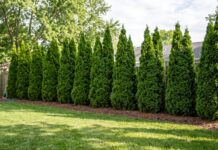
Navigator Pear is a cold-hardy ornamental pear cultivar, usually listed as Pyrus x ‘DurPSN303’. It has a dense upright or pyramidal form, white spring flowers, glossy green summer foliage, and yellow-orange fall color. It may produce small ornamental fruit, but it is not mainly grown as an eating pear.
- Best use: Front-yard accent, boulevard planting, narrow landscape space, ornamental spring-flowering tree.
- Mature size: Common nursery listings range from about 23–35 feet tall and 10–18 feet wide.
- Flowers: White blooms in spring.
- Fall color: Yellow-orange, sometimes described as yellow to red.
- Fruit: Usually small, minimal, rare, or ornamental depending on pollination and local conditions.
- Important caution: Ornamental pears have invasive and structural concerns in some regions, so check local rules before planting.
| Feature | Navigator Pear Details | What It Means for Homeowners |
|---|---|---|
| Botanical name | Pyrus x ‘DurPSN303’ | Look for this cultivar name when comparing nursery listings. |
| Plant type | Deciduous ornamental pear tree | It loses leaves in winter and is grown mainly for ornamental value. |
| Mature height | Often listed around 23–35 feet | Leave room for the larger estimate if planting near structures. |
| Mature spread | Often listed around 10–18 feet | Useful for narrow spaces, but not a tiny patio tree. |
| Shape | Upright, dense, pyramidal, or conical | Good for formal landscapes and vertical accents. |
| Flowers | White spring flowers | Main spring ornamental feature. |
| Foliage | Glossy green summer leaves; yellow-orange fall color | Adds seasonal interest after flowers fade. |
| Sun | Full sun | Flowering and shape are best in open sun. |
| Soil | Moist, well-drained soil; some listings mention higher pH preference | Avoid soggy, compacted planting spots. |
| Hardiness | Commonly listed as very cold hardy, often Zone 2 or Zone 3 depending source | One reason it appears often in Canadian prairie nursery catalogs. |
Is Navigator Pear a Real Pear Tree or an Ornamental Tree?
Navigator Pear is a real pear in the botanical sense, but in the landscape trade it is sold as an ornamental pear. That means its main job is to look good, not produce grocery-store pears. Homeowners plant it for white spring flowers, upright shape, glossy summer foliage, and fall color.
Some nursery descriptions say Navigator Pear produces small ornamental fruit. Others say it rarely fruits or produces minimal fruit. Both can be true depending on local pollination, nearby pear trees, age, and growing conditions. If you want edible pears for fresh eating, choose a fruiting pear cultivar instead.
Navigator Ornamental Pear Tree: What Makes It Different?
The phrase Navigator ornamental pear tree matters because this plant sits in a different category than edible pear trees. A fruiting pear is selected for harvest quality. Navigator Pear is selected for landscape traits: a narrow upright crown, dense branching, white spring bloom, glossy leaves, and fall color.
That ornamental purpose affects how you should judge it. Do not compare Navigator Pear to Bartlett, Bosc, Anjou, or other dessert pears. Compare it to other spring-flowering landscape trees such as Chanticleer pear, serviceberry, redbud, crabapple, flowering dogwood, and fringe tree.
The best reason to plant Navigator Pear is its tidy vertical shape in a cold-climate yard. The best reason to pause is the broader ornamental pear problem: in some regions, Callery-type pears are restricted, discouraged, or considered invasive. That does not mean every nursery listing is automatically wrong for every yard, but it does mean local advice matters more than a pretty product photo.
Navigator Pear Tree Size: How Big Does It Get?
Navigator Pear size is one of the most confusing parts of researching this tree. Different nurseries list different mature sizes. Some describe it around 23 to 26 feet tall with a 10 to 13 foot spread. Others list it closer to 35 feet tall and 18 feet wide. Some tree farms list it around 10 meters tall and 6 meters wide, which is roughly 33 feet by 20 feet.
The safest planting assumption is this: treat Navigator Pear as a medium-sized ornamental tree, not a shrub and not a dwarf patio tree. In a cold, exposed, or dry site, it may stay smaller. In a good site with deep soil, irrigation during establishment, and room to grow, it may approach the larger nursery estimates.
If a tree listing gives you two possible mature sizes, design for the larger one. A tree that stays smaller is easy to live with. A tree that outgrows the driveway, roofline, or sidewalk becomes an expensive pruning problem.
Navigator Pear Flowers and Fall Color
Navigator Pear blooms in spring with clusters of white flowers. That flower display is the reason many homeowners notice it at garden centers. After bloom, the tree carries glossy green foliage through summer. In fall, the leaves turn yellow-orange, and some nursery descriptions mention yellow to red autumn color.
Because Navigator Pear is deciduous, it will drop its leaves in winter. That can be a benefit in colder climates because the tree gives shade in summer but allows winter light through after leaf drop.
Does Navigator Pear Produce Fruit?
Navigator Pear can produce fruit, but the fruit is not the main reason to plant it. Nursery descriptions vary from “small fruit” to “minimal fruit” to “rarely fruits.” Where fruit appears, it is usually ornamental and not the large dessert pear people expect from a fruiting pear tree.
If fruit mess is your biggest concern, ask the local nursery whether Navigator Pear fruits heavily in your region. Pollination can change the amount of fruit. A single ornamental pear in one yard may behave differently from a tree planted near other pears in the neighborhood.
Can You Eat Navigator Pear Fruit?
Navigator Pear is not normally planted as an edible pear tree. Even if fruit forms, it is usually small and ornamental. Some nursery listings describe small pear-like fruit; others say fruit is rare or minimal. In practical home-garden terms, do not buy Navigator Pear if your goal is fresh eating, canning, or baking.
For edible fruit, look at true fruiting pear cultivars that are selected for taste, texture, disease resistance, and harvest quality. For landscape flowers and fall color, Navigator Pear is the relevant choice.
Is Navigator Pear Tree Good for Small Yards?
Navigator Pear can work in a smaller yard when the space is narrow but still tall enough and open enough for a medium ornamental tree. Its upright form is useful where a wide-spreading shade tree would feel too bulky. That said, “narrow” does not mean “tiny.” A tree that may reach 23 to 35 feet tall still needs room above, below, and around the canopy.
It is a better fit for a front-yard accent, boulevard strip with enough width, or open side yard than for a cramped patio corner. If your planting spot is close to a house, driveway, sidewalk, fence, or power line, choose the larger mature-size estimate and measure before planting.
Where Navigator Pear Grows Best
Navigator Pear is commonly promoted as a cold-hardy ornamental tree. It is often listed for very cold regions and appears frequently in Canadian prairie nursery catalogs. The tree performs best in full sun and well-drained soil. A slightly moist site is better than a dry, compacted, neglected strip of hard clay.
Avoid planting in low spots where water sits after rain. Like many ornamental trees, Navigator Pear is easier to establish when the planting hole is wide, the root flare is kept at grade, and the tree receives consistent watering during the first couple of growing seasons.
How to Plant a Navigator Pear Tree
Plant Navigator Pear in spring or early fall when the weather is mild and the tree has time to establish roots before extreme heat or deep winter cold. In very cold climates, spring planting is often safer because the tree gets a full growing season before winter.
- Choose a full-sun site. Navigator Pear develops its best flowering, shape, and fall color in open light.
- Measure the space. Allow for a mature spread that may reach 18 feet or more depending local growing conditions.
- Dig wide, not deep. The hole should be about two to three times wider than the root ball and no deeper than the root ball height.
- Find the root flare. The flare should sit at or slightly above surrounding soil level, not buried.
- Backfill with native soil. Avoid creating a soft “pot” of heavily amended soil inside compacted ground.
- Water deeply. Settle the soil around the roots without drowning the planting area.
- Mulch correctly. Use a 2- to 3-inch mulch ring, but keep mulch away from the trunk.
- Stake only if needed. If the tree stands securely, skip heavy staking. If the site is windy, stake loosely and remove supports once established.
Navigator Pear Care After Planting
The first two years matter most. A newly planted tree has a limited root system and needs regular moisture while it establishes. Deep watering is better than frequent shallow sprinkling. Water slowly around the root zone so moisture moves down into the soil.
After establishment, Navigator Pear is usually considered a relatively low-maintenance ornamental tree, but it still benefits from mulch, structural pruning, and occasional inspection for stress, disease, and broken branches.
Watering
Water deeply after planting, then continue watering during dry spells for the first two growing seasons. In hot summer weather, newly planted trees may need water once or twice per week depending soil type and rainfall. Established trees are tougher but still perform better when drought stress is avoided.
Mulching
Mulch helps keep soil moisture steady and protects the trunk from lawn mower and string trimmer damage. Keep mulch in a wide donut shape. Do not pile it against the trunk like a volcano.
Fertilizing
Do not automatically fertilize a newly planted Navigator Pear. If the tree is growing normally and leaf color looks healthy, fertilizer may not be needed. If growth is weak, use a soil test before adding nutrients. Too much nitrogen can push soft growth and make pruning harder.
Pruning
Prune during dormancy when you can see the branching structure. Remove broken, crossing, rubbing, or badly angled limbs. With ornamental pears, structural pruning while the tree is young is especially valuable because it can help reduce future storm-breakage problems.
Navigator Pear Problems to Know Before Planting
Navigator Pear is attractive, but no ornamental pear should be treated as a perfect tree. Before planting, think through size, structure, fruit, local regulations, and ecological concerns.
1. Ornamental Pear Invasive Concerns
Many homeowners know ornamental pears through Bradford pear and Callery pear problems. Some Callery pear cultivars have spread beyond landscapes, forming dense wild stands and competing with native plants. Several U.S. states have restricted or banned Callery pear because of invasive behavior.
Navigator Pear is commonly listed as Pyrus x ‘DurPSN303’, not simply as Bradford pear. Still, because it is sold as an ornamental pear, the smart move is to ask your local extension office or nursery whether ornamental pears are recommended, discouraged, restricted, or banned in your region.
2. Storm Damage and Branch Structure
Older ornamental pears became infamous for weak branch structure and storm breakage. Navigator Pear is often marketed with a stronger upright form, but you should still train the tree early. Remove narrow competing leaders, rubbing limbs, and weak branch angles before the tree becomes large.
3. Fruit Mess
Navigator Pear is not usually planted for heavy fruit production, but small fruit may appear. Fruit can attract birds and may drop. In many yards this is minor, but it matters near sidewalks, patios, cars, and high-traffic walkways.
4. Flower Smell
Some ornamental pears are known for flowers that smell unpleasant to many people. Navigator Pear listings usually focus on the visual flower show rather than fragrance. If flower smell bothers you, visit local flowering pears in bloom before planting one near a patio, bedroom window, or front door.
5. Wrong Tree, Wrong Place
The upright form makes Navigator Pear look like a small-space tree, but it still needs root room, canopy room, and long-term clearance. Do not wedge it into a tiny strip just because it looks narrow in a nursery pot.
Is Navigator Pear Invasive?
The honest answer is: check locally before planting. Navigator Pear is not always described the same way as Bradford or Callery pear in nursery catalogs, but it belongs to the broader ornamental pear conversation. In the United States, Callery pear and its cultivars have become a major invasive concern in several regions, with sale or planting restrictions in some states.
If you live in Ohio, Pennsylvania, South Carolina, Massachusetts, or another state with ornamental pear restrictions, confirm the current rule before buying any ornamental pear cultivar. Even where legal, many extension offices and native plant groups recommend choosing non-invasive flowering trees instead.
Navigator Pear vs Bradford Pear
| Feature | Navigator Pear | Bradford Pear / Callery Pear Concern |
|---|---|---|
| Main use | Ornamental accent tree | Historically planted as a flowering street and yard tree |
| Shape | Upright, dense, pyramidal or conical | Often dense and upright, but some cultivars develop weak branch angles |
| Flowers | White spring flowers | White spring flowers, often with an unpleasant scent |
| Fruit | Small, rare, minimal, or ornamental depending conditions | Small fruits can be spread by birds in invasive populations |
| Planting caution | Verify local recommendations before buying | Restricted, discouraged, or banned in some regions |
Navigator Pear vs Chanticleer Pear
Chanticleer Pear, often sold as an upright Callery pear cultivar, is another narrow ornamental pear used in streetscapes and small yards. Navigator Pear is also upright and ornamental, but it is especially promoted in cold-climate nursery listings. If you are comparing the two, focus less on the marketing name and more on three things: local legality, mature size, and branch structure.
In regions where Callery pear is restricted or strongly discouraged, do not assume another ornamental pear is a safe substitute without local confirmation. A local extension office or reputable nursery can tell you which flowering trees are appropriate for your county.
Best Places to Plant Navigator Pear
Navigator Pear works best where its upright shape has room to mature. Good locations include:
- Front-yard accent: Good where you want spring flowers and fall color without a wide-spreading canopy.
- Boulevard or street planting: Often marketed for narrow spaces, but only where local rules and planting strip width allow it.
- Side yard with full sun: Works better when the space is narrow but not cramped.
- Formal landscapes: The pyramidal habit suits symmetrical designs and repeated plantings.
- Cold-climate gardens: Its hardiness is one of its biggest selling points in northern nursery catalogs.
Where Not to Plant Navigator Pear
- Under power lines: Even upright trees can outgrow low utility clearance.
- Too close to the house: Leave enough room for canopy spread, pruning, and airflow.
- Wet, compacted soil: Poor drainage stresses young trees and increases failure risk.
- Regions with ornamental pear restrictions: Check current local rules before buying.
- Wildland edges: Avoid planting ornamental pears near natural areas where seed dispersal is a concern.
Better Alternatives to Navigator Pear
If ornamental pears are discouraged in your region, you can still get spring flowers, small-tree structure, and fall color from better-behaved alternatives. Native choices are especially valuable because they support local insects, birds, and wildlife more effectively than many ornamental imports.
| Alternative Tree | Why It Works | Best Use |
|---|---|---|
| Serviceberry | White spring flowers, edible berries, fall color, wildlife value. | Small yards, native landscapes, front-yard specimen. |
| Eastern Redbud | Spring flowers, graceful branching, good small-tree scale. | Front yards, woodland edges, pollinator-friendly landscapes. |
| Flowering Dogwood | Classic spring flowers, fall color, red fruit for wildlife. | Partial shade, traditional landscapes, native plantings. |
| American Plum | White flowers, fruit for wildlife, native character. | Naturalized areas, wildlife gardens, edible landscapes. |
| Crabapple | Heavy spring bloom, fruit, many mature sizes and disease-resistant cultivars. | Ornamental flowering tree where fruit drop is acceptable. |
| Fringe Tree | Soft white flowers and a refined small-tree habit. | Small yards, native gardens, ornamental accents. |
Should You Plant Navigator Pear?
Plant Navigator Pear if you want a cold-hardy, upright, spring-flowering ornamental tree and your local nursery or extension office considers ornamental pears acceptable in your area. It makes the most sense where you have full sun, well-drained soil, and enough vertical space for a medium-sized tree.
Skip Navigator Pear if ornamental pears are invasive or restricted where you live, if you want edible fruit, or if you need a native tree that supports more wildlife. In those cases, serviceberry, redbud, flowering dogwood, plum, crabapple, or fringe tree may be a better long-term choice.
A medium-sized ornamental tree is easy to underestimate when it is sitting in a nursery pot. If you are planting near pavement, utilities, drainage lines, or a foundation, a local tree or landscaping professional can help you avoid a costly placement mistake.
Final Verdict
Navigator Pear is best understood as a cold-hardy ornamental pear tree with a narrow, upright look. It can be a handsome spring-flowering tree for the right yard, especially in northern climates where cold hardiness matters. The strongest reasons to consider it are its white spring flowers, glossy green foliage, yellow-orange fall color, and tidy pyramidal shape.
The reasons to pause are just as important: ornamental pears are controversial in some regions, mature size varies by listing, fruiting can vary, and local restrictions may apply. If you plant it, give it full sun, well-drained soil, enough room, and early structural pruning. If your region discourages ornamental pears, choose a native flowering alternative instead.
Frequently Asked Questions
What is a Navigator Pear tree?
Navigator Pear is a cold-hardy ornamental pear tree usually listed as Pyrus x ‘DurPSN303’. It is grown for upright form, white spring flowers, glossy foliage, and yellow-orange fall color rather than high-quality edible fruit.
Is Navigator Pear the same as Bradford pear?
No. Navigator Pear is sold as Pyrus x ‘DurPSN303’, while Bradford pear is a well-known Callery pear cultivar. However, both are part of the broader ornamental pear discussion, so local invasive-plant rules and nursery recommendations still matter.
How big does Navigator Pear get?
Nursery listings vary. Some describe Navigator Pear around 23 to 26 feet tall and 10 to 13 feet wide, while others list it closer to 35 feet tall and 18 feet wide. Plant it with the larger estimate in mind.
Does Navigator Pear produce fruit?
It can produce small ornamental fruit, but fruiting is often described as minimal, rare, or not the main feature. Pollination and local conditions can change how much fruit appears.
Can you eat Navigator Pear fruit?
Navigator Pear is not grown as a dessert pear. Even when fruit appears, it is usually small and ornamental. Choose a true fruiting pear cultivar if you want pears for fresh eating or cooking.
Is Navigator Pear invasive?
Navigator Pear itself is not always discussed the same way as Bradford pear, but ornamental pears are restricted or discouraged in some regions because of Callery pear invasiveness. Check your local extension office, state rules, or reputable nursery before planting.
What does Navigator Pear look like in spring?
Navigator Pear produces white spring flowers on an upright, dense canopy. The bloom display is one of the main reasons it is sold as an ornamental landscape tree.
What fall color does Navigator Pear have?
Navigator Pear is commonly described as having yellow-orange fall color. Some nursery descriptions mention yellow to red tones depending growing conditions.
Where should I plant Navigator Pear?
Plant Navigator Pear in full sun with well-drained soil and enough room for a medium-sized upright tree. Avoid cramped spots near foundations, overhead lines, narrow sidewalks, or natural areas where ornamental pears are discouraged.
What are better alternatives to Navigator Pear?
Good alternatives include serviceberry, eastern redbud, flowering dogwood, American plum, disease-resistant crabapple, and fringe tree. The best choice depends on your region, soil, sun exposure, and whether you want native wildlife value.
Is Navigator Pear an ornamental pear tree?
Yes. Navigator Pear is sold as an ornamental pear tree, not a fruiting pear for eating. Its main value is landscape appearance: spring flowers, upright shape, glossy foliage, and fall color.
Is Navigator Pear good for small yards?
Navigator Pear can fit some small yards because it has an upright shape, but it is still a medium-sized tree. Use the larger mature-size estimate when planting near houses, sidewalks, fences, driveways, or overhead lines.
Join the free Garden Frontier list for tree profiles, planting tips, landscaping ideas, and practical yard decisions that age well.
100% free. No spam. Unsubscribe anytime.