














A fir tree is an evergreen conifer in the genus Abies. That detail matters because many trees with “fir” in the common name are not true firs. Douglas-fir is the famous example: it looks like a fir to many people, but it is not in the Abies genus.
For homeowners, gardeners, hikers, and Christmas tree shoppers, the practical question is simpler: how do you tell a fir tree from spruce, pine, Douglas-fir, hemlock, or another evergreen? The answer usually starts with the needles, cones, bark, overall shape, and where the tree is growing.
The name on a nursery tag is not always enough. If you want to know whether an evergreen is really a fir, start with the needles and cones before you worry about the shape of the whole tree.

- True firs are Abies trees: A real fir tree belongs to the genus Abies.
- Needles: Fir needles are usually single, soft, flat, and attached directly to the twig.
- Cones: True fir cones usually stand upright on branches and break apart on the tree instead of falling whole.
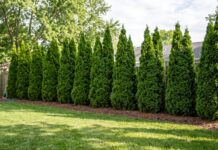
- Shape: Many fir trees have a symmetrical pyramidal or conical evergreen shape.
- Spruce vs fir: Spruce needles are usually sharper and more rigid; fir needles feel softer and flatter.
- Pine vs fir: Pine needles grow in bundles; fir needles attach singly.
- Douglas-fir: Despite the name, Douglas-fir is not a true fir.
- Christmas trees: Fraser fir, balsam fir, noble fir, white fir, and grand fir are common Christmas tree types.
If you are identifying or planting fir trees, do not rely on one clue. Use needles, cones, branch structure, location, mature size, and growth habit together. For landscaping, confirm the exact species before buying because a dwarf concolor fir and a full-size noble fir are not the same yard decision.
What Is a Fir Tree?
A fir tree is a true fir when it belongs to the genus Abies. Firs are evergreen conifers in the pine family, and many are known for soft needles, upright cones, fragrant foliage, and a classic pyramid shape.
The word “fir” is also used loosely in common names, which is why people get confused. Douglas-fir, for example, is one of the most famous conifers in North America, but it is not a true fir. That does not make the name wrong in everyday language; it just means the common name and botanical classification do not match.
How to Identify a Fir Tree
Watch: Fir vs Pine vs Spruce in 60 Seconds
Need a fast visual trick? This short video explains the easiest way to tell fir, pine, and spruce trees apart by checking the needles and cones.
Fir tree identification is easiest when you look closely at needles and cones. Shape helps, but many evergreens can look triangular from a distance. Needles and cones tell you more.
1. Check the Needles
Fir needles are usually attached singly to the twig. They are often soft, flat, and flexible compared with spruce needles. Many fir needles also have pale lines or bands underneath.
If the needles are in bundles of two, three, or five, you are probably looking at a pine, not a fir. If the needles are sharp, stiff, and roll easily between your fingers, spruce becomes more likely.
2. Look for Upright Cones
True fir cones usually stand upright on the branches. They also tend to break apart on the tree, which means you often will not find whole fir cones lying under the tree the way you might with spruce or pine.
This is one of the best clues, but it is not always available. Mature cones may be high in the canopy, and young landscape trees may not produce obvious cones yet.
3. Look at the Twig
Fir needles tend to leave a small round scar when pulled away. Spruce twigs often feel rougher because spruce needles leave woody peg-like projections. This twig clue can help when cones are missing.
4. Study the Overall Shape
Many firs have a pyramidal or conical form, especially when young. This is why so many firs are used as Christmas trees. Mature forest trees may become less perfect in shape as they age, but the classic young fir outline is usually symmetrical.
Fir vs Spruce vs Pine
Most “what tree is this?” evergreen questions come down to fir, spruce, or pine. These trees are all conifers, but their needles and cones are different enough to separate them with a little practice.
If you are comparing two common evergreens, read our focused spruce vs fir guide for needle feel, cone direction, branch texture, tree shape, and Christmas tree differences.
Needles: Soft, flat, single needles.
Cones: Often upright and break apart on the tree.
Memory trick: Fir feels friendly and flat.
Needles: Sharp, stiff, single needles; often roll between fingers.
Cones: Usually hang downward and fall intact.
Memory trick: Spruce is spiky.
Needles: Needles grow in bundles or clusters.
Cones: Woody cones often fall whole.
Memory trick: Pine needles come in packets.
Is Douglas-Fir a True Fir?
No. Douglas-fir is not a true fir because it is not in the genus Abies. It belongs to a different genus, Pseudotsuga. The hyphen in Douglas-fir is often used to signal that it is not a true fir.
Douglas-fir still matters in this discussion because many people compare it with fir trees. It can be sold as a Christmas tree, it has evergreen needles, and its common name makes it sound like a fir. But if you are identifying true firs, Douglas-fir belongs in the “look-alike” category.
Douglas-Fir Clue
Douglas-fir cones have distinctive bracts that stick out between the cone scales. People often describe them as little tails or “mouse tails.” True fir cones behave differently and usually break apart on the tree.
Common Types of Fir Trees
There are many true fir species, and not all are practical for the same use. Some are forest giants. Some are grown as Christmas trees. Some work in cooler landscapes. Some are better left to mountain forests or specialty collections.
Fraser Fir
Fraser fir is one of the most popular Christmas tree firs, especially in the eastern United States. It is known for a classic shape, pleasant fragrance, strong branches, and good needle retention as a cut tree.
In the landscape, Fraser fir is more demanding than many people expect. It prefers cool, moist, well-drained conditions and does not love hot, humid, poorly drained sites.
Balsam Fir
Balsam fir is a fragrant northern fir often associated with Christmas trees, wreaths, and cold-climate forests. It has aromatic foliage and a classic evergreen form.
Balsam fir is best suited to cooler climates. It is not the right tree for hot, dry, compacted, or poorly drained landscapes.
Noble Fir
Noble fir is a tall western fir often used for premium Christmas trees and greenery. It has strong branches, attractive foliage, and a stately shape.
In the wild, noble fir can become a large forest tree. In a home landscape, mature size and climate suitability matter before planting.
White Fir / Concolor Fir
White fir, also called concolor fir, is one of the better fir choices for some landscapes because of its attractive blue-green to gray-green needles and more adaptable ornamental use compared with some high-elevation firs.
It still wants good drainage and enough space. Heavy clay, soggy soil, and cramped urban planting sites can cause problems.
Grand Fir
Grand fir is a large fir native to parts of western North America. It can grow quickly in suitable conditions and has glossy green foliage with a pleasant evergreen scent.
It is usually more of a forest or large-property tree than a small-yard ornamental.
Subalpine Fir
Subalpine fir is a high-elevation fir with a narrow, spire-like shape. It is beautiful in mountain settings but not a universal landscape tree.
It is best understood as a cold-climate, high-elevation species rather than a general backyard evergreen.
Nordmann Fir
Nordmann fir is widely valued as a Christmas tree in some markets because of its soft needles and good needle retention. It is often grown commercially rather than planted casually in small yards.
Best Fir Trees by Use
Best for Learning Fir Tree ID: Conifer Identification Guide
Best for: Homeowners, hikers, gardeners, and anyone comparing fir, spruce, pine, cedar, hemlock, and Douglas-fir.
A good tree identification guide helps you compare needles, cones, bark, and range instead of guessing from one photo.
Fir Trees as Christmas Trees
Fir trees are some of the most popular Christmas trees because many have a symmetrical shape, pleasant scent, soft needles, and good ornament-holding branches. Fraser fir and balsam fir are especially familiar to Christmas tree shoppers, but noble fir, white fir, grand fir, and other firs may also appear depending on region and supplier.
Fraser Fir Christmas Tree
Fraser fir is often chosen for its strong branches, classic shape, fragrance, and needle retention. It is one of the safest choices when you want a premium Christmas tree that handles ornaments well.
Balsam Fir Christmas Tree
Balsam fir is known for fragrance. If the smell of a real Christmas tree matters most, balsam fir is often in the conversation. The tradeoff is that availability and needle retention can vary by region and freshness.
Noble Fir Christmas Tree
Noble fir has a layered branch structure and strong limbs, which makes it useful for heavier ornaments. It is common in some western Christmas tree markets.
White Fir / Concolor Fir Christmas Tree
White fir, often sold as concolor fir, can have a softer color and pleasant citrus-like scent. It can be a good choice if you want something different from Fraser or balsam fir.
How to Choose a Fresh Fir Christmas Tree
- Needles should look fresh, not dull, gray, or brittle.
- The tree should smell fresh when needles are crushed.
- Branches should be flexible, not snapping dry.
- The trunk cut should look fresh or be recut before placing in water.
- The tree stand should hold enough water.
- Keep the tree away from heat vents, fireplaces, and strong sun.
- Check water daily, especially during the first few days indoors.
Best Christmas Tree Upgrade: Large-Capacity Tree Stand
Best for: Fraser fir, balsam fir, noble fir, and other real Christmas trees.
A good stand should match the trunk size, hold enough water, and keep the tree stable. A cheap unstable stand can ruin the whole real-tree experience.
Can You Plant a Fir Tree in Your Yard?
Yes, but only if the species fits your climate, soil, and space. A fir tree that looks perfect as a small nursery plant can become a large evergreen with a wide root system and tall canopy. The biggest mistake is buying a fir because it looks cute in a pot and ignoring its mature size.
Before Planting a Fir Tree, Ask:
- How tall and wide will this species or cultivar get?
- Is it adapted to my USDA zone and summer heat?
- Does my soil drain well?
- Will it have enough sun?
- Is there enough room away from the house, driveway, sidewalk, septic system, and overhead wires?
- Will deer, wind, drought, or road salt be a problem?
- Is this a full-size species or a dwarf cultivar?
Best Site for a Fir Tree
Most fir trees prefer cool conditions, good drainage, and enough sun. Some species tolerate partial shade when young, but poor drainage is a common problem. Fir roots do not want to sit in compacted, soggy soil.
Good Fir Tree Site
- Full sun to part shade depending on species.
- Moist but well-drained soil.
- Enough room for mature size.
- Protection from extreme reflected heat.
- No standing water after rain.
- Good air movement.
Poor Fir Tree Site
- Heavy compacted clay that stays wet.
- Hot dry parking-strip locations.
- Small spaces near foundations.
- Under power lines.
- Low spots with poor drainage.
- Warm climates where the species is not adapted.
How to Plant a Fir Tree
Planting correctly matters more than adding fancy amendments. A fir tree planted too deep, placed in poor drainage, or squeezed into a tiny space can struggle for years.
Basic Planting Steps
- Choose a species or cultivar suited to your climate and space.
- Check the mature height and spread before buying.
- Dig a hole wider than the root ball, not excessively deeper.
- Find the root flare and keep it at or slightly above the surrounding soil level.
- Set the tree straight before backfilling.
- Backfill mostly with native soil unless a soil test or site issue says otherwise.
- Water deeply after planting.
- Add mulch in a wide ring, but keep mulch away from the trunk.
- Stake only if needed, and remove stakes once the tree is stable.
- Water regularly while the tree establishes.
Best for New Fir Trees: Tree Watering Bag or Slow-Release Watering Ring
Best for: Newly planted fir trees, dwarf conifers, and young evergreens during establishment.
New trees need consistent deep watering while roots establish. A slow-release watering bag can help, but it should not be left on the trunk constantly without checking for moisture, pests, or bark problems.
Fir Tree Care Basics
Fir tree care depends on the species, but most problems come from poor site selection, planting too deep, drought stress during establishment, heat stress, compacted soil, root damage, pests, or disease.
Watering
Newly planted fir trees need regular watering while they establish. Deep watering is better than frequent shallow sprinkling. Once established, the tree’s needs depend on species, soil, rainfall, temperature, and site conditions.
Mulch
Use a wide mulch ring to help conserve moisture and reduce weed competition. Keep mulch a few inches away from the trunk. Do not build a mulch volcano around the tree.
Fertilizer
Do not fertilize blindly. If a fir tree looks weak, first check soil moisture, drainage, planting depth, root damage, and pests. A soil test is more useful than guessing.
Pruning
Fir trees usually need less pruning than many landscape trees. Remove dead, damaged, or crossing branches when needed. Avoid cutting into the central leader unless you know what you are doing because it can ruin the tree’s natural shape.
Winter Care
Young firs can suffer from winter wind, drought, deer browsing, salt exposure, and sunscald depending on location. Water before the ground freezes if the fall has been dry, and protect small trees from deer where needed.
Common Fir Tree Problems
Yellowing or Browning Needles
Some interior needle drop is normal, but widespread yellowing or browning can signal drought stress, root problems, pests, poor drainage, winter injury, or disease.
Root Rot
Root rot is more likely in compacted, soggy, poorly drained soil. A fir tree that sits in wet soil can decline slowly and look drought-stressed even when the ground is wet.
Pests
Pest problems vary by species and region. Adelgids, mites, aphids, bark beetles, and other pests may affect firs. Inspect new growth, branch tips, bark, and undersides of needles if the tree declines.
Heat Stress
Many firs prefer cooler conditions. A species adapted to mountains or northern climates may struggle in hot, humid, dry, or urban heat-island sites.
Wrong Tree, Wrong Place
This is the most common landscaping mistake. A fir tree planted in the wrong climate, wrong soil, or too-small space may never perform well no matter how much you water or fertilize it.
- Brown tips after planting: Check watering, root ball moisture, heat, and transplant stress.
- Yellow needles inside the tree: Some seasonal interior shedding may be normal.
- Widespread browning: Check drought, root rot, pests, and planting depth.
- Slow growth: Check light, soil drainage, competition, and mature species expectations.
- Sticky residue or speckling: Inspect for insects or mites.
- Tree leaning: Check root stability, wind exposure, and whether staking is needed temporarily.
Fir Tree FAQ
What is a fir tree?
A fir tree is a true fir when it belongs to the genus Abies. Firs are evergreen conifers often recognized by soft single needles, upright cones, and a pyramidal shape.
Is fir the same as pine?
No. Fir and pine are different types of conifers. Pine needles grow in bundles, while fir needles are usually attached singly to the twig.
Is fir the same as spruce?
No. Fir and spruce are different conifers. Fir needles are usually softer and flatter, while spruce needles are often sharper, stiffer, and attached to small woody pegs.
How can you tell a fir tree from a spruce tree?
Fir needles are usually soft and flat, and fir cones often stand upright and break apart on the tree. Spruce needles are usually sharper and more rigid, and spruce cones often hang downward and fall intact.
How can you tell a fir tree from a pine tree?
Look at the needles. Pine needles grow in bundles or clusters, while fir needles attach singly to the branch.
Is Douglas-fir a true fir?
No. Douglas-fir is not a true fir because it is not in the genus Abies. It is a look-alike conifer with fir in the common name.
Why are fir cones hard to find on the ground?
True fir cones often break apart on the tree instead of dropping whole. That is why you may find cone pieces instead of intact fir cones under a true fir.
What are common types of fir trees?
Common fir trees include Fraser fir, balsam fir, noble fir, white fir or concolor fir, grand fir, subalpine fir, and Nordmann fir.
Which fir tree is best for Christmas?
Fraser fir is one of the most popular Christmas tree choices because of its shape, fragrance, strong branches, and needle retention. Balsam fir, noble fir, white fir, and grand fir are also used as Christmas trees.
What does a fir tree smell like?
Many fir trees have a fresh evergreen scent. Balsam fir is especially known for fragrance, while concolor fir can have a softer citrus-like scent depending on the tree.
Do fir trees grow fast?
Growth rate depends on species, climate, soil, moisture, and site conditions. Some firs are slow to moderate growers, while others can grow faster in suitable forest conditions.
Can you plant a fir tree in a small yard?
Only if you choose a dwarf or compact cultivar suited to the site. Many full-size fir species become too large for small yards.
What soil do fir trees like?
Most fir trees prefer moist but well-drained soil. Heavy compacted clay, soggy low spots, and poorly drained sites can cause root problems.
Do fir trees need full sun?
Many firs grow best in full sun to part shade, depending on species and climate. Check the exact species before planting.
Can fir trees grow in hot climates?
Many fir trees prefer cooler climates and may struggle in hot, dry, humid, or urban heat-island conditions. Species selection matters.
Why is my fir tree turning brown?
Browning can come from drought stress, transplant shock, poor drainage, root rot, pests, winter injury, heat stress, or normal interior needle shedding. Check the pattern before treating.
Are fir trees good for landscaping?
Yes, some fir trees are excellent landscape evergreens when planted in the right climate and soil. Concolor fir and dwarf fir cultivars are often more practical for home landscapes than huge forest species.
Are fir trees deer resistant?
Deer resistance varies by species, region, deer pressure, and food availability. Young fir trees may still need protection in areas with heavy browsing.
Can I grow a Christmas fir tree outside after the holidays?
Only if it is a living potted or balled-and-burlapped tree, not a cut tree, and only if the species suits your climate and planting site. Keep live Christmas trees indoors briefly and plant correctly afterward.
What is the easiest way to remember fir vs spruce vs pine?
Fir feels friendly and flat, spruce is spiky, and pine needles come in packets or bundles.
Join Garden Frontier for practical tree care, landscaping, gardening, home improvement, tools, and seasonal maintenance advice.
100% free. No spam. Unsubscribe anytime.