








Trestle tables are back because they solve a dining room problem most people notice only after the table is  delivered: corner legs get in the way. Someone always ends up straddling a table leg, bumping a knee, or discovering that the “seats eight” table only seats six comfortably once real chairs are pulled in.
A trestle table uses two end supports connected by a long stretcher or cross-brace instead of four perimeter legs. That sounds like a small design change, but it affects everything: legroom, seating flexibility, bench storage, visual weight, stability and how the table feels in a farmhouse kitchen or formal dining room.
It is also a category where online shopping can fool you. A glossy product photo may hide a weak stretcher, thin veneer top, awkward base footprint or low crossbar that blocks chair arms. This guide breaks down what a trestle table is, which styles are worth comparing, how to choose the right size, and what to check before buying one for everyday family use.
- Best overall style: A solid wood trestle dining table with a strong center stretcher, enough knee clearance and a durable finish.
- Best farmhouse pick: A rustic or reclaimed-look trestle table with an X-frame or chunky beam base.
- Best flexible option: An extendable trestle table if you host holidays but do not need a huge table every day.
- Best DIY angle: Heavy-duty metal trestle table legs paired with a butcher block, hardwood slab or custom top.
- Best seating advantage: Trestle bases usually allow better bench seating and fewer corner-leg conflicts than traditional four-leg tables.
- Biggest buying mistake: Buying by tabletop length only and forgetting to check trestle base placement, stretcher height and chair clearance.
Here is the fast buyer version before the full guide. Always check dimensions, base placement, tabletop material and delivery details before ordering furniture online.
| Option | Best For | Why It Makes Sense | Check Price |
|---|---|---|---|
| Farmhouse Trestle Dining Table | Warm kitchens and family dining rooms | Chunky bases, rustic finishes and bench-friendly layouts fit the classic farmhouse look. | Amazon |
| Solid Wood Trestle Table | Long-term everyday use | Hardwood tops can age better, feel heavier and may be refinishable depending on construction. | Amazon |
| Extendable Trestle Table | Holiday hosting | Leaves add seating when needed without forcing you to live with a giant table year-round. | Amazon |
| Round Trestle Table | Breakfast nooks and smaller rooms | A round top with a trestle or pedestal-style base can create better flow in compact spaces. | Amazon |
| Metal Trestle Table Legs | DIY custom builds | Heavy-duty steel bases can turn a hardwood slab or butcher block top into a custom table. | Amazon |
| Dining Bench for Trestle Table | Flexible seating | Benches pair naturally with trestle bases because there are fewer corner legs in the way. | Amazon |
What Is a Trestle Table?
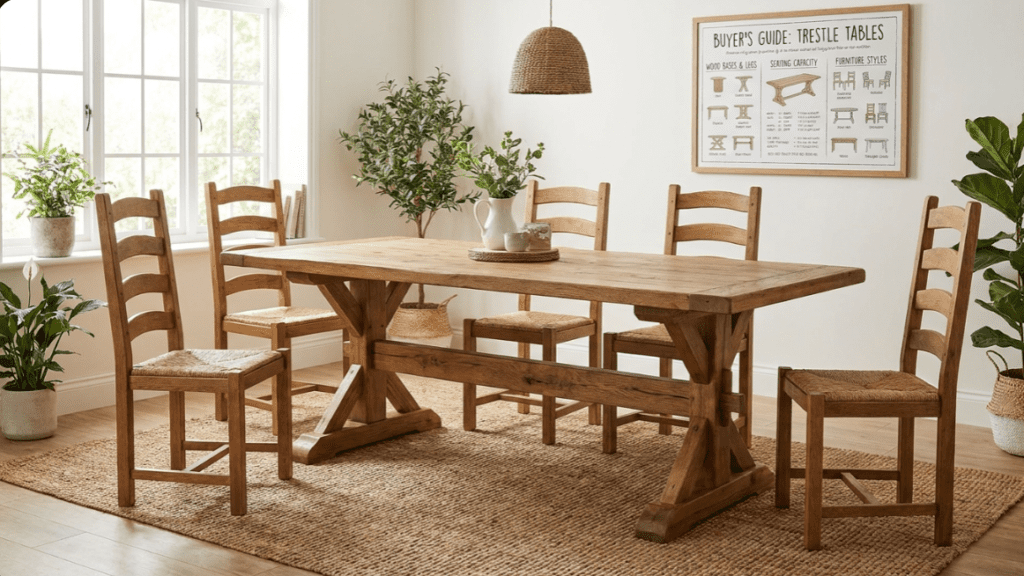
A trestle table is a table supported by two or more end structures, often connected by a horizontal stretcher beam underneath the tabletop. Instead of four legs sitting near the corners, the support system is moved inward and tied together through the center.
The design is old, practical and still extremely useful. Traditional trestle tables could be simple boards placed over removable supports. Modern trestle dining tables are usually permanent furniture pieces with fixed bases, bolted stretchers, shaped feet, decorative frames and heavy tops.
The main reason people like them today is simple: they create better seating flexibility. With the legs moved away from the corners, chairs and benches can slide in more easily, and guests are less likely to fight table legs for knee space.
Trestle Table vs Pedestal Table vs Four-Leg Dining Table
| Table Type | Support Style | Best For | Watchout |
|---|---|---|---|
| Trestle table | Two end supports connected by a stretcher or central brace. | Family dining, benches, farmhouse rooms, long rectangular tables. | Stretcher height and base footprint can interfere with chairs if poorly designed. |
| Pedestal table | One central base or column, often used with round tables. | Breakfast nooks, round dining tables, compact spaces. | Large tops can feel less stable if the pedestal is undersized. |
| Four-leg table | One leg at or near each corner. | Simple construction, modern styles, small tables. | Corner legs can limit chair and bench placement. |
Why Trestle Tables Are Popular Again
The current trestle table comeback is not just farmhouse nostalgia. The design fits how people actually use dining rooms now. Many homes have open kitchens, multi-use dining areas, homework zones, hybrid workspaces and holiday seating problems. A trestle dining table handles those uses better than many delicate or leggy designs.
- Better legroom: Inset supports reduce corner-leg conflicts.
- Bench-friendly seating: Benches can often slide under the table more cleanly.
- Strong visual anchor: The base gives the room architectural weight.
- Farmhouse appeal: X-frame and beam-style bases pair naturally with rustic interiors.
- Custom potential: Trestle bases work well with reclaimed wood, live-edge slabs and DIY tops.
- Good for long tables: A center stretcher can support longer tops when properly engineered.
Trestle Table Sizes and Seating Capacity
The top measurement is only half the story. You also need to know where the trestle supports sit. A 72-inch table with supports placed far inward may seat differently from a 72-inch table with wide end frames near the chair positions.
| Table Length | Typical Seating | Best Use | Buying Note |
|---|---|---|---|
| 48 to 60 inches | 4 to 6 people | Apartments, breakfast nooks, small kitchens. | Check that end supports do not crowd the two short ends. |
| 66 to 72 inches | 6 to 8 people | Standard family dining rooms. | Often the residential sweet spot. |
| 84 to 96 inches | 8 to 10 people | Large dining rooms and holiday hosting. | Delivery access and room clearance become more important. |
| 108 inches and up | 10 to 12+ people | Great rooms, banquet spaces, custom homes. | Usually best as a custom or premium furniture purchase. |
Room clearance rule: Leave about 36 inches around the table for chair movement and walking space when possible. More is better if the table sits near a kitchen island, sideboard or doorway.
How to Choose the Right Trestle Dining Table
1. Check the Distance Between the Trestle Supports
Do not only read the total tabletop length. Look for the usable space between the trestle bases. This determines how many chairs or benches can actually fit without legs hitting the supports.
2. Check Stretcher Height
The stretcher is the horizontal beam running between the trestles. It looks beautiful, but if it sits too high or too far out, it can interfere with knees, chair arms or bench storage.
3. Measure Chair Arm Height
Dining chairs with arms need extra clearance under the tabletop and around the base. A trestle table may be great for armless chairs but awkward with bulky armchairs.
4. Compare Solid Wood vs Veneer
Solid wood can be sanded and refinished more easily than veneer, but it can also expand and contract with humidity. Veneer over engineered wood may stay dimensionally stable and cost less, but deep scratches and water damage are harder to repair.
5. Think About Delivery
Large trestle tables are heavy. Measure doorways, stairs, hallways and corners before ordering. Many tables arrive in multiple boxes and require assembly.
Best Trestle Table Styles
1. Farmhouse Trestle Table
A farmhouse trestle table is the classic choice for warm, casual dining rooms. It often uses thick legs, visible beams, X-frame supports, distressed finishes or plank-style tops. This style looks best when the table feels sturdy rather than delicate.
Choose a farmhouse trestle table if you want a table that can handle family meals, homework, holiday dishes, serving platters and the normal chaos of daily life.
- Best for: Farmhouse kitchens, rustic dining rooms, open-concept homes and family seating.
- Pros: Warm look, bench-friendly, hides small wear better when distressed.
- Cons: Chunky bases can dominate small rooms.
Check Farmhouse Trestle Tables on Amazon
2. Solid Wood Trestle Table
A solid wood trestle table is the better long-term choice if you want furniture that can age with the house. Oak, maple, walnut, cherry and rubberwood are common options, though quality varies by brand and construction.
Solid wood is not magic. It still needs a durable finish, smart joinery and normal care. But compared with thin veneer or paper-laminate furniture, it has a better chance of surviving scratches, sanding, refinishing and years of daily meals.
- Best for: Buyers who want long-term furniture instead of temporary decor.
- Pros: Durable feel, natural grain, better repair potential.
- Cons: Higher cost, heavier delivery and more sensitivity to humidity changes.
Check Solid Wood Trestle Tables on Amazon
3. Extendable Trestle Table
An extendable trestle table is the right pick if your dining room needs to serve four people on Tuesday and ten people at Thanksgiving. Leaves make the table more flexible, especially in homes where the dining room is also used for homework, crafts or work-from-home overflow.
The important detail is how the leaf system interacts with the base. Some extension tables keep legroom clean. Others place the trestle supports or stretcher awkwardly once the table is fully extended.
- Best for: Holiday hosts, flexible dining rooms and growing families.
- Pros: More seating when needed, smaller footprint day to day.
- Cons: Leaf storage, added weight and more moving parts.
Check Extendable Trestle Tables on Amazon
4. Round Trestle Table
A round trestle table blends the social feel of a round table with a more decorative base. It is a good option for breakfast nooks, square dining spaces and rooms where sharp corners make traffic flow awkward.
For round tables, stability depends heavily on base width and tabletop diameter. A small base under a large round top can feel tippy or awkward, especially if people lean on the edge.
- Best for: Breakfast rooms, apartments, smaller dining spaces and conversation-friendly layouts.
- Pros: Easy conversation, softer traffic flow, compact footprint.
- Cons: Less surface area for serving dishes compared with long rectangular tables.
Check Round Trestle Tables on Amazon
5. Trestle Table Legs and Bases
Trestle table legs are a smart route if you want a custom table without building the base from scratch. Heavy-duty metal bases pair well with butcher block, live-edge slabs, reclaimed boards or thick hardwood tops.
DIY table builds can look incredible, but the top still needs to be flat, sealed, supported and attached correctly. Very heavy slabs may require professional flattening, sanding or finishing.
- Best for: DIY furniture builds, custom sizes, live-edge tops and industrial interiors.
- Pros: Flexible design, strong base options, custom size potential.
- Cons: Top prep and fastening can be harder than it looks.
Check Metal Trestle Table Legs on Amazon
Best Wood for a Trestle Dining Table
| Wood / Material | Best For | What to Know |
|---|---|---|
| Oak | Classic solid dining tables | Durable, traditional and good for farmhouse or craftsman styles. |
| Maple | Clean modern or family-use tables | Hard, smooth and often lighter in tone. |
| Walnut | Premium modern dining rooms | Beautiful dark grain, usually higher cost. |
| Pine | Rustic budget farmhouse look | Softer wood; dents and marks more easily. |
| Veneer over engineered wood | Budget-friendly style | Can look good, but deep damage is harder to repair and refinishing is limited. |
Can You Use a Bench with a Trestle Table?
Yes, and this is one of the best reasons to choose a trestle base. Because there are no corner legs blocking the long sides, a bench can often slide under the table cleanly when not in use.
Before buying a bench, measure the space between the trestle supports, not just the tabletop length. The bench needs to fit between the supports or sit comfortably outside them without blocking traffic.
DIY Custom Trestle Tables: When to Build Instead of Buy
Building a custom trestle table makes sense if you need an unusual size, a specific wood species, a live-edge slab or a base style you cannot find in stores. The easiest route is often buying a heavy-duty metal base and pairing it with a finished tabletop.
The hard part is the tabletop. Flattening, joining, sanding and sealing thick hardwood slabs takes tools and patience. A table that looks simple in a photo can become a wobbly, cupped, uneven project fast if the wood is not prepared correctly.
A local carpenter or custom furniture maker can help with slab flattening, joinery, base fitting, sanding, sealing and building a trestle table that actually fits your room.
Common Buying Mistakes
- Ignoring chair clearance: Measure chair arms, seat width and the lowest apron or stretcher before buying.
- Buying by tabletop length only: The trestle base position determines real seating space.
- Choosing a weak stretcher: A flimsy center brace can lead to wobble over time.
- Forgetting room clearance: A large table needs walking space on all sides.
- Assuming veneer is solid wood: Read material descriptions carefully.
- Not checking delivery access: Large dining tables may not fit through tight stairs or hallways.
- Overlooking foot placement: Wide feet that protrude too far can become toe-stubbers.
- Buying too rustic for your room: Chunky farmhouse bases can overpower small or modern spaces.
- Skipping care instructions: Wood finishes vary, and some need more protection than others.
How to Care for a Trestle Table
Daily care depends on the finish, but the basics are simple. Wipe spills quickly, use placemats or coasters when needed, avoid harsh chemical cleaners and keep extreme heat away from the surface.
- Use a slightly damp soft cloth for daily wiping.
- Dry the surface after cleaning.
- Use trivets under hot pots and serving dishes.
- Avoid leaving wet glasses, flower vases or damp placemats on wood.
- Check bolts and base fasteners occasionally, especially after moving the table.
- Keep indoor humidity reasonably stable to reduce wood movement.
Final Takeaway
A good trestle table is more than a farmhouse trend. It is a smart dining table design for people who want better legroom, flexible seating, strong visual presence and a table that can anchor a room.
For most homes, a 66- to 72-inch trestle dining table is the practical sweet spot. Larger 84- to 96-inch tables are excellent for holiday hosting if your room has enough clearance. Solid wood is the better long-term investment, extendable models give you flexibility, and metal trestle legs are a strong path for DIY custom builds.
Before you buy, check the base placement, stretcher height, chair clearance, tabletop material and delivery path. That is where the difference between a beautiful lifetime table and a frustrating online furniture mistake usually shows up.
Frequently Asked Questions About Trestle Tables
What is a trestle table?
A trestle table is a table supported by two end structures connected by a stretcher or cross-brace instead of four individual corner legs. The design creates more open seating space along the sides.
What is the advantage of a trestle dining table?
The main advantage is better legroom and seating flexibility. Because the supports are set inward, chairs and benches often fit more easily than they do around a standard four-leg table.
Are trestle tables stable?
Well-built trestle tables can be very stable, especially when the end supports are wide and the center stretcher is strong. Poorly built trestle tables can wobble if the base is weak or badly fastened.
Can a trestle table seat more people?
Sometimes, yes. A trestle table may seat more people comfortably than a similar-length four-leg table because there are fewer corner legs blocking chair placement.
What size trestle table seats six people?
A 60- to 72-inch trestle table usually seats six people, depending on chair width, base placement and whether you use benches.
What size trestle table seats eight people?
A 72- to 84-inch trestle table often seats eight people, but you should confirm the usable space between the trestle supports before buying.
Can you use benches with trestle tables?
Yes. Benches pair very well with trestle tables because the absence of corner legs makes it easier to slide a bench under the tabletop.
What is the best wood for a trestle table?
Oak, maple, walnut and cherry are strong long-term choices for solid wood trestle tables. Pine is more affordable and rustic, but it dents more easily.
Are trestle tables good for small rooms?
They can be, especially round or compact rectangular versions. Just avoid overly chunky bases that visually crowd the room or block chair movement.
Do trestle tables require assembly?
Most online trestle tables require assembly because the top, end supports and center stretcher often ship separately. Large solid wood tables can be heavy and may need two people to assemble safely.
What are trestle table legs?
Trestle table legs are the base supports used under a tabletop, often sold separately for DIY furniture builds. They can be wood, steel, cast iron or powder-coated metal.
Is a trestle table good for a farmhouse dining room?
Yes. Trestle tables are one of the most popular farmhouse dining table styles because they combine rustic structure, generous seating and a strong central base design.
Join our home and garden community for practical buying guides, room upgrade ideas, furniture tips and seasonal home projects.
100% Free. No spam. Unsubscribe anytime.