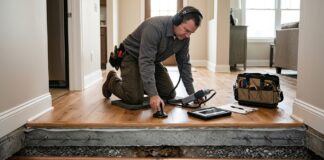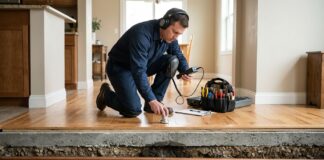











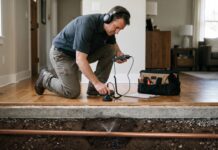
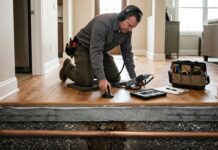
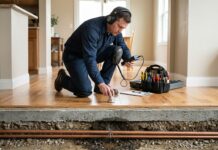


If you are trying to figure out how to find a water leak under a slab, do not start by removing flooring or breaking concrete.
Start by proving three things:
- Water is actually being lost.
- The leak is not coming from an ordinary fixture, appliance or irrigation system.
- The evidence points toward plumbing beneath or inside the slab.
A warm floor, high water bill or damp spot can make a slab leak suspicious, but none of those symptoms tells you exactly where a buried pipe has failed.
The objective is to narrow the problem enough that a plumber can use professional leak-detection equipment to locate the line before unnecessary demolition begins.

Start by turning off every known water use and checking the water meter.
EPA WaterSense recommends reading the meter during a period when no water is being used, then reading it again about two hours later. If the reading changes, you probably have a leak somewhere in the property plumbing.
Next, rule out toilets, faucets, irrigation, appliances and visible plumbing. Only then should you start treating an under-slab pipe as the likely source.
Finding a leak exists is different from locating the exact pipe failure. Exact slab-leak location usually requires professional pressure testing, acoustic detection, thermal imaging or other specialized diagnostics.
If a slab leak has already been confirmed, skip ahead to our complete Slab Leak Repair Guide.
If your main question is price, see our 2026 Slab Leak Repair Cost Guide.
7 Checks Before You Break Concrete
Check 1: Look for Unexplained Water Use
Before testing individual pipes, establish whether your home is actually consuming more water than expected.
Compare recent utility bills with your normal usage for the same season.
EPA WaterSense specifically recommends comparing current water use with the same period in previous years because an unexplained increase can indicate a hidden leak.
Things that can legitimately change consumption include:
- More people living in the home
- Hot weather
- Lawn irrigation
- Pool filling
- New appliances
- Extended guests
If none of those changed and your consumption suddenly climbed, move to the meter test.
Check 2: Perform a Water Meter Leak Test
This is one of the most useful homeowner checks because it answers a simple question:
Is water moving through the meter when the house should be using none?
How to Test the Water Meter
- Turn off faucets.
- Do not run the dishwasher or washing machine.
- Make sure toilets have finished filling.
- Turn off irrigation.
- Do not use showers, ice makers or other water-using equipment during the test.
- Photograph or record the water-meter reading.
- Wait without using water.
- Check the meter again.
EPA WaterSense recommends comparing readings over approximately two hours. If the meter reading changes while no water should be used, a leak is likely somewhere in the plumbing system.
Important: a moving meter confirms unexplained water flow. It does not prove that the leak is under the slab.
See the current EPA WaterSense home leak guidance.
What About the Small Leak Indicator?
Many mechanical water meters have a small dial, triangle, star or other low-flow indicator that moves with very small amounts of water use.
Digital meters may instead display a flow rate or leak warning.
If that indicator continues moving when everything should be off, investigate further.
Rule out toilets, fixtures and irrigation next. If unexplained flow remains, professional leak detection can narrow the location before anyone opens the floor.
Check 3: Rule Out Toilets, Faucets and Visible Fixtures
A moving meter does not mean you should immediately blame the slab.
EPA WaterSense identifies common household leaks such as worn toilet flappers, dripping faucets and leaking valves as frequent sources of wasted water.
Test the Toilets
A toilet can leak silently into the bowl without leaving water on the floor.
EPA recommends placing a few drops of food coloring in the toilet tank, waiting about 10 minutes without flushing, and checking whether color appears in the bowl.
If it does, the toilet is leaking.
Flush immediately afterward to avoid staining.
Check Faucets and Shutoff Valves
Inspect:
- Kitchen faucets
- Bathroom faucets
- Under-sink supply valves
- Toilet supply lines
- Hose bibbs
- Water heater connections
Look and feel for damp fittings rather than relying only on visible dripping.
Check 4: Eliminate Appliances and Irrigation
Outdoor and appliance leaks can mimic the water usage pattern of a hidden slab leak.
Check:
- Washing machine hoses
- Dishwasher supply lines
- Refrigerator and ice-maker lines
- Water softeners
- Reverse-osmosis systems
- Pool auto-fill systems
- Automatic irrigation
- Outdoor faucets
Irrigation is especially important because a broken underground landscape line can consume large amounts of water without creating obvious moisture inside the house.
Do another meter test with irrigation positively disabled rather than merely assuming its timer is off.
Check 5: Map Warm Spots, Damp Areas and Water Sounds
Once ordinary leaks have been eliminated, physical clues inside the house become much more useful.
Warm Floor Areas
A localized warm spot can occur above a leaking hot-water line.
But heat alone does not prove there is a slab leak.
Other possible causes include:
- Sun exposure
- Heating ducts
- Radiant floor heating
- Appliances
- Electrical equipment
A warm floor becomes more suspicious when it occurs together with a moving water meter or unusually frequent water-heater operation.
Damp Flooring
Look for:
- Darkened grout
- Loose tile
- Buckled wood flooring
- Swollen baseboards
- Damp carpet
- Musty odors
- Unexpected moisture near interior walls
Remember that water can move sideways through materials before becoming visible, so the wettest spot is not always directly above the failed pipe.
Listen When the House Is Quiet
With all known fixtures off, listen for:
- Hissing
- Faint rushing water
- Persistent trickling
- Water movement near a wall or floor
The sound may help narrow the general area, but household listening is not a substitute for professional acoustic leak detection.
Can a Moisture Meter Find a Slab Leak?
A moisture meter can help answer a narrower question:
Where are accessible building materials wetter than surrounding areas?
That can be useful for mapping damage, but it does not tell you that a buried pipe is directly underneath the reading.
Best for: comparing relative moisture in drywall, masonry and wood around suspicious areas.
Klein specifies non-destructive relative moisture detection in supported materials to a depth of approximately 3/4 inch.
That makes it useful for scanning nearby walls and finishes, but it does not see a water pipe buried several inches below a concrete slab.
Klein’s current specifications confirm a 3/4-inch sensing depth and calibration modes for drywall, masonry, hardwood and softwood.
Can a Thermal Camera Find a Slab Leak?
Thermal imaging can be useful when a hot-water leak creates a temperature pattern through the floor.
But a thermal image shows temperature differences, not the pipe itself.
Heat can spread through concrete, and HVAC systems, sunlight or radiant heating can create similar patterns.
A professional therefore combines thermal evidence with meter readings, pressure tests, plumbing layout and other detection methods before deciding where to open the slab.
Do not mark an X on the floor from one thermal image and start drilling. Thermal imaging is evidence to investigate, not permission to demolish concrete.
Check 6: Look for Water-Pressure Clues
A substantial supply-line leak can affect household pressure, although low pressure has many possible causes.
EPA WaterSense says residential fixtures generally operate best with incoming service pressure around 45–60 psi.
If pressure has dropped suddenly without a utility outage or known plumbing change, a leak is one possibility worth investigating.
Other causes include:
- Utility supply changes
- Pressure regulator failure
- Partially closed valves
- Clogged piping
- Water treatment equipment
Pressure is therefore a supporting clue, not a slab-leak locator.
Check 7: Use the Main Shutoff to Narrow the Search
This test can be useful in homes where the water meter is outside and the home’s main shutoff is located downstream of the meter.
Only do this if you know which valve is your normal household shutoff and can operate it safely.
Basic Principle
If unexplained water flow is showing at the meter:
- Turn off the normal main shutoff that supplies the house.
- Check the water meter again.
- If meter flow stops, the unexplained use is likely downstream of that shutoff.
- If meter flow continues, the leak may be between the meter and that shutoff or elsewhere upstream of the isolated house plumbing.
Do not force an old, corroded or unfamiliar valve. Shutoff configurations vary, and some valves near a utility meter belong to the water provider. If you are unsure which valve to operate, stop and contact the utility or a plumber.
What the Seven Checks Can — and Cannot — Tell You
How Plumbers Find Slab Leaks Without Guessing
Once homeowner checks indicate an unexplained leak, professional diagnosis becomes much more efficient.
Depending on the plumbing configuration, plumbers and leak-detection specialists may use a combination of:
- Pressure testing to determine whether an isolated plumbing circuit holds pressure.
- Acoustic detection to listen for the noise created by pressurized water escaping a pipe.
- Thermal imaging to look for temperature patterns from hot-water leakage.
- Electronic leak detection to narrow hidden water movement.
- Moisture mapping to determine how water has migrated through accessible materials.
- Plumbing-zone isolation to determine which branch is losing pressure or flow.
- Drain cameras where the suspected problem involves a drain or sewer line rather than a pressurized supply pipe.
The important part is that several pieces of evidence should agree before expensive demolition begins.
Supply-Line Leak vs. Drain-Line Leak
This distinction changes how the leak behaves.
Can a Smart Water Monitor Detect a Slab Leak?
A whole-home flow monitor can be very useful for detecting a pattern of continuous water consumption.
EPA WaterSense recommends leak-detection and flow-monitoring systems as a way to identify unusual water-use patterns and reduce damage from hidden leaks.
But a whole-home monitor generally answers:
“Is unexpected water flowing?”
It usually does not answer:
“Which pipe beneath the kitchen floor is leaking?”
Best for: homeowners who want ongoing whole-home water-use monitoring without cutting into the main supply pipe.
Flume says its default Smart Leak Alert can notify the homeowner after continuous water flow and specifically lists low-flow problems such as running toilets, pinhole leaks and slab leaks as examples it is designed to help identify.
Flume also explicitly notes that while the device can indicate a leak, it cannot tell you where the leak is located.
Check water-meter compatibility before buying.
EPA’s current leak-monitoring guidance also distinguishes between point-of-use moisture sensors and whole-home flow monitoring. A point sensor can tell you exactly where it became wet, but only if water physically reaches that sensor. A whole-home flow monitor can detect abnormal use elsewhere in the plumbing but does not necessarily identify the exact location.
What If the Floor Is Wet but the Meter Does Not Move?
Do not automatically rule out water damage.
Possible explanations include:
- Drain-line leakage
- Groundwater intrusion
- Foundation seepage
- Roof leakage traveling through walls
- Window or door leakage
- HVAC condensate
- Shower waterproofing failure
- Previous leak moisture still drying
If there is significant water damage, our Home Restoration Guide covers the next step after the source is stabilized.
What If You See a Crack in the Slab?
Do not assume a visible concrete crack is the source of the water.
Concrete can crack because of shrinkage, settlement, movement and other conditions unrelated to plumbing.
Likewise, filling a visible surface crack does not repair a damaged water line underneath the slab.
For ordinary concrete crack repair products and when they are appropriate, see our Concrete Crack Sealer Guide.
Do not seal an actively wet crack before finding the water source. You can hide a symptom without correcting the underlying failure.
When to Stop Testing and Call a Plumber
Homeowner testing has done its job when you can say:
- The meter shows unexplained water flow.
- Toilets and visible fixtures have been ruled out.
- Irrigation and appliances have been eliminated.
- The symptoms point toward hidden indoor plumbing.
At that point, additional guessing has diminishing value.
Professional detection can narrow down the failing line before a repair method is selected.
A licensed plumber can pressure-test the plumbing and use professional leak-detection equipment before flooring or concrete is removed.
You can also see our Slab Leak Repair Near Me page for questions to ask when comparing local plumbing help.
How Much Does Professional Slab Leak Detection Cost?
Professional detection is normally a separate diagnostic step or a line item included in a larger repair project.
Current 2026 planning figures commonly put professional slab leak detection around $150–$400, although difficult investigations can cost more.
The bigger financial mistake is often paying for unnecessary demolition because the leak location was guessed incorrectly.
See our complete Slab Leak Repair Cost Guide for direct repair, rerouting, lining, concrete access and restoration costs.
Should You Break the Concrete Yourself?
No — not based on homeowner leak checks alone.
The concrete may contain or conceal:
- Water lines
- Drain lines
- Electrical conduits
- Post-tension cables in some foundations
- Structural reinforcement
- Heating systems
Even if you have correctly identified that a hidden leak exists, that does not mean you know the safe demolition location.
How to Find a Water Leak Under a Slab FAQ
How can I tell if water is leaking under my slab?
Start by checking the water meter when all known water use is off. If unexplained flow remains after toilets, faucets, irrigation and appliances are ruled out, hidden plumbing becomes more likely. Warm floor spots, damp finishes and running-water sounds can add supporting evidence.
How do I perform a water meter test for a slab leak?
Turn off all known water uses, record the meter reading and avoid using water during the test. EPA WaterSense recommends checking the reading again after about two hours. A changed reading indicates that water probably leaked or was otherwise used during the test period.
Does a moving water meter mean I have a slab leak?
No. It means water is moving somewhere downstream of the meter. Toilets, irrigation, appliances, faucets and other leaks should be eliminated before assuming the pipe is beneath the slab.
Will a slab leak always make the water meter move?
A continuously leaking pressurized supply line normally creates water use that can affect the meter. A drain-line leak behaves differently because the water has already passed through the meter before entering the drain.
Does a hot floor mean there is a slab leak?
Not always. Radiant heating, ductwork, appliances and sunlight can also warm a floor. A persistent localized hot spot combined with unexplained water use is more suspicious.
Can I hear a slab leak?
Some pressurized leaks produce hissing or running-water sounds that are audible when the house is quiet. Professional acoustic equipment is much more sensitive and can help narrow the source.
Can a moisture meter find a pipe leak under concrete?
A consumer moisture meter can identify elevated moisture in supported accessible materials but cannot normally locate a pipe several inches beneath a concrete slab.
Can a thermal camera detect a slab leak?
Thermal imaging can reveal temperature differences consistent with some hot-water leaks, but the image shows heat patterns rather than the buried pipe itself. Other heat sources can create similar patterns.
How do plumbers locate water leaks under concrete?
Depending on the system, professionals may use water-meter analysis, pressure testing, acoustic listening equipment, thermal imaging, electronic detection, moisture mapping and plumbing-zone isolation.
Can plumbers find a slab leak without breaking concrete?
They can often narrow the likely leak location substantially before destructive access. Concrete may still need to be opened if direct repair is ultimately selected.
What does slab leak detection cost?
Current 2026 planning figures commonly place professional slab leak detection around $150–$400, although difficult or specialized investigations can cost more.
Can low water pressure indicate a slab leak?
A significant supply leak can contribute to low pressure, but pressure regulator problems, utility conditions, valves and pipe restrictions can cause similar symptoms. Low pressure alone does not diagnose a slab leak.
What if my water meter does not move but the floor is wet?
Possible causes include a drain leak, groundwater, foundation seepage, HVAC condensate, roof or window leakage, shower waterproofing failure or moisture remaining from an earlier leak.
Can a smart water monitor detect a slab leak?
A whole-home flow monitor can identify abnormal or continuous water-use patterns that may be caused by a slab leak, but it generally cannot identify the exact location of the failed pipe.
Should I break the concrete where the floor feels warm?
No. Heat can spread through concrete and can have causes unrelated to plumbing. The leak location should be confirmed with appropriate professional diagnostics before destructive access.
Can a cracked slab cause water to come through the floor?
Water can travel through cracks, but the presence of a crack does not identify the original water source. Groundwater, drainage and plumbing leaks are different problems and require different repairs.
Should I shut off the water if I suspect a slab leak?
If an active leak is causing significant damage, shutting off the household water supply can limit additional water loss until help arrives. If you do not know which valve is the normal household shutoff, do not operate unfamiliar utility valves.
How long should I test the water meter?
EPA WaterSense recommends comparing meter readings over approximately two hours when no water is being used.
Can a slab leak cause a high water bill?
Yes. A continuously leaking pressurized line can increase water consumption substantially, particularly when the leak remains hidden for weeks or months.
What is the best first test for a suspected slab leak?
A controlled water-meter test is one of the most useful first checks because it establishes whether unexplained water flow exists before you begin trying to locate it.
Join Garden Frontier for practical home improvement, restoration, gardening and homeowner advice.
100% free. No spam. Unsubscribe anytime.