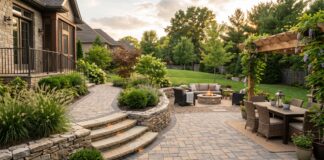













Paver patio cost looks simple when you see a price per square foot. Then the excavation starts.
A 300-square-foot patio on flat, firm, machine-accessible soil is a very different project from the same 300 square feet behind a townhouse where every bucket of clay has to leave through a narrow gate.
The pavers may be identical. The invoice will not be.
For a standard professionally installed concrete or brick paver patio, a useful current national baseline is about $10–$17 per square foot. Current 2026 contractor-market data also show many U.S. cities at roughly $8–$26 per square foot, with higher-cost locations and premium natural stone pushing beyond that range.
The important part is understanding what the price includes.
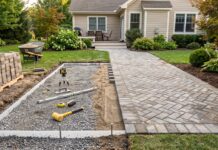
A durable paver patio is not just the visible paver. You are paying for excavation, disposal, subgrade preparation, aggregate base, compaction, bedding, cutting, edge restraint, joint material, drainage planning, and labor before the first chair ever sits on it.
The cheapest paver is not necessarily the cheapest patio, and the cheapest patio quote is not necessarily the cheapest patio to own.

Standard installed paver patio: about $10–$17 per square foot is a useful national planning baseline for many concrete and brick paver installations.
Current local-market range: Angi’s 2026 city-level cost data shows many markets around $8–$26 per square foot, while higher-cost cities can be around $9–$28 per square foot.
200 sq. ft. patio: roughly $2,000–$3,400 using the $10–$17 national baseline before unusually difficult site work or premium materials.
400 sq. ft. patio: roughly $4,000–$6,800 on the same basis.
Biggest cost variables: patio size, paver material, excavation, soil, drainage, access, base preparation, pattern complexity and local labor.
Square-foot estimates are useful for budgeting, but slope, soil, excavation access and drainage can change a paver quote substantially. Compare several local scopes before selecting an installer.
Paver Patio Cost Per Square Foot in 2026
A reasonable starting point for a professionally installed conventional paver patio is approximately $10–$17 per square foot.
HomeGuide’s current national patio data puts concrete or brick paver patios in that range, compared with approximately $5–$15 per square foot for basic poured concrete and $8–$19 for stamped concrete.
See the current HomeGuide patio cost data.
But the $10–$17 range is not a ceiling.
Angi’s 2026 local data illustrates how location changes pricing:
- Many large markets currently show roughly $8–$25 or $8–$26 per square foot.
- New York City is currently closer to about $9–$28 per square foot.
- Premium natural stone in some markets can approach or exceed $50 per square foot.
That difference is why a national calculator should be treated as a planning tool rather than a contractor quote.
Paver Patio Cost by Size
The following numbers use the $10–$17 per square foot standard installed baseline. They are useful for comparing patio sizes before detailed site conditions are known.
| Patio Size | Square Feet | Planning Range |
|---|---|---|
| 10 × 10 ft. | 100 | $1,000–$1,700 |
| 12 × 12 ft. | 144 | $1,440–$2,450 |
| 10 × 20 ft. | 200 | $2,000–$3,400 |
| 14 × 20 ft. | 280 | $2,800–$4,760 |
| 15 × 20 ft. | 300 | $3,000–$5,100 |
| 20 × 20 ft. | 400 | $4,000–$6,800 |
| 20 × 25 ft. | 500 | $5,000–$8,500 |
| 24 × 24 ft. | 576 | $5,760–$9,790 |
| 25 × 30 ft. | 750 | $7,500–$12,750 |
These are baseline calculations, not promises. Difficult excavation, drainage systems, steps, seat walls, borders, premium stone, limited equipment access or complicated patterns can push the project higher.
What Does a $10–$17 per Square Foot Paver Price Include?
A legitimate installed price should cover considerably more than pavers.
A conventional project may include:
- Layout and elevation setup
- Removing sod or existing surface
- Excavation
- Hauling and disposal
- Preparing the soil subgrade
- Aggregate base material
- Mechanical compaction
- Bedding material
- Pavers
- Cutting
- Edge restraint
- Joint sand
- Final compaction
- Cleanup
One national paver-cost dataset currently breaks a typical installation into roughly $3.40–$6.20 per square foot for materials and base components and about $6.25–$10.90 per square foot for labor, though individual projects vary.
That helps explain why buying a $3 or $4 paver does not create a $4-per-square-foot patio.
What Makes a Paver Patio More Expensive?
1. Excavation
Pavers require room for the pavement structure below them.
A contractor may need to remove turf, topsoil, old concrete, roots or unsuitable fill before the structural base can be installed.
The deeper and harder the excavation, the more labor and disposal cost increase.
2. Access
Machine access is one of the quietest price differences between two otherwise identical patios.
If a mini loader can reach the backyard, excavation and aggregate placement can move quickly.
If every wheelbarrow has to pass through a narrow gate, labor rises.
Angi’s current 2026 city data specifically identifies limited equipment access and manual excavation as meaningful cost drivers.
3. Soil
Firm, well-drained native soil is easier to build over than soft clay, wet soil, uncontrolled fill or recently disturbed ground.
Weak areas may require:
- Additional excavation
- More aggregate
- Geotextile or stabilization where appropriate
- Drainage correction
- Engineering on unusual sites
4. Base Depth
A pedestrian patio does not normally need the same pavement section as a driveway, but even patios vary by soil, drainage and climate.
More base means more excavation, material, hauling and compaction.
The Concrete Masonry & Hardscapes Association emphasizes that base design depends on soil strength, drainage, climate and pavement loading.
5. Drainage
If the proposed patio occupies a low area or changes the direction of runoff, the project may need more than simply sloping the pavers.
Additional work can include:
- Drain channels
- Catch basins
- Underdrains
- Downspout rerouting
- Grading changes
- Permeable pavement systems
Paying for drainage during construction is usually more attractive than removing finished pavers to solve a water problem later.
6. Pattern Complexity
Straightforward running-bond layouts are generally easier to install than highly detailed borders, curves, medallions or layouts requiring many small cuts.
Complex patterns also increase material waste.
7. Patio Shape
A simple rectangle maximizes full pavers and predictable cuts.
Curves, multiple radii and irregular outlines can require considerably more layout and cutting time.
8. Steps and Elevation Changes
A flat patio is simpler than a patio connected by masonry steps or retaining walls.
Once grade changes substantially, the job begins moving from flatwork toward structural hardscaping.
9. Borders and Seat Walls
Contrasting borders look simple in a finished photo but add material changes, cutting and layout.
Seat walls add masonry, foundation work and labor beyond the patio surface itself.
10. Local Labor Costs
This is why national averages should never be treated as universal.
Current Angi city data shows installed ranges changing meaningfully between markets, with New York City’s typical square-foot pricing above many other metro areas.
Paver Patio Cost by Material
Concrete Pavers
Concrete pavers are usually the best place to start when you want the paver look without moving immediately into premium natural stone.
Current national guides commonly place installed concrete paver patios around $8–$15 per square foot for many standard projects.
Best for: broad design choice, patios, walkways and homeowners who want individual-unit repairability.
Brick or Clay Pavers
Brick has a more traditional appearance and works especially well with colonial, cottage and older architecture.
Current national data commonly places installed brick paver patio work around $10–$17 per square foot, although local premium products can cost more.
Best for: traditional architecture and classic courtyard designs.
Natural Stone
Natural stone pricing varies dramatically because “stone” can describe very different products and installation methods.
Premium flagstone, bluestone and other natural stone can substantially exceed manufactured concrete pavers. Current 2026 Angi city guides show premium natural-stone ranges approaching roughly $50 per square foot or more in some markets.
Best for: premium landscapes where natural color and variation justify the higher budget.
Permeable Pavers
Permeable pavers should be priced as a pavement system, not simply as a more expensive surface block.
EPA explains that permeable pavement allows rainfall to enter through the surface into underlying stone layers where water can be stored, infiltrated or moved through an underdrain.
That means the open-graded base and drainage design beneath the pavers are part of the product.
See the EPA permeable pavement overview.
Paver Patio Cost vs Concrete Patio
If initial price is the main concern, poured concrete usually wins.
| Surface | Current Installed Planning Range |
|---|---|
| Poured concrete | About $5–$15/sq. ft. |
| Stamped concrete | About $8–$19/sq. ft. |
| Concrete / brick pavers | About $10–$17/sq. ft. |
Pavers generally cost more upfront, but they offer an advantage concrete cannot match as easily: individual units can be removed and reset.
That can matter if:
- A utility needs access below the patio.
- A localized area settles.
- A paver becomes damaged.
- A drain must be added later.
Concrete can certainly be repaired, but a patched slab rarely disappears visually the way reset pavers can.
For a broader comparison of patios, retaining walls, materials and outdoor construction, see our complete hardscaping guide.
Why Paver Base Preparation Changes the Price
This is the section I would examine most closely when comparing contractor bids.
CMHA describes edge restraint as an essential part of interlocking concrete pavement and emphasizes proper subgrade and base preparation throughout its technical guidance.
A conventional paver assembly can include:
- Prepared soil subgrade
- Compacted aggregate base
- Bedding layer
- Pavers
- Edge restraint
- Joint material
If one installer proposes less excavation, less aggregate and fewer compaction steps than another, the cheaper bid is not necessarily pricing the same patio.
Cost comparison rule: before comparing two patio totals, compare excavation depth, compacted base thickness, base material, drainage, edge restraint and disposal. The visible paver is only one part of the construction.
For a deeper look at excavation depth, compacted aggregate thickness, bedding sand, and soil conditions, see this detailed paver base depth guide.
How Much Does Paver Patio Labor Cost?
Labor is often the largest part of a professionally installed paver patio.
One current national cost dataset estimates roughly $6–$11 per square foot for paver-installation labor, with grading, excavation, access and layout complexity influencing the result.
That labor is not just somebody kneeling down and setting blocks.
Professional labor can include:
- Layout
- Grade setup
- Excavation
- Loading soil
- Hauling
- Base spreading
- Compaction
- Screeding
- Cutting pavers
- Installing borders
- Edge restraint
- Sweeping joints
- Final compaction
- Cleanup
A patio with dozens of cuts can consume far more labor than the same square footage laid in a simple rectangle.
How Much Does Excavation Add?
Current cost breakdowns often place basic excavation around roughly $0.80–$1.50 per square foot, with disposal and hauling added separately.
That figure can climb quickly when:
- Machines cannot reach the patio.
- Existing concrete must be demolished.
- Large roots interfere with the excavation.
- The site contains heavy clay or rock.
- Soil must be carried a long distance.
- Disposal fees are high.
Ask where the excavated material is going.
“Excavation included” and “excavation plus off-site disposal included” are not always the same thing.
What About an Existing Concrete Patio?
Removing an existing slab changes the project before new pavers even arrive.
The contractor may need:
- Concrete breaking equipment
- Additional labor
- Dump fees
- More trucking
- Subgrade correction after removal
A quote for “pavers over an empty lawn” should not be compared directly with “remove 400 square feet of old concrete and rebuild the patio.”
Do You Need to Seal Pavers?
Sealing is not necessarily part of every initial installation.
Where used, current cost guides place professional paver cleaning and sealing around roughly $1.50–$3.25 per square foot.
Whether sealing makes sense depends on:
- Paver manufacturer guidance
- Desired appearance
- Stain exposure
- Joint system
- Climate
- Maintenance expectations
Do not assume a glossy sealer is automatically an upgrade. Some homeowners prefer the natural unsealed finish.
How Much Does a DIY Paver Patio Cost?
A DIY patio can save a large portion of professional labor, but the savings are not equal to the full contractor markup.
HomeGuide currently estimates many DIY paver patios at around $5–$10 per square foot, depending on material, site work and equipment.
DIY costs can include:
- Pavers
- Aggregate base
- Bedding material
- Joint sand
- Edge restraint
- Geotextile where appropriate
- Delivery
- Excavation
- Dump fees
- Plate compactor rental
- Masonry saw rental
- Sod cutter or excavator rental
- Hand tools
Equipment rental alone can add hundreds of dollars per day depending on the machine and location.
When DIY Makes Sense
- The patio is small.
- The yard is relatively flat.
- Soil is stable.
- Drainage is straightforward.
- Access is good.
- The pattern is simple.
- You are comfortable operating compaction and cutting equipment.
When Professional Installation Starts Looking Cheaper
- Large patio
- Clay or weak soil
- Retaining wall
- Major grade change
- Drainage problem
- Many cuts or curves
- Existing concrete demolition
- Restricted backyard access
- Heavy permanent outdoor kitchen or fireplace
DIY becomes expensive when you have to rent equipment twice because the first weekend was spent discovering that excavation took longer than expected.
How Much Extra Paver Material Should You Order?
Exact waste depends on the product and pattern.
A common planning rule is to order approximately 10% extra for cuts and waste on straightforward projects, with more potentially required for diagonal or highly cut patterns.
HomeGuide currently suggests around 10% extra for standard installations and approximately 20% for angled patterns.
Before ordering, check the paver manufacturer’s recommendation and whether unused full units can be returned.
Do Paver Patios Require Permits?
Permit requirements are local.
A simple at-grade patio may be treated differently from a project involving:
- Retaining walls
- Major grading
- Drainage changes
- Gas lines
- Electrical work
- Outdoor kitchen utilities
- Pergola footings
- Structures near property setbacks
HOA rules, easements and local stormwater requirements can also matter even when the patio surface itself does not require a building permit.
Call 811 Before Excavation
Paver construction involves excavation, often deeper than homeowners expect.
The national 811 system connects excavators with their local one-call center so participating underground utilities can be marked before digging.
Contact requirements and waiting periods vary by state, so start the process before excavation is scheduled.
See 811 Call Before You Dig information.
How to Read a Paver Patio Quote
A contractor quote should make it possible to understand what is actually being built.
Look for:
- Patio dimensions and square footage
- Exact paver manufacturer and product
- Paver color and finish
- Demolition
- Excavation depth
- Soil disposal
- Subgrade preparation
- Base type
- Compacted base thickness
- Bedding material
- Edge restraint
- Joint material
- Drainage work
- Steps or walls
- Utility sleeves
- Cleanup
- Payment schedule
- Warranty
If two bids are thousands of dollars apart, this list often explains why.
Ask each contractor to describe excavation, compacted base, drainage, edge restraint and disposal. A lower bid may simply contain less construction beneath the same visible paver.
Why the Cheapest Paver Quote Can Become the Most Expensive
Imagine two contractors quote the same 400-square-foot patio using the same paver.
Contractor A is $1,500 cheaper.
That sounds compelling until you compare the construction:
- Less excavation
- Thinner base
- No drainage allowance
- Minimal edge restraint
- No disposal in the written scope
- No clear warranty for settlement
Contractor B may not actually be selling the same patio for more money.
They may be selling a different pavement structure.
The visible paver is only the easiest part for a homeowner to compare.
12 Hidden Paver Patio Costs to Ask About
1. Existing patio demolition
Breaking and hauling old concrete can add substantial labor before new construction starts.
2. Excavated soil disposal
Hundreds of square feet of excavation create more material than many homeowners expect.
3. Weak soil
Unsuitable subgrade discovered after excavation can require additional work.
4. Drainage correction
Low spots, downspouts and runoff problems should be solved before the patio surface is finished.
5. Limited machine access
Manual material movement increases labor quickly.
6. Paver cutting
Curves and complicated borders require more cuts, time and waste.
7. Steps
Changes in elevation can add masonry and structural work.
8. Seat walls
They add function, but also base, masonry units, caps and labor.
9. Utility sleeves
Planning future lighting, irrigation or outdoor-kitchen utilities before paving can save reopening the patio later.
10. Material delivery
Pavers and aggregate are heavy. Freight and placement location matter.
11. Sealing
If specified, ask whether sealing is included in the initial quote or priced later.
12. Permits or approvals
Requirements vary by jurisdiction and can become relevant when the project includes structural, utility or drainage work.
How to Save Money on a Paver Patio Without Cheapening the Construction
Keep the Shape Simple
Rectangles use material efficiently and reduce cutting.
Spend on the Base Before the Border
If the budget is tight, I would rather use a simpler paver over a properly prepared base than buy premium pavers and reduce the construction underneath them.
Avoid Too Many Paver Types
Every extra border, color and unit size increases layout complexity and potential waste.
Design the Correct Size
Bigger is not automatically better.
Measure the furniture and circulation you actually need before adding another 150 square feet simply because the yard has space.
Plan Future Utilities Now
Installing conduit or sleeves before the patio is complete can be far cheaper than lifting finished pavers later.
Compare Equal Contractor Scopes
A competitive quote is useful only when everyone is bidding on roughly the same construction.
Is a Paver Patio Worth the Extra Cost?
Pavers are not the cheapest way to create a hard patio surface.
Their strongest advantages are different:
- Wide range of colors, shapes and textures
- Individual-unit replacement
- Ability to lift and reset localized areas
- Easy integration of borders and patterns
- Good fit with steps, walks and other hardscape
If the only priority is the lowest initial installed price, conventional concrete may be the better fit.
If repairability, design flexibility and the modular look matter, the additional cost of pavers can make sense.
Final Verdict: Budget for the Patio You Cannot See
A useful starting budget for a conventional professionally installed paver patio is around $10–$17 per square foot.
Current 2026 local-market data shows why you should allow more room than that when planning: many cities currently land around $8–$26 per square foot, and expensive locations or premium stone can go well beyond it.
The difference between a reasonable patio and an expensive one is not always the paver.
It is often:
- What must be removed
- How difficult it is to reach the backyard
- How much aggregate is required
- Whether the soil is stable
- Whether drainage has to be rebuilt
- How many cuts the design requires
- Whether steps or walls are involved
When contractor quotes arrive, look below the paver.
A properly prepared $4 paver can outperform an expensive paver installed over a shortcut.
Paver Patio Cost FAQ
How much does a paver patio cost per square foot?
About $10–$17 per square foot installed is a useful national planning baseline for many standard concrete or brick paver patios. Local 2026 pricing can be broader, depending on labor, site conditions and material.
How much does a 10×10 paver patio cost?
A 100-square-foot paver patio is roughly $1,000–$1,700 using a $10–$17 per square foot baseline, before unusually difficult site preparation or premium materials.
How much does a 12×12 paver patio cost?
A 144-square-foot paver patio is approximately $1,440–$2,450 using the standard planning range.
How much does a 10×20 paver patio cost?
A 200-square-foot paver patio is approximately $2,000–$3,400 using the standard $10–$17 installed baseline.
How much does a 20×20 paver patio cost?
A 400-square-foot paver patio is approximately $4,000–$6,800 using the national baseline. Difficult excavation, premium material or drainage work can increase the total.
How much does a 500-square-foot paver patio cost?
At $10–$17 per square foot, a 500-square-foot patio works out to roughly $5,000–$8,500 before major site complications or premium upgrades.
What is the cheapest type of paver patio?
Standard concrete pavers are generally among the least expensive manufactured paver choices. Natural stone and highly detailed premium products typically cost more.
Are pavers more expensive than concrete?
Usually. Current national cost data puts poured concrete around $5–$15 per square foot installed and concrete or brick pavers around $10–$17 per square foot for many projects.
Why is paver installation so expensive?
The installation includes much more than placing pavers. Excavation, disposal, aggregate base, compaction, bedding, cutting, edge restraint, joint material, drainage and labor all contribute to the installed price.
How much does paver patio labor cost?
Current national planning data places paver installation labor around $6–$11 per square foot for many projects, with access, grading and pattern complexity affecting the final price.
How much does a DIY paver patio cost?
Many DIY paver patio projects fall around $5–$10 per square foot once pavers, base materials, delivery, edge restraint, sand, equipment rental and disposal are included.
How much extra paver material should I order?
Approximately 10% extra is a common starting allowance for cuts and waste on straightforward layouts. More may be appropriate for diagonal or highly cut patterns.
Do pavers need a gravel base?
Conventional interlocking paver installations typically use a compacted structural aggregate base over prepared subgrade, followed by a thinner bedding layer below the pavers.
Does a paver patio need edge restraint?
Yes. CMHA describes edge restraints as an essential part of interlocking concrete pavement because they help prevent the pavers from spreading laterally.
Does a paver patio need drainage?
The patio must be designed so rainfall moves to an appropriate location rather than collecting on the surface or being directed toward the house. Some sites require dedicated drainage components in addition to surface grading.
Are permeable pavers more expensive?
They can be because permeable pavement is an engineered system involving specialized surface openings, joint aggregate and underlying stone layers for stormwater storage and drainage.
Do I need a permit for a paver patio?
Requirements vary by jurisdiction. Simple at-grade patios may be treated differently from projects involving walls, structures, utilities, grading or drainage changes.
Should I get multiple paver patio quotes?
Yes. Compare several detailed written scopes when possible, and make sure the bids include comparable excavation, base preparation, drainage, edge restraint and material specifications.
What should I ask a paver contractor?
Ask about excavation depth, soil condition, base material, compacted base thickness, drainage, edge restraint, disposal, exact paver product, warranty and how unexpected weak soil is handled.
Join Garden Frontier for practical hardscaping, landscaping, gardening and home-improvement advice.
100% free. No spam. Unsubscribe anytime.