

















Christmas flower arrangements work best when they look festive without looking as though every red object in the craft drawer was added at once.
The strongest holiday arrangements usually have a simple structure: one dominant color story, two or three types of fresh flowers, plenty of seasonal greenery and a container that suits where the arrangement will actually be used.
For a dining table, that usually means a long, low centerpiece guests can see across.
For an entry table or kitchen island, height and drama work better. For gifting, a compact vase arrangement travels more safely than a wide centerpiece full of candles and loose ornaments.
And you do not need expensive flowers everywhere.
A few premium roses or amaryllis stems can look far more generous when they are surrounded by inexpensive carnations, chrysanthemums, cedar, fir, pine, eucalyptus or other seasonal foliage.
The trick is to spend money on the flowers people notice first and let greenery create the volume.

Classic: red roses or carnations + fir or pine + red berries + pinecones.
Elegant: white roses + white carnations or chrysanthemums + eucalyptus + evergreen + metallic accents.
Modern: burgundy or plum flowers + dark greenery + minimal gold or copper accents.
Best dining-table shape: long and low so the flowers do not block conversation.
Best value strategy: use greenery for volume and reserve premium flowers for focal points.
For longer vase life: start with a clean container, make fresh stem cuts, keep foliage out of the water and use commercial flower food.
Christmas Flower Arrangements at a Glance
| Style | Best Flowers | Best Greenery | Best Location |
|---|---|---|---|
| Traditional red & green | Red roses, carnations, mums | Fir, pine, cedar | Dining table |
| White Christmas | White roses, mums, hydrangea | Eucalyptus, fir | Formal table |
| Rustic woodland | Carnations, berries | Pine, cedar, juniper | Mantel / farmhouse table |
| Luxury | Garden roses, amaryllis, orchids | Magnolia, eucalyptus | Entry / event table |
| Budget | Carnations, alstroemeria, mums | Evergreen clippings | Anywhere |
What Flowers Do Florists Use in Christmas Arrangements?
Current florist Christmas collections continue to rely heavily on a relatively small group of reliable holiday flowers.
The most common choices include:
- Red roses
- White roses
- Carnations
- Chrysanthemums
- Amaryllis
- Poinsettias
- Lilies
- Hydrangeas
- Hypericum berries
- Alstroemeria
Then florists build the Christmas identity with greenery and texture:
- Fir
- Pine
- Cedar
- Juniper
- Eucalyptus
- Magnolia
- Holly
- Pinecones
- Decorative berries
- Ribbon
- Small ornaments
Current Christmas collections from major U.S. flower-delivery companies prominently feature poinsettias, amaryllis, red and white roses, lilies, evergreens and Christmas centerpieces.
How Much Do Florist Christmas Arrangements Cost in 2026?
There is no single national florist price because the final cost depends on local flower prices, size, delivery, container and labor.
But current national online florist listings give us a useful planning range.
| Type | Typical 2026 Online Starting Range |
|---|---|
| Small holiday bouquet | About $40–$60 |
| Standard Christmas arrangement | About $50–$80 |
| Table centerpiece | About $50–$95 |
| Premium centerpiece | $100–$200+ |
| Large luxury / designer arrangement | $150–$300+ |
Delivery, service fees and holiday-date surcharges can increase the final checkout total, so compare the final delivered price rather than only the advertised arrangement price.
Before You Arrange: The Three Florist Rules That Matter Most
1. Use a Clean Container
Bacteria in a dirty vase shorten flower life. Wash reused containers thoroughly before adding new flowers.
2. Keep Leaves Out of the Water
Remove leaves that would sit below the waterline. Submerged foliage breaks down and contaminates the water.
3. Make Fresh Stem Cuts
Trim the bottom of the stems with clean, sharp cutting tools immediately before arranging.
Iowa State Extension also recommends a commercial floral preservative rather than relying on household tricks such as aspirin, pennies or random kitchen mixtures.
Garden Frontier already has a broader article on creating a theme for flower arrangements if you want to go deeper into color, occasion and style planning.
Useful Tools for Christmas Floral Arranging
You can make a good arrangement with basic garden pruners and a vase, but three inexpensive tools make the process noticeably easier.
Best for: roses, carnations, greenery, berry stems and general Christmas floral prep.
These compact bypass floral pruners are designed for cut flowers and light stems and include a stem-stripper feature that is useful when preparing roses or foliage.
Best for: holding stems in place across a vase opening without filling the container with floral foam.
The reusable silicone grid stretches over many vase openings and creates individual spaces that help separate stems while you arrange them.
25 Christmas Flower Arrangements to Try in 2026
1. Classic Red Roses and Evergreen Centerpiece
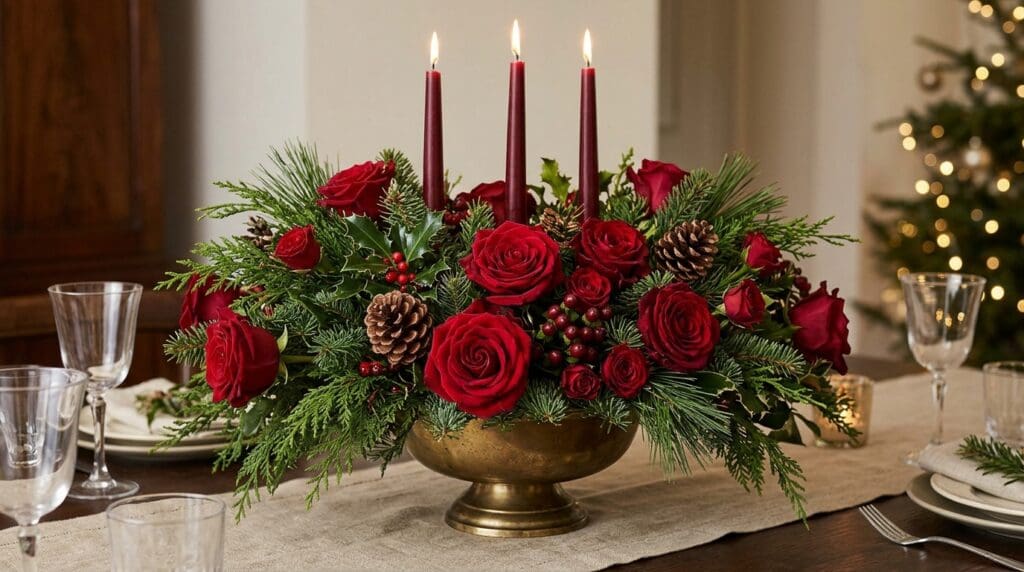
Best for: traditional Christmas dining tables.
Use: 6–8 red roses, 5–7 red carnations, fir or pine, eucalyptus, red berries and 3–5 pinecones.
Container: low oval bowl or compote.
This is the arrangement that immediately reads “Christmas” without explanation.
Build the volume with evergreens first, then place roses as the focal flowers, with carnations between them. Use berries and pinecones in smaller groups rather than spacing every accent perfectly evenly.
2. White Christmas Rose Arrangement

Best for: elegant, neutral interiors.
Use: white roses, white chrysanthemums, silver-dollar eucalyptus, fir and a small amount of silver or pearl ornamentation.
Container: white ceramic, clear glass or silver-toned vessel.
The easiest way to make a white arrangement feel expensive is to use several textures rather than several colors.
Pair smooth rose petals with soft mums, matte eucalyptus, and darker evergreen.
3. Red and White Candy-Cane Arrangement

Use: red roses or carnations, white roses or mums, red berries, and striped red-and-white ribbon.
Keep the candy-cane idea in the color palette rather than adding literal candy everywhere. Red and white flowers alternating against green foliage give the same effect with much less visual clutter.
4. Long-and-Low Christmas Dinner Centerpiece

Use: fir, pine, eucalyptus, red carnations, hydrangea, and hypericum berries.
This is one of the most practical florist formats because the arrangement spreads horizontally rather than vertically.
Mississippi State’s professional florist program uses this exact long-and-low principle for holiday centerpieces intended for seated dinner parties.
Rule: keep the center low enough that guests can comfortably maintain eye contact across the table.
5. Red Rose and Gold Christmas Arrangement

Use: red roses, dark evergreen, eucalyptus, pinecones, and small matte-gold ornaments.
Gold works best as an accent rather than a second main material. A few small ornaments or a gold vessel are enough.
6. Burgundy and Plum Modern Christmas Arrangement

Use: burgundy carnations or roses, plum-toned chrysanthemums, dark foliage, eucalyptus and copper accents.
This is a good alternative when bright Christmas red feels too traditional.
Deep wine colors still look seasonal but suit modern and darker interiors.
7. Red Carnation Budget Centerpiece

Use: red carnations, white chrysanthemums, evergreen clippings, pinecones and berries.
Carnations are one of the easiest ways to build a dense Christmas arrangement without buying two dozen roses.
Group them in clusters of three rather than placing single blooms at perfectly equal distances. The arrangement looks fuller and less mechanical.
8. Evergreen and Pinecone Woodland Arrangement

Use: two or three evergreen textures, pinecones, white carnations or roses, and a few natural berry stems.
Let the foliage dominate.
This style works especially well on rustic wood tables and does not need glitter, ribbon, or ornaments to convey the season.
9. Amaryllis Christmas Statement Arrangement

Use: 3–5 amaryllis stems, eucalyptus, evergreen, and minimal red or gold accents.
Amaryllis has enough scale to be treated as the focal point rather than mixed into a crowded bouquet.
Use fewer stems and give the blooms room to open.
10. Poinsettia Bowl Arrangement

Use: poinsettia bracts, evergreen, white roses, and small gold ornaments.
Poinsettia gives instant Christmas identity, especially in a low bowl.
Its large bracts occupy visual space quickly, so you need fewer additional flowers.
11. White Hydrangea and Evergreen Centerpiece

Use: white or pale-green hydrangea, white roses, fir and eucalyptus.
Hydrangea creates mass efficiently. One large head can replace several smaller flowers and helps soften the harder texture of pine and fir.
12. Red Roses, White Lilies and Pine
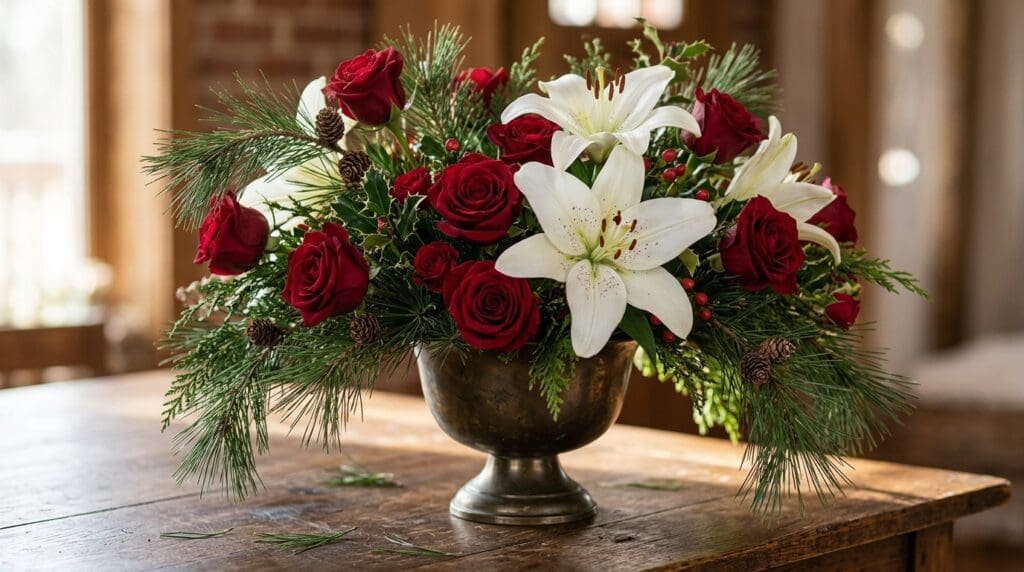
Use: red roses, white lilies, pine, eucalyptus and restrained berry accents.
This gives a classic florist-delivery look with strong contrast and fragrance.
Cat owners: true lilies in the Lilium group can cause severe, potentially fatal kidney injury in cats. Use a lily-free version if cats have access to the room.
13. Eucalyptus and White Rose Minimalist Arrangement

Use: white roses, seeded or silver-dollar eucalyptus, and just a few evergreen sprigs.
This is one of the easiest arrangements to make look professionally restrained.
Do not fill every gap. Negative space is part of the design.
14. Magnolia Leaf and Red Rose Arrangement

Use: glossy magnolia foliage, red roses, cedar, and pinecones.
Magnolia gives you two colors from one leaf: glossy green above and warm brown beneath.
Turn some leaves deliberately so that both surfaces are visible.
15. Christmas Arrangement With Battery Candle

Use: a stable battery-operated pillar candle, fir, eucalyptus, carnations, chrysanthemums, and berries.
Battery-operated candles are especially useful when fresh greenery is near the candle area.
Mississippi State Extension specifically uses battery candles in professional Christmas centerpiece designs and notes their usefulness in spaces where open flames are restricted.
16. Twin-Taper Florist-Style Centerpiece

Use: two taper-style candle elements, red carnations, green hydrangea, white pine, noble fir, juniper, and ribbon.
Two vertical candle elements give structure to a low arrangement without requiring tall flower stems.
For home use, battery-operated taper candles eliminate the risk of an open flame near drying foliage.
17. Christmas Arrangement Without Floral Foam

Use: a flower frog, tape grid or reusable arranging grid inside a watertight bowl.
A foam-free centerpiece works particularly well with woody evergreen stems because those materials can help create their own structural framework.
Start with the strongest foliage stems, crossing them through the container to create support. Then add flowers into the spaces.
Best for: low bowls and modern arrangements where stems need firm support without floral foam.
The metal pin holder sits inside the vessel and grips stems at their cut ends. It is especially useful for minimalist designs with fewer, more deliberate stems.
18. Rustic Mason Jar Christmas Flowers

Use: carnations, alstroemeria, cedar, pine, and berries.
This works better as several small arrangements than one giant jar.
Repeat three similar jars down a long dining table for an inexpensive coordinated look.
19. Mini Christmas Tree Flower Arrangement
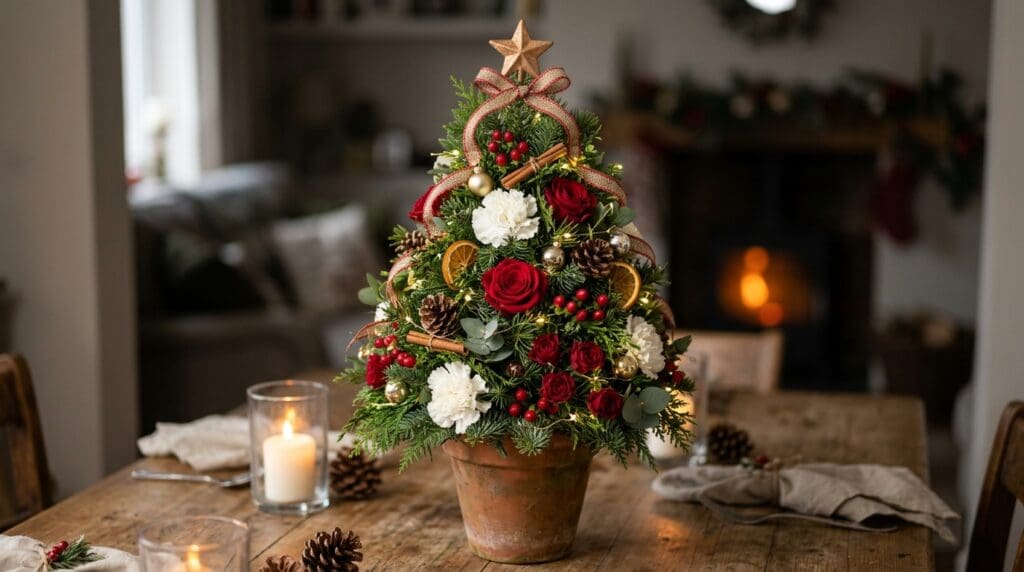
Use: upright evergreen stems shaped into a small cone, plus miniature flowers, berries and tiny ornaments.
Treat the greenery as the tree structure and use flowers like ornaments.
Small carnations, spray roses and hypericum berries work better than huge blooms.
20. Red and Green Kitchen Island Arrangement

Use: red roses, carnations, eucalyptus, pine and cedar in a taller vase.
A kitchen island is one place where the arrangement can be taller because guests are not trying to talk across it while seated.
21. Winter White Entryway Arrangement

Use: tall white branches, white roses, hydrangea, eucalyptus and fir.
Entryway flowers should read from several feet away. Use larger forms and more height than you would at the dining table.
22. Burgundy Rose and Copper Centerpiece

Use: burgundy roses, dark red carnations, eucalyptus, pine and copper-toned ornaments.
Copper is warmer than silver and less traditional than bright gold, making it a good match for dark wood dining tables.
23. Scandinavian Green-and-White Christmas Arrangement

Use: white flowers, pine, fir, eucalyptus and natural wood or ceramic accents.
Skip shiny ornamentation and concentrate on greenery texture, simple white flowers and a neutral vessel.
24. Christmas Flower Arrangement in a Basket

Use: a waterproof liner inside the basket, evergreen, carnations, roses, berries and pinecones.
The liner matters. Never assume a decorative basket can hold water safely on furniture.
25. Florist’s-Choice Christmas Arrangement
If you are ordering rather than making the arrangement yourself, one of the best value strategies is often giving the florist flexibility.
Instead of demanding a long list of specific flowers, specify:
- Your budget
- Red/white / green or another color palette
- Table or display location
- Desired dimensions
- Whether candles are wanted
- Flowers that must be avoided
- Whether pets are present
A florist who can substitute based on fresh inventory often has more room to create a fuller design at the same budget.
A Foolproof DIY Christmas Centerpiece Recipe
If you only make one arrangement from this article, start here.
For one medium long-and-low centerpiece:
- 6 red roses
- 6 red carnations
- 5 white chrysanthemums
- 4–6 fir or pine branches
- 3 eucalyptus stems
- 3 berry stems
- 3 pinecones
- 1 low watertight container
- Flower frog, tape grid or hydrated floral foam
- Commercial flower food
Step 1: Prepare the Flowers
Wash the container, add properly mixed flower-food solution and remove every leaf that would sit underwater.
Step 2: Build the Greenery Shape First
Insert fir or pine horizontally to establish the overall length and width.
Add eucalyptus slightly higher to soften the outline.
Step 3: Place the Roses
Use the roses as focal points. Place one near the visual center and distribute the rest unevenly around the design.
Perfect symmetry often makes a fresh arrangement look artificial.
Step 4: Add Carnations and Mums
Use these secondary flowers to fill the larger empty zones without burying the roses.
Step 5: Finish With Berries and Pinecones
Place these accents after the flowers. Think of them as punctuation, not filler.
Step 6: Check the Arrangement From a Seated Position
Put it on the actual dining table and sit down.
If you cannot comfortably see the person opposite you, shorten the central material now rather than during Christmas dinner.
Floral Foam vs Flower Frogs vs Tape Grids
| Mechanic | Best For | Trade-Off |
|---|---|---|
| Floral foam | Dense low centerpieces and difficult shapes | Single-use or limited-reuse material; must remain hydrated |
| Flower frog / kenzan | Low bowls and minimalist designs | Needs a stable vessel and deliberate stem placement |
| Tape grid | Vases and bowls with wide openings | Tape must adhere to a clean, dry rim |
| Reusable silicone grid | Simple vase arrangements | Must fit the vessel opening |
How to Make Christmas Flower Arrangements Last Longer
Christmas arrangements face one major enemy that spring bouquets often avoid: heated indoor air.
Fireplaces, radiators, furnace vents and sunny windows can accelerate water loss and flower decline.
Start With a Clean Vase
Wash previously used containers with hot soapy water and rinse thoroughly before adding flowers.
Remove Foliage Below the Waterline
Leaves sitting in water decay and encourage microbial growth.
Re-Cut the Stems
Make a fresh cut at the base with a clean, sharp tool and immediately return the stem to water.
Use Commercial Flower Food
Commercial floral preservative is designed to support hydration while controlling microbial growth.
Iowa State Extension specifically advises that common home remedies such as pennies, aspirin and random sugar mixtures do not perform as reliably as commercial floral preservative.
Best for: Christmas bouquets, vase arrangements and other fresh-cut flowers.
This version comes in individual 5-gram packets, making the dilution more repeatable than guessing at homemade additives.
Check the Water Daily
Dense evergreen arrangements can hide the water reservoir completely.
Do not assume there is still water simply because the arrangement looks fresh.
Keep the Arrangement Cool
Keep fresh flowers away from heating vents, radiators, direct strong sun and other heat sources whenever practical.
Remove Aging Flowers
One declining flower does not mean the whole centerpiece is finished. Remove spent flowers and replace individual stems if needed.
Pet Safety: Christmas Flowers to Think About Before You Buy
A beautiful Christmas centerpiece can become a veterinary problem if a curious cat or dog starts chewing it.
Lilies and Cats
This is the one I would take most seriously.
ASPCA warns that true Lilium lilies can cause severe kidney injury in cats. Even flower parts and pollen are a concern.
Amaryllis
ASPCA lists amaryllis as toxic to dogs and cats and notes gastrointestinal and other symptoms after ingestion.
Holly
Holly leaves and berries can cause vomiting, diarrhea and depression in dogs and cats.
Poinsettia
Poinsettia has an irritating sap and is listed as toxic to dogs and cats, although ASPCA notes that its toxicity is commonly exaggerated. Mouth and stomach irritation and occasional vomiting can occur.
Pet household: if you have a cat that investigates bouquets, the easiest approach is to request a lily-free arrangement rather than trying to place dangerous lilies “high enough.”
Should You Use Real Candles in a Fresh Christmas Arrangement?
Fresh greenery eventually becomes dry greenery.
That alone is enough reason to be conservative around open flame.
For arrangements where the visual effect matters more than a real flame, a stable battery-operated candle is the simpler option.
Mississippi State Extension specifically uses battery-operated candles in holiday floral designs because they are practical for venues where open flames may be restricted.
DIY or Order From a Florist?
DIY Makes Sense When:
- You enjoy arranging flowers.
- You already have greenery available.
- You need several similar centerpieces.
- You want complete control over colors and pet-safe choices.
- You can buy flowers several days before the event and condition them properly.
Use a Florist When:
- The arrangement is a gift being delivered.
- You need premium flowers that are difficult to source locally.
- You need a large formal centerpiece.
- The event has several tables.
- Timing matters and you cannot afford an unsuccessful DIY arrangement.
- You want the arrangement professionally transported.
How to Order a Better Christmas Arrangement From a Florist
Instead of saying only “I need Christmas flowers,” tell the florist:
- Your total budget
- Where the flowers will sit
- Approximate table dimensions
- Preferred colors
- Whether you want a low centerpiece or upright bouquet
- Whether cats or dogs are in the home
- Whether lilies, poinsettias, amaryllis or other plants must be excluded
- Whether the recipient prefers traditional or modern styling
- Whether the container should be reusable
Then allow some flexibility in exact flower varieties.
A good florist can often make a fuller arrangement when allowed to use the strongest fresh inventory available that day.
12 Christmas Flower Arrangement Mistakes to Avoid
1. Making a Dining Centerpiece Too Tall
If people have to lean around the flowers to talk, the arrangement is failing at its main job.
2. Using Too Many Christmas Colors
Red, burgundy, white, silver, gold, plaid, glitter and multicolor ornaments do not all need to appear in the same bowl.
3. Spending the Entire Budget on Roses
A few focal roses plus carnations, mums and abundant greenery often look fuller than a sparse all-rose arrangement.
4. Ignoring Greenery Texture
Mixing two or three types of greenery creates more depth than using a single flat evergreen texture.
5. Leaving Leaves Underwater
Submerged foliage breaks down and shortens usable vase life.
6. Using Dirty Containers
Fresh flowers deserve fresh water in a properly cleaned vase.
7. Putting Flowers Beside a Heating Vent
Warm moving air speeds dehydration.
8. Using Open Flame Too Close to Greenery
Battery-operated candles remove much of this risk without changing the visual idea.
9. Forgetting About Pets
Lilies, amaryllis, holly and poinsettias deserve special consideration in pet households.
10. Buying by Photograph Alone
When ordering online, check the arrangement size, flower substitutions, vase, delivery fee and final checkout price.
11. Building the Arrangement Before Preparing the Flowers
Condition, trim and clean stems first. Do not improvise stem preparation halfway through the design.
12. Making Every Stem the Same Height
Small height changes create depth. Perfectly level flowers often look stiff and artificial.
Final Verdict: The Best Christmas Arrangements Are Simpler Than They Look
The strongest Christmas flower arrangements do not necessarily use the largest number of flowers.
They use a clear idea.
Choose one color story.
Use seasonal greenery to establish the shape.
Add a few strong focal flowers.
Fill with more economical secondary blooms.
Then stop before every pinecone, ornament and ribbon in the house ends up in the same centerpiece.
For a dining table, I would start with a long-and-low red, white and evergreen arrangement.
For something more contemporary, use white flowers with eucalyptus and restrained evergreen.
For maximum impact, amaryllis or premium roses make excellent focal flowers.
And if you are ordering from a florist, give them your budget, color palette and practical requirements — then allow enough flexibility to use the best fresh flowers they have available.
A Christmas arrangement should make the table feel finished, not make everyone wonder where they are supposed to put the dinner.
Christmas Flower Arrangements FAQ
What flowers are best for Christmas arrangements?
Red and white roses, carnations, chrysanthemums, amaryllis, poinsettias, hydrangeas and seasonal berries are common choices. Fir, pine, cedar, eucalyptus and other evergreen foliage create the holiday structure around the flowers.
What flowers do florists use at Christmas?
Current florist collections commonly use red roses, white roses, carnations, lilies, amaryllis, poinsettias, chrysanthemums and seasonal greenery such as fir and pine.
How much does a Christmas flower arrangement cost?
Many current online Christmas arrangements begin around $40–$95, while large or premium florist centerpieces can exceed $100–$200. Delivery fees, size, container and local flower pricing affect the final cost.
What is the best Christmas centerpiece for a dining table?
A long-and-low arrangement is usually the most practical choice because it provides substantial decoration without blocking the view between seated guests.
How tall should a Christmas table flower arrangement be?
There is no single required height, but a seated dining arrangement should stay low enough that guests can comfortably see and speak across the table. Test the finished arrangement from a dining chair before the event.
How do you make a simple Christmas flower arrangement?
Start with evergreen foliage to establish the shape. Add several focal flowers such as roses, fill the remaining gaps with carnations or chrysanthemums, then finish with berries and pinecones.
How do you make Christmas flowers look expensive?
Use a small number of premium focal flowers, abundant fresh greenery and a restrained color palette. Group flowers in small clusters instead of scattering every stem evenly.
What greenery is best for Christmas arrangements?
Fir, pine, cedar, juniper, eucalyptus and magnolia are useful options. Combining more than one foliage texture usually gives an arrangement more depth.
Can you make a Christmas arrangement without floral foam?
Yes. Flower frogs, reusable arranging grids and tape grids can support stems in water-filled containers without floral foam.
What can I use instead of floral foam?
A metal flower frog or kenzan, waterproof tape grid, reusable silicone grid or interlocking woody foliage stems can all provide structure depending on the container and design.
How do you keep Christmas flower arrangements fresh?
Use a clean container, remove leaves below the waterline, make fresh stem cuts, use commercial floral preservative, maintain the water level and keep flowers away from strong heat sources.
How often should I add water to a Christmas centerpiece?
Check the water level every day. Dense evergreen arrangements can hide the reservoir, and flowers may consume more water than expected in heated winter rooms.
Can I make a Christmas flower arrangement the day before?
Yes. Many arrangements benefit from being made ahead, provided they remain hydrated and are stored in a cool location away from freezing conditions and strong heat.
Are carnations good for Christmas arrangements?
Yes. Red and white carnations are useful Christmas flowers because they provide strong color, good visual volume and often cost less than premium roses.
Are roses good for Christmas arrangements?
Yes. Red and white roses remain common focal flowers in Christmas bouquets and centerpieces. They pair especially well with evergreen foliage, berries and pinecones.
Can you use poinsettias in flower arrangements?
Yes, poinsettias can create dramatic Christmas color, but the stems contain irritating sap and the plant should be kept away from pets that may chew it.
Is poinsettia poisonous to pets?
ASPCA lists poinsettia as toxic to dogs and cats because its sap can irritate the mouth and stomach, although ASPCA also notes that the plant’s toxicity is commonly exaggerated.
Are amaryllis safe around pets?
No. ASPCA lists amaryllis as toxic to dogs and cats. Pet households should keep the plant securely out of reach or choose another flower.
Are Christmas lilies safe around cats?
True Lilium species are particularly dangerous to cats and can cause severe kidney injury. Cat households are safest requesting lily-free bouquets and arrangements.
Can you put candles in Christmas flower arrangements?
Candles are common holiday design elements, but fresh greenery can dry over time. Battery-operated candles provide a similar visual effect without an open flame near foliage.
What colors work for Christmas flower arrangements?
Traditional red, white and green remains popular, but white and silver, burgundy and copper, red and gold, and green-and-white minimalist palettes also work well.
What is the cheapest way to make a Christmas centerpiece?
Use evergreen clippings for most of the volume, then add economical carnations and chrysanthemums with a smaller number of roses or other focal flowers.
What should I tell a florist when ordering Christmas flowers?
Provide your budget, color preference, arrangement location, approximate size, style, delivery date and any flowers that must be excluded for allergy, pet-safety or personal reasons.
Is florist’s choice a good option for Christmas flowers?
It can be. Giving a florist flexibility within a defined budget and color palette allows them to use the freshest seasonal inventory available rather than forcing substitutions for unavailable varieties.
How early should I order Christmas flowers?
Order earlier rather than later if you need a specific delivery date, premium flowers or a custom centerpiece. Florist capacity and particular varieties become more limited as Christmas approaches.
Can I use grocery-store flowers for a Christmas arrangement?
Yes. A grocery bouquet can look much more intentional after separating the flowers, removing excess filler and rebuilding the arrangement with fresh evergreen, eucalyptus and a consistent color palette.
Join Garden Frontier for practical gardening, flower, home and seasonal ideas without the filler.
100% free. No spam. Unsubscribe anytime.