
















Every year, when I plan my backyard vegetable layout, I try to add at least one tomato that breaks the monotony of standard red slicers. A few seasons ago, I wanted something colorful for salads and sandwiches, so I planted the Jubilee tomato, often sold as Golden Jubilee tomato.
It earned a permanent place in my garden because it checks a lot of boxes: golden-orange fruit, mild flavor, meaty flesh, few seeds, strong production, and that old-fashioned heirloom charm that makes a tomato bed feel more interesting.
The Golden Jubilee tomato is not just another yellow tomato. It has real history behind it, too: Tomato Jubilee was a 1943 All-America Selections Vegetable Winner, which helps explain why it still shows up in seed catalogs and backyard gardens decades later.
If you are wondering whether Jubilee tomatoes are worth growing, the short answer is yes—especially if you want a productive golden slicing tomato with a sweeter, milder profile than wide red varieties.

Golden Jubilee Tomato Quick Facts
- Common names: Jubilee tomato, Golden Jubilee tomato, yellow Jubilee tomato
- Type: Heirloom, open-pollinated tomato
- Growth habit: Indeterminate
- Fruit color: Golden-orange to yellow-orange
- Fruit size: Usually medium to large, often around 6–12 ounces depending on growing conditions
- Days to maturity: About 70–80 days from transplant
- Flavor: Mild, sweet, meaty, lower-acid profile
- Best uses: Slicing, sandwiches, salads, salsa, sauce, tomato juice
- Support needed: Strong cage, stake, or trellis
- Best for: Gardeners who want a productive golden slicing tomato
Is Golden Jubilee Tomato Determinate or Indeterminate?
Golden Jubilee tomato is indeterminate.
That means the plant grows as a vining tomato and continues producing fruit through the season until frost, rather than setting one main crop all at once like a determinate tomato.
This is one of the most important things to know before planting it. Jubilee vines can get tall and heavy, especially when they are loaded with fruit. In my garden, I treat them like serious indeterminate slicers—not casual patio tomatoes.
Most reputable seed listings describe Jubilee as an indeterminate tomato, and that matches exactly how it behaves in the garden: tall vines, steady production, and fruit continuing over a long season.
My first mistake with Jubilee was using cheap wire cone cages. By midseason, the vines were leaning, the fruit was pulling the cages sideways, and I was tying emergency supports with twine. Since then, I use heavy-duty cages, tall stakes, or a trellis system.
My Support Recommendation
For indeterminate vines like Golden Jubilee, skip thin wire tomato cones. Use heavy-duty square tomato cages, tall stakes, cattle panel, or a Florida weave system.
What Does a Jubilee Tomato Taste Like?
Jubilee tomatoes have a mild, sweet, meaty flavor. They are not sharp or intensely tangy like some red tomatoes. If you like a softer, less acidic tomato flavor, this variety is an excellent fit.
I would describe the taste as sweet, gentle, and old-fashioned. It is not a super-acidic tomato sauce, nor is it a tiny, candy-sweet cherry tomato. It sits in that useful middle ground: flavorful enough for fresh eating and mild enough for people who do not love sharp red slicers.
Seed catalogs commonly describe Golden Jubilee as a mild, meaty, golden-orange tomato with relatively few seeds and a lower-acid flavor profile. That matches my experience: it is a beautiful slicing tomato when you want sweetness and color without the sharp bite of wide red varieties.
Are Jubilee Tomatoes Low Acid?
Jubilee tomatoes are commonly described as low-acid or lower-acid compared with many red slicing tomatoes.
I would be careful with this point, though. “Low-acid” in seed catalogs usually describes flavor profile, not a medical guarantee. If you are sensitive to acidic foods, try a small amount first and adjust according to your dietary needs.
From a gardener’s perspective, the important point is that Jubilee tomatoes taste milder and sweeter than many classic red tomatoes. That makes them excellent for fresh slices, tomato juice, summer salads, and colorful salsa.
Golden Jubilee Tomato Size, Height, and Plant Habit
Golden Jubilee is usually a medium-to-large slicing tomato. Fruit size varies depending on seed source, soil fertility, pruning, watering, and weather.
In most gardens, expect fruits in the medium-to-large range, often roughly 2.5 to 3.5 inches across. Many fruits land around 6–8 ounces, but well-grown plants can produce larger tomatoes when soil, water, and support are dialed in.
| Trait | Golden Jubilee Tomato |
|---|---|
| Plant habit | Indeterminate vining tomato |
| Typical height | Often 6 feet or taller with good support |
| Fruit color | Golden-orange / yellow-orange |
| Fruit texture | Meaty, thick-walled, relatively few seeds |
| Flavor | Mild, sweet, lower-acid profile |
| Days to maturity | About 70–80 days from transplant |
How to Grow Jubilee Tomatoes From Seed
Golden Jubilee tomatoes are remarkably simple to start from seed if you give them warmth, light, and enough time before transplanting.
1. Start Seeds Indoors
Start seeds indoors about 6–8 weeks before your last expected spring frost. I use a sterile seed-starting mix, cell trays, and a heat mat if the room is cool.
Tomato seeds germinate best in warm conditions. Once seedlings emerge, move them under strong grow lights to prevent them from stretching and becoming leggy.
Need Seeds?
Golden Jubilee tomato seeds are usually sold as heirloom, open-pollinated seeds. Look for fresh seed packets from reputable sellers and check the expected maturity date before buying.
2. Pot Up the Seedlings
When seedlings develop their first true leaves, pot them up into larger containers. This gives the roots more room and helps create sturdy transplants.
If the stems are a little leggy, bury them slightly deeper when potting up. Tomatoes can root along buried stem tissue, which helps create a stronger plant.
3. Harden Off Before Planting
Do not move indoor seedlings straight into full sun and wind. Harden them off gradually for 7–10 days by placing them outside for short periods, increasing exposure each day.
This step prevents sunscald, transplant shock, and snapped stems.
Planting Golden Jubilee Tomatoes Outside
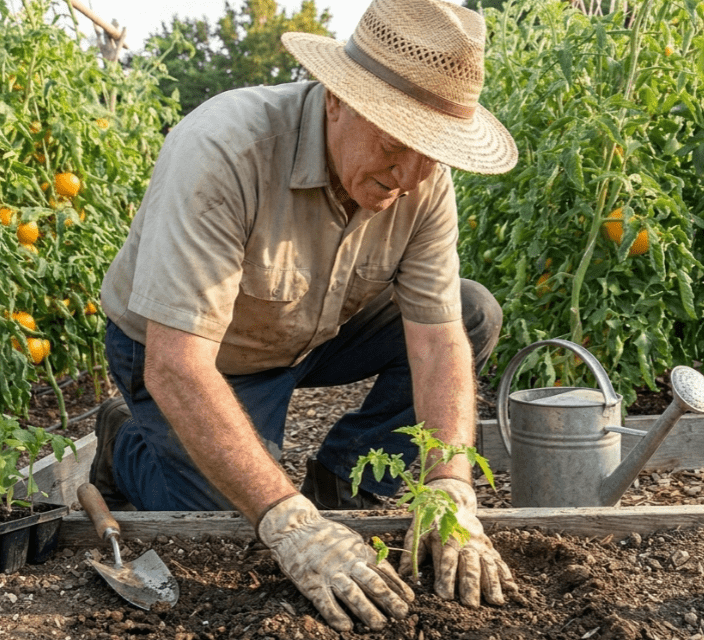
Transplant Golden Jubilee tomatoes after danger of frost has passed and the soil has warmed. Choose a spot with full sun, good air circulation, and fertile, well-drained soil.
I like planting Jubilee tomatoes deep. I remove the lowest leaves and bury the stem so the plant can root along the buried portion. This gives the plant a stronger root system for summer heat and heavy fruit production.
Spacing
Give Golden Jubilee tomatoes enough room. For caged or staked plants, I prefer about 24–36 inches between plants. If you let them sprawl, they need much more space—but I do not recommend sprawling this variety.
Soil Prep
Before planting, mix compost into the bed and avoid overdoing nitrogen. Too much nitrogen can create giant leafy vines with fewer tomatoes.
For best results, aim for steady fertility, consistent watering, and mulch to protect soil moisture.
Watering and Feeding Jubilee Tomatoes
Jubilee tomatoes produce best with even moisture. Inconsistent watering can lead to splitting, stress, and blossom-end rot.
I water deeply rather than lightly sprinkling every day. A drip line or soaker hose is ideal because it keeps foliage dry while sending water directly to the roots.
My watering routine
- Water deeply after transplanting.
- Keep soil evenly moist, not soggy.
- Mulch with straw, shredded leaves, or untreated grass clippings.
- Avoid overhead watering when possible.
- Increase watering during fruit set and hot weather.
Useful Tomato Growing Supplies
If you are setting up a tomato bed, the most useful add-ons are not fancy. I would prioritize cages, mulch, drip irrigation, pruning snips, plant labels, and a balanced tomato fertilizer.
Should You Prune Golden Jubilee Tomatoes?
Yes, I recommend light pruning for Golden Jubilee tomatoes because they are indeterminate and can become dense.
You do not need to strip the plant bare. In fact, too much pruning can expose fruit to sunscald. My goal is airflow and structure, not turning the plant into a single naked vine.
How I prune Jubilee tomatoes
- Remove lower leaves that touch the soil.
- Remove crowded suckers if the plant gets too dense.
- Keep one to three main leaders depending on your support system.
- Do not remove too much foliage during hot weather.
- Prune on dry mornings so cuts heal quickly.
If you are using a single stake, prune more aggressively. If you are using a large cage or cattle panel, you can leave more growth.
When to Pick Golden Jubilee Tomatoes
Golden Jubilee tomatoes are ready when the fruit turns a rich golden-orange color and gives slightly under gentle pressure.
Do not pick too early when they are still pale yellow and hard unless bad weather is coming. The best flavor develops when the fruit has fully colored and softened slightly.
Harvest signs
- The tomato turns deep golden-orange.
- The skin looks smooth and glossy.
- The fruit feels heavy for its size.
- It gives slightly when gently squeezed.
- The shoulders are no longer hard green.
My storm tip: if a heavy rainstorm is coming and the fruit has started to color, pick it at the breaker stage and ripen it indoors. Big heirloom-style tomatoes can split after sudden heavy watering.
What Are Jubilee Tomatoes Best Used For?
Jubilee tomatoes are excellent fresh-eating tomatoes. Their meaty texture and mild flavor make them very useful in the kitchen.
Best uses
- Sliced tomato sandwiches
- BLTs
- Fresh salads
- Colorful salsa
- Tomato juice
- Fresh sauce
- Stuffed tomatoes
- Caprese-style plates with a yellow-orange color
Because they are less sharp than many red tomatoes, I like pairing them with herbs, salt, basil, mozzarella, cucumbers, sweet onions, and mild peppers.
Can You Can Golden Jubilee Tomatoes?
You can preserve Jubilee tomatoes, but do not assume yellow or mild tomatoes are automatically safe to can without acidification. Follow a tested canning recipe from a trusted source and use the required bottled lemon juice, citric acid, or vinegar when the recipe calls for it.
For casual home use, I prefer freezing extra Jubilee tomatoes for sauce or juice. Freezing is simpler and avoids the food-safety precision required for canning.
Common Problems When Growing Jubilee Tomatoes
Jubilee tomatoes are productive, but they can still run into the same problems as other indeterminate tomatoes.
1. Weak support
This is the big one. The vines get heavy. Use strong support early, not after the plant is already leaning.
2. Cracking after rain
Large tomatoes can crack when water uptake changes suddenly. Mulch and consistent watering help.
3. Blossom end rot
This is usually related to inconsistent watering and calcium movement in the plant, not simply a lack of calcium in the soil.
4. Dense foliage
Indeterminate tomatoes can turn into a jungle. Light pruning improves airflow.
5. Sunscald
Do not over-prune in hot climates. The fruit needs some leaf cover.
Golden Jubilee Tomato Review: Is It Worth Growing?
Yes, I think Golden Jubilee is worth growing if you want a golden-orange slicing tomato with mild flavor and steady production.
It is not the tomato I would choose if I wanted a super-rich, acidic, old-school red tomato. It is also not a tiny snack tomato for grazing in the garden. But for sandwiches, salads, tomato juice, and color contrast on a plate, it is excellent.

My Verdict
Grow Golden Jubilee tomato if you want:
- A productive indeterminate heirloom
- Golden-orange slicing tomatoes
- Mild, sweet, lower-acid flavor
- Meaty flesh and fewer seeds
- A tomato that stands out from standard red varieties
Skip it if you want: a compact patio tomato, a determinate paste tomato, or the strongest acidic tomato flavor.
Final Thoughts
The Jubilee tomato is one of those varieties that looks beautiful in the garden and earns its space in the kitchen. It is productive, mild, colorful, and useful in more ways than I expected when I first planted it.
The most important thing is to treat it like the indeterminate tomato it is. Give it strong support, steady water, full sun, and enough room. Do that, and Golden Jubilee can reward you with a long season of glowing golden-orange fruit.
If your tomato garden feels too red and predictable, Jubilee is one of the first yellow-orange heirlooms I would add.
FAQ: Golden Jubilee Tomato
Is Golden Jubilee tomato determinate or indeterminate?
Golden Jubilee tomato is indeterminate. The vines continue growing and producing through the season until frost, so they need strong staking, cages, or trellising.
Are Jubilee tomatoes low acid?
Jubilee tomatoes are commonly described as low-acid or lower-acid compared with many red slicing tomatoes. They have a mild, sweet flavor, but this should be understood as a flavor description rather than a medical guarantee.
When should I pick Golden Jubilee tomatoes?
Pick Golden Jubilee tomatoes when they turn a rich golden-orange color, look glossy, feel heavy, and give slightly under gentle pressure.
How tall do Golden Jubilee tomato plants get?
Golden Jubilee is an indeterminate tomato, so plants can often grow 6 feet or taller with good support and a long growing season.
How big are Jubilee tomatoes?
Jubilee tomatoes are usually medium to large slicing tomatoes. Many fruits are around 2.5 to 3.5 inches across and roughly 6–12 ounces depending on growing conditions and seed source.
How long do Golden Jubilee tomatoes take to mature?
Most sources list Golden Jubilee around 70–80 days from transplant, depending on seed strain, weather, and growing conditions.
What do Jubilee tomatoes taste like?
Jubilee tomatoes taste mild, sweet, and meaty. They are less sharp than many red slicing tomatoes and are often described as having a lower-acid flavor profile.
Are Jubilee tomatoes heirloom?
Yes. Jubilee or Golden Jubilee tomato is commonly sold as an heirloom, open-pollinated tomato variety.
Are Jubilee tomatoes good for sandwiches?
Yes. Jubilee tomatoes are excellent for sandwiches because they are meaty, mild, and have fewer seeds than many juicy red slicers.
Can you save seeds from Golden Jubilee tomatoes?
Yes, because Golden Jubilee is open-pollinated. To keep the variety true, save seeds from healthy plants and avoid cross-pollination with nearby tomato varieties when possible.
Can you grow Golden Jubilee tomatoes in containers?
You can grow Golden Jubilee tomatoes in large containers, but they need a big pot, strong support, full sun, consistent watering, and regular feeding. A small patio pot is not ideal.
What is the difference between Jubilee and Golden Jubilee tomato?
In most seed catalogs and garden listings, Jubilee and Golden Jubilee are used for the same golden-orange heirloom tomato variety. Some sellers may use slightly different naming, so check the plant description, fruit color, and growth habit.