











An end grain cutting board looks expensive before you even pick it up.
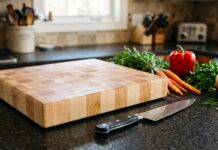
The checkerboard surface, extra thickness and weight make it feel more like a piece of butcher-block furniture than an ordinary kitchen board.
There is a practical reason for that construction.
Instead of presenting the long sides of the wood fibers to your knife, an end grain board turns the wood so the fiber ends face upward. A knife edge can press between those fibers rather than repeatedly cutting across long fibers in the same way it does on many face- or edge-grain surfaces.
That generally creates a pleasant cutting feel, hides shallow knife marks well and is one reason serious cooks are willing to live with the extra weight and maintenance.
But end grain is not magic.
It does not literally heal itself, it is not automatically sanitary because it is wood, and paying $300 for a board does not make soaking it in a sink a good idea.
The best end grain cutting board is a well-built board made from appropriate hardwood, large enough for the way you cook, thick enough to stay stable and maintained so moisture does not destroy the glue joints or warp the block.

Yes, if you cook frequently and want a heavy, stable wooden cutting surface that is relatively forgiving to knife edges and can last for years with proper maintenance.
Hard maple is the safest default choice. Walnut is excellent when you want darker wood, cherry develops a warm patina, teak handles moisture well when properly cared for, and acacia can deliver strong value at lower prices.
The downside: end grain boards are heavier, more expensive and more dependent on proper washing and oiling than inexpensive plastic boards.
Best all-around size for many kitchens: roughly 18 × 12 to 20 × 15 inches, with about 1.5–2 inches of thickness for a serious primary board.
What Is an End Grain Cutting Board?
Picture a bundle of drinking straws standing upright.
The openings at the top represent the ends of the wood fibers.
That is roughly what you are looking at on the working surface of an end grain board.
To manufacture one, hardwood is cut into sections, rearranged so the end grain faces upward and glued into a block.
That creates the distinctive checkerboard or brick-like appearance associated with butcher blocks.
End Grain vs Edge Grain vs Face Grain
| Construction | What Faces Up | Typical Trade-Off |
|---|---|---|
| End grain | Ends of wood fibers | Premium cutting feel and repairable surface, but heavy and expensive |
| Edge grain | Narrow long edge of boards | Good durability with lower cost and weight |
| Face grain | Wide face of boards | Beautiful grain display but usually shows knife wear more readily |
TeakHaus describes edge grain as long strips of wood joined side by side, while its end grain boards expose the ends of those fibers at the cutting surface.
For many home cooks, edge grain is actually the rational value choice.
It is thinner, lighter, cheaper and easier to move to the sink.
End grain starts making more sense when the board is used constantly and you value the cutting feel, mass and long-term ability to sand and maintain a substantial wood surface.
Why End Grain Feels Different Under a Knife
With an end grain surface, the knife edge meets the ends of the fibers rather than repeatedly crossing the long side grain.
Under pressure, fibers can separate slightly around the knife edge and then move back toward their original position.
That is where the popular phrase “self-healing cutting board” comes from.
Is End Grain Really Self-Healing?
Not literally.
A deep gouge does not regenerate new wood.
What happens is less dramatic: shallow knife tracks can become visually less obvious because the fiber orientation allows them to close around the cut instead of leaving a long severed groove across the grain.
A heavily damaged board can still need sanding or eventually replacement.
So when a manufacturer says “self-healing,” read it as good at hiding and recovering from ordinary shallow knife scoring, not Wolverine in cutting-board form.
Does an End Grain Board Keep Knives Sharper?
End grain is generally considered a knife-friendly cutting surface because the edge can move into the fiber structure rather than repeatedly striking across dense long grain.
That does not mean your chef’s knife stops needing sharpening.
Knife wear also depends on:
- Steel hardness
- Edge angle
- Cutting technique
- How hard you chop
- The wood species
- Whether you use serrated blades on the board
- How clean the cutting surface is
The Boardsmith specifically describes its end grain boards as easier on knives than other board constructions, while current independent kitchen-equipment reviews continue to favor quality maple end grain boards for knife-friendly prep.
End Grain Cutting Board Pros and Cons
Advantages
- Excellent cutting feel
- Generally gentle on knife edges
- Shallow knife marks tend to be less visible
- Heavy boards remain stable during chopping
- Can be sanded and refinished
- Attractive butcher-block appearance
- Available in maple, walnut, cherry, teak, acacia and other hardwoods
- A quality board can remain in service for many years
Disadvantages
- More expensive than most edge-grain or plastic boards
- Often heavy enough to be inconvenient to move
- Must be hand washed
- Should never be soaked
- Requires periodic conditioning with food-safe oil
- Can warp or crack when moisture is badly managed
- Contains many glue joints, making workmanship important
- Large premium models can cost several hundred dollars
Best End Grain Cutting Boards to Consider in 2026
The recommendations below are based on construction, published specifications, manufacturer care requirements, current availability and established independent recommendations.
We are not claiming hands-on testing of these specific boards.
Best for: someone who wants a substantial traditional hard-maple butcher block and plans to keep it for years.
The Boardsmith makes its standard maple board from FSC-certified hard maple and offers 12 × 18, 16 × 22 and 18 × 24-inch sizes, generally at a full 2 inches thick.
Feet, finger grooves and juice-groove options make it possible to configure the board for a permanent countertop setup rather than treating it like a thin board that gets stored after every meal.
Why we like the specification: maple is the classic butcher-block material, 2-inch construction provides real mass, and the manufacturer is unusually transparent about oiling, moisture control and care.
Watch for: price and weight. A large Boardsmith is closer to kitchen equipment than a lightweight chopping mat.
Best for: getting into a substantial end grain board without jumping directly into premium maple pricing.
The Ironwood Gourmet Large End Grain Prep Station uses acacia and measures about 20 × 14 × 1.25 inches.
That is a genuinely useful prep size while remaining thinner and lighter than many 2-inch butcher blocks.
Serious Eats has kept this model as a budget wooden-board recommendation for years and reaffirmed it again in 2026.
Why we like the value: you get true end grain construction and a large usable surface at a much lower price than artisan maple or walnut boards.
Watch for: acacia varies more in color and density than hard maple, and this board does not have the mass of a 2-inch premium butcher block.
Best for: cooks who want end grain construction in teak plus a useful carving groove.
TeakHaus lists the 311 at approximately 16 × 12 × 1.5 inches and 10 pounds, with end grain construction, hand grips, a juice canal and reversible use.
It is also FSC-certified and currently positioned below many premium maple artisan boards.
Why we like the configuration: the 1.5-inch body gives it useful stability without creating a 20-pound object every time you need to wash the board.
Watch for: teak’s appearance can vary significantly and, like every glued wood board, it still needs controlled washing and drying despite teak’s natural oil content.
What Is the Best Wood for an End Grain Cutting Board?
Hard Maple: Best All-Around Choice
If you want one safe default answer, choose hard maple.
Northern hard maple has a long history in butcher blocks because it is dense, close-grained and durable without being absurdly hard against a knife edge.
The FDA Food Code specifically states that hard maple or an equivalently hard, close-grained wood may be used for cutting boards and cutting blocks in food-service applications.
That does not mean the FDA is endorsing one consumer brand. It simply confirms why hard maple remains such a traditional choice for food-contact cutting surfaces.
Read the current FDA Food Code.
Best for: heavy everyday kitchen use and buyers who want the traditional butcher-block material.
Black Walnut: Best Dark Premium Wood
Walnut gives an end grain board an entirely different personality.
Instead of pale blond maple, you get deep brown and chocolate tones with substantial natural variation.
Walnut is also somewhat softer than hard maple, which many cooks enjoy under a knife.
The trade-off is that premium walnut boards often cost more and the dark surface can show certain stains, oils and wear differently from maple.
Best for: a permanent countertop board where appearance matters almost as much as utility.
Cherry: Best for Warm Color and Patina
Cherry begins lighter and develops a richer reddish-brown appearance with age and exposure to light.
It is softer than hard maple and creates a very pleasant cutting surface.
The Boardsmith currently sells cherry alongside maple and walnut in its flagship end grain line.
Best for: buyers who want warm color and natural visual change over time.
Teak: Best for Moisture-Conscious Kitchens
Teak naturally contains more oil than many domestic hardwoods, which is one reason it is widely used where moisture resistance matters.
That does not make a teak cutting board waterproof.
TeakHaus still instructs owners to hand wash, towel dry and periodically condition its end grain boards.
Best for: cooks who like teak’s appearance and want a durable tropical hardwood from a supplier with clear sourcing information.
Acacia: Best Budget-Friendly Hardwood
Acacia is one of the reasons end grain boards are no longer automatically $200-plus products.
It can produce striking contrast between light and dark blocks, and products such as the Ironwood Gourmet board make true end grain construction available at more accessible prices.
The catch is that “acacia” covers many species and product quality varies widely.
A good acacia board can be excellent value. A bargain board with poor glue joints, thin construction or inadequate drying is not automatically a deal just because the wood looks dramatic.
If you like acacia elsewhere in the home, our acacia wood overview explains why the species group is so popular for furniture and household products.
What Wood Should You Avoid for a Cutting Board?
A cutting board is not the place to use random leftover lumber simply because it looks interesting.
Be cautious with:
- Unknown wood species
- Reclaimed wood with uncertain chemical history
- Pressure-treated lumber
- Painted or chemically preserved wood
- Very soft woods that scar deeply
- Boards with large open defects or unstable glue joints
For a food-contact board, known close-grained hardwood from a reputable maker is a much better bet than experimenting with mystery lumber.
What Size End Grain Cutting Board Should You Buy?
Small: Around 12 × 8 Inches
Useful for citrus, cheese, garnishes and quick prep.
Too small to serve as the primary board for most serious meal prep.
Medium: Around 18 × 12 Inches
This is the sweet spot for many home kitchens.
It gives enough room for vegetables, chicken portions and normal prep without making cleanup ridiculous.
Large: Around 20 × 15 to 22 × 16 Inches
Excellent when you prep large batches or want ingredients to stay on the board instead of migrating across the countertop.
Check your sink dimensions first.
A board you cannot comfortably wash is a board you will eventually resent.
Extra Large: 24 Inches and Up
At this point the board becomes a semi-permanent work surface.
The Boardsmith’s largest standard blocks can exceed 20 pounds, which is wonderful for stability and considerably less wonderful if you expect to carry one across the kitchen after every onion.
How Thick Should an End Grain Cutting Board Be?
Around 1.5–2 inches is a useful target for a serious everyday end grain board.
Thickness provides:
- Mass
- Stability
- More material for future sanding
- More substantial glue surface between blocks
But thicker is not automatically better.
A 3-inch block can be fantastic if it stays on the counter. It can be annoying if you are short, your counters are already high or you need to move it into a sink twice a day.
Feet or Reversible: Which Is Better?
Boards With Feet
Feet create airflow beneath the board, reduce sliding and make a heavy block easier to leave permanently on the counter.
The Boardsmith installs feet by default on many of its large blocks specifically because it considers airflow and moisture management important to stability.
Downside: you lose the ability to use both faces as full cutting surfaces.
Reversible Boards
A reversible board gives you twice the usable surface and makes it easy to dedicate one face to carving or messier tasks.
Downside: the board must be dried carefully so moisture does not remain trapped between the lower face and countertop.
If a reversible board has no feet, stand it on edge after washing until both faces are completely dry.
Do You Need a Juice Groove?
A juice groove is useful if you regularly carve:
- Roasts
- Chicken
- Turkey
- Watermelon
- Very juicy fruit
For ordinary vegetable prep, the groove can become annoying because diced food falls into it and the groove reduces flat working area.
My preference for a primary prep board is either no groove or a reversible board with a groove on only one face.
Finger Grips: Small Feature, Big Difference
Once a board reaches 10, 15 or 20 pounds, picking it up from a flat countertop becomes awkward.
Recessed finger grips are one of the few upgrades I would consider genuinely practical rather than decorative.
How to Clean an End Grain Cutting Board
End grain construction does not change the basic food-safety requirement: remove food residue and clean the board after use.
USDA recommends washing cutting boards with hot, soapy water after each use, rinsing with clear water and drying them.
For a glued end grain board, follow the manufacturer’s more conservative wood-care instructions:
- Remove loose food.
- Wash with warm or hot water and mild dish soap.
- Do not leave the board submerged.
- Rinse without prolonged soaking.
- Dry immediately with a clean towel.
- Stand the board on edge or allow airflow around both faces until completely dry.
See the USDA’s cutting-board food-safety recommendations.
Never put a quality glued end grain board in the dishwasher. Extended heat, water and moisture cycling can swell the wood, stress glue joints and cause warping or cracking. Major end grain manufacturers such as The Boardsmith and TeakHaus specifically require hand washing.
Can You Cut Raw Meat on a Wooden Cutting Board?
USDA states that consumers may use either wood or a nonporous cutting surface for raw meat and poultry.
The bigger concern is cross-contamination.
Both USDA and FDA recommend, where possible, using one cutting board for fresh produce and bread and another for raw meat, poultry and seafood.
That is a sensible reason to own a second inexpensive board even if your end grain butcher block is the centerpiece of the kitchen.
How to Oil an End Grain Cutting Board
Use food-safe mineral oil or a cutting-board conditioner specifically formulated for wood food-contact surfaces.
The Boardsmith uses food-safe mineral oil followed by a mineral-oil-and-beeswax board butter and recommends conditioning whenever the wood begins to look dry.
Simple Oiling Method
- Clean the board and let it dry completely.
- Apply food-safe mineral oil generously.
- Spread it across the entire face, edges and end areas.
- Oil the opposite face as well.
- Allow the wood to absorb the oil.
- Wipe away excess.
- Apply board cream or beeswax/mineral-oil conditioner if desired.
Oiling both faces is important because uneven moisture absorption can lead to warping.
The Boardsmith provides detailed instructions in its cutting-board care recommendations.
How Often Should You Oil an End Grain Board?
There is no universally useful calendar because a board washed twice a day dries out faster than one washed twice a week.
Look at the wood.
If it becomes lighter, chalky or obviously dry, it needs conditioning.
Manufacturers commonly recommend frequent oiling when a board is new, then moving to an as-needed schedule.
John Boos, for example, recommends at least monthly maintenance depending on use and household conditions, while TeakHaus suggests oiling some boards two or three times per month.
Do Not Use Olive Oil or Vegetable Oil
Cooking oil is not automatically cutting-board oil.
The Boardsmith and John Boos both advise against using ordinary vegetable, olive and similar cooking oils because they can oxidize and become rancid.
Use food-safe mineral oil or a purpose-made board conditioner instead.
Why End Grain Cutting Boards Warp
Wood continually exchanges moisture with its environment.
Warping becomes more likely when one part of the board becomes wetter or drier than another.
Common causes include:
- Leaving a wet board flat on the counter
- Soaking it in a sink
- Dishwasher use
- Drying only one face
- Conditioning only the upper face repeatedly
- Extreme heat
- Very dry indoor air
- Poorly dried wood before manufacture
- Poor glue-up or construction
If a board has no feet, drying it vertically helps air reach both large faces.
Can a Warped End Grain Board Be Fixed?
A slight moisture-related cup can sometimes improve after the board’s moisture content equalizes.
A severely twisted board, separated glue joint or structural crack is a different problem.
Do not keep using a board with deep openings that trap food and cannot be cleaned effectively.
Can You Sand an End Grain Cutting Board?
Yes, which is one advantage of buying a thick solid-wood board.
Light sanding can remove:
- Raised fibers
- Shallow stains
- Minor knife marks
- Small surface scratches
After sanding, remove all dust and recondition the wood with food-safe mineral oil.
Deep cracks or failing glue joints are not cosmetic sanding problems.
End Grain vs Plastic Cutting Board
Plastic wins convenience.
Wood wins feel and longevity when properly maintained.
| Factor | End Grain Wood | Plastic |
|---|---|---|
| Knife feel | Excellent | Varies by plastic |
| Dishwasher | No for glued premium boards | Often yes if manufacturer allows |
| Weight | Heavy | Usually light |
| Refinishing | Can often be sanded | Usually replaced when badly scarred |
| Maintenance | Hand wash + oil | Low |
| Price | Medium to very high | Usually low |
There is nothing wrong with owning both.
A large wooden board can be the primary vegetable, bread and general-prep surface while a dishwasher-safe plastic board handles especially messy raw-meat jobs.
End Grain vs Bamboo Cutting Board
Bamboo is not technically wood; it is a grass laminated into a board.
USDA notes that bamboo absorbs relatively little moisture and resists knife scarring.
Bamboo boards are typically lighter and cheaper than large end grain hardwood blocks.
The trade-off is cutting feel. Many cooks find bamboo noticeably harder under a knife than maple or walnut butcher block.
How Much Should an End Grain Cutting Board Cost?
There is a huge price spread because the category covers both mass-produced acacia boards and made-to-order artisan maple and walnut blocks.
Budget: roughly $50–$100 can buy a real end grain acacia or smaller teak board.
Mid-range: roughly $100–$200 opens up thicker teak, larger boards and better-known manufacturers.
Premium: handmade maple, cherry and walnut butcher blocks commonly start above $200 and can exceed $500 as size and customization increase.
The Boardsmith’s current flagship end grain line, for example, begins around the mid-$200 range, while larger configurations and premium walnut can cost substantially more.
What Makes an Expensive End Grain Board Better?
You are not only paying for species.
Look for:
- Properly dried hardwood
- Stable grain selection
- Clean glue joints
- Food-appropriate adhesive
- Generous thickness
- Flat machining
- Sanded edges and corners
- Reliable finish
- Clear care instructions
- Repair or warranty support
A $300 board is not automatically three times better than a $100 board.
But there is real labor in cutting, arranging, gluing, flattening, sanding and finishing dozens of individual end grain blocks accurately.
How to Make an End Grain Cutting Board
The basic process is simple to describe and surprisingly demanding to execute accurately.
- Select dry, appropriate hardwood.
- Joint and plane the stock square and parallel.
- Rip strips to consistent width.
- Glue the strips into an edge-grain panel.
- Flatten the panel.
- Crosscut it into equal strips.
- Rotate those strips so the end grain faces upward.
- Arrange the pattern.
- Glue the final block.
- Flatten carefully.
- Sand progressively.
- Round or chamfer edges.
- Apply food-safe mineral oil and conditioner.
The difficult part is flattening. End grain is demanding to machine. Do not assume every thickness planer is an appropriate or safe way to flatten an assembled end grain block. Follow the equipment manufacturer’s instructions and use a woodworking method appropriate to the machine and workpiece.
Because `how to make an end grain cutting board` has a very different DIY intent from buying one, it deserves its own dedicated woodworking article rather than turning this page into a full shop manual.
How to Choose an End Grain Cutting Board
1. Start With Wood Species
For the least complicated decision, choose maple.
Choose walnut for dark color, cherry for warm aging, teak for a tropical moisture-tolerant option or acacia when value is the priority.
2. Measure Your Counter and Sink
A giant board is wonderful until you cannot wash it.
Measure:
- Available countertop depth
- Distance beneath upper cabinets
- Sink width
- Dish-rack space
- Storage space if the board will not live on the counter
3. Check the Weight
Weight is a feature until you need to lift it.
A 10-pound board is stable and manageable for most people. A 20-plus-pound butcher block is essentially a countertop fixture.
4. Choose the Right Thickness
Around 1.5–2 inches works well for a serious primary board.
5. Decide Whether You Need a Juice Groove
Carving meat regularly? A groove is useful.
Mostly chopping vegetables? Flat uninterrupted space is usually better.
6. Look at How the Board Is Meant to Dry
Feet provide airflow. A reversible board should be stored so both sides can dry.
7. Read the Care Instructions Before Buying
If hand washing and periodic oiling already sound irritating, an expensive end grain board may be the wrong kitchen tool for you.
When an Edge Grain Board Is the Better Buy
End grain gets the prestige, but edge grain wins several practical categories.
Choose edge grain instead if you want:
- Lower price
- Lower weight
- A thinner board
- Easier sink cleanup
- Less countertop height
- Good hardwood performance without butcher-block mass
A quality edge grain maple board is a better purchase than a poorly assembled bargain end grain board.
When You Should Skip Wood Entirely
A dishwasher-safe nonporous board may make more sense if:
- You do not want to hand wash
- You regularly prep raw meat and want a dedicated sanitation-friendly surface
- You need a very lightweight board
- You have limited drying space
- You do not want to oil wood
Tools are supposed to fit the kitchen, not create another maintenance hobby you dislike.
Final Verdict: Who Should Buy an End Grain Cutting Board?
Buy an end grain board if you cook frequently, care about your knives and want a substantial work surface that can stay in service for years.
For most buyers, I would make the decision this way:
- Hard maple: best all-around traditional choice
- Walnut: best premium dark wood
- Cherry: best warm color and aging
- Teak: best tropical hardwood option
- Acacia: best path to lower-cost end grain construction
Then size the board around your sink and your body, not an Instagram photo.
A 24-inch butcher block is impressive. An 18-inch board you actually wash, dry and oil properly is more useful.
Most importantly, remember that the board’s life is determined after you buy it.
Keep it clean. Keep it dry. Oil it when the wood looks thirsty. Never soak it. And never introduce your expensive butcher block to a dishwasher.
End Grain Cutting Board FAQ
What is an end grain cutting board?
An end grain cutting board is made by arranging blocks of wood so the ends of the wood fibers form the cutting surface. This creates the characteristic checkerboard or butcher-block appearance.
Are end grain cutting boards better?
They are excellent for frequent cutting because they provide a pleasant, knife-friendly surface and shallow knife marks tend to be less visible. They are also heavier, more expensive and require more maintenance than many alternatives.
What is the best wood for an end grain cutting board?
Hard maple is the traditional all-around choice because it is hard, close-grained and durable. Walnut, cherry, teak and acacia are also common options with different colors, hardness and price points.
Is maple good for an end grain cutting board?
Yes. Hard maple is one of the traditional butcher-block woods, and the FDA Food Code specifically recognizes hard maple or equivalently hard, close-grained wood for cutting boards and blocks in food-service settings.
Is walnut good for cutting boards?
Yes. Black walnut is widely used for premium cutting boards. It is darker and somewhat softer than hard maple, producing an attractive and pleasant cutting surface.
Is acacia good for an end grain cutting board?
Acacia can provide excellent value and attractive natural variation. Quality varies between products, so construction, thickness, glue joints and manufacturer reputation matter.
Is teak good for cutting boards?
Teak is widely used for cutting boards and contains natural oils that contribute to moisture resistance. It still requires hand washing, thorough drying and periodic conditioning.
Are end grain boards self-healing?
“Self-healing” is an exaggeration if taken literally. End grain fibers can move around shallow knife cuts so scoring becomes less visible, but deep cuts and gouges do not regenerate new wood.
Are end grain cutting boards better for knives?
End grain is generally considered a knife-friendly surface because the blade can move between exposed wood fibers rather than repeatedly cutting across long grain.
How thick should an end grain cutting board be?
About 1.5–2 inches is a useful range for a substantial everyday end grain board. Thicker boards add mass and stability but also increase weight and countertop height.
What size end grain cutting board should I buy?
Around 18 × 12 to 20 × 15 inches works well for many kitchens. Measure your countertop and sink before buying a very large board.
Can you put an end grain cutting board in the dishwasher?
No. Quality glued end grain boards should be hand washed. Dishwasher heat and prolonged moisture can contribute to warping, cracking and glue-joint damage.
How do you clean an end grain cutting board?
Wash it with warm or hot soapy water, rinse without prolonged soaking, towel dry immediately and allow air to reach both sides until the board is completely dry.
Can you cut raw meat on a wood cutting board?
USDA states that consumers may use wood or nonporous cutting boards for raw meat and poultry. To reduce cross-contamination, using a separate board for raw meat, poultry and seafood is recommended.
How often should you oil an end grain cutting board?
Oil the board whenever the wood begins looking dry or pale. A heavily used and frequently washed board needs conditioning more often than one used occasionally.
What oil should you use on a cutting board?
Food-safe mineral oil is a standard choice. Mineral-oil-and-beeswax board conditioners can add additional surface protection.
Can you use olive oil on a cutting board?
It is better to use food-safe mineral oil or a purpose-made board conditioner. Major wood-board manufacturers advise against ordinary cooking oils because they can oxidize and become rancid.
Why did my end grain cutting board warp?
Uneven moisture is a common cause. Soaking, drying one face while the other remains wet, dishwasher use, trapped water beneath the board and very dry conditions can all contribute to movement.
Can you sand an end grain cutting board?
Yes. Light sanding can restore a worn solid-wood surface. Remove dust completely and recondition the board with food-safe mineral oil afterward.
Is end grain better than edge grain?
End grain provides a premium cutting surface and hides shallow knife wear well, while edge grain is lighter and usually less expensive. The better choice depends on budget, size and how much maintenance and weight you want.
Why are end grain cutting boards so expensive?
They require more machining and glue-up than simple boards. Wood must be milled, glued into panels, crosscut, rearranged, glued again, flattened, sanded and finished accurately.
Can I make an end grain cutting board myself?
Yes, but accurate milling, glue-up and flattening are important. End grain can also be demanding to machine, so use woodworking equipment only in ways approved by its manufacturer.
Join Garden Frontier for practical home, kitchen, woodworking, gardening and outdoor advice without the filler.
100% free. No spam. Unsubscribe anytime.