











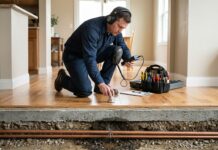




Slab leak repair does not automatically mean a plumber has to jackhammer through the middle of your living room.
Sometimes direct access through the slab is the correct repair. In other homes, a plumber may reroute the leaking line through walls or an attic, tunnel beneath the foundation, or use a trenchless lining method when the pipe and damage are suitable for it.
That is why the first expensive decision should not be “Where do we break the concrete?”
It should be:
Where is the leak, what pipe has failed, and which repair method fixes the problem with the least unnecessary demolition?
Current 2026 national data puts many professional slab leak repairs between $630 and $4,400, with an average around $2,280. But the final bill can rise well beyond that if the leak damages flooring, cabinets, drywall, subflooring or the foundation itself.

Typical 2026 range: about $630–$4,400.
National average: about $2,280, including leak detection.
Leak detection alone: commonly about $150–$400.
Rerouting: often around $600–$4,000, depending on the route and amount of new plumbing.
Drain line repair: roughly $800–$5,000 in current national planning data.
Important: flooring, cabinets, drywall, mold remediation and concrete build-back can add substantially to the plumbing repair itself.
A licensed plumber can locate the leak before unnecessary flooring or concrete is removed and explain whether spot repair, rerouting, lining or another approach makes sense.
What Is a Slab Leak?
A slab leak is a plumbing leak associated with piping beneath or within a concrete slab foundation.
The classic example is a leaking pressurized hot- or cold-water line running below the house.
Drain and waste lines beneath a slab can also fail, although the symptoms and repair approach may differ from a pressurized supply-line leak.
Because the pipe is hidden beneath concrete, flooring and often finished living space, the plumbing repair itself may be relatively small while accessing the pipe becomes the expensive part.
Slab Leak Warning Signs You Should Not Ignore
No single symptom proves that a pipe is leaking below the slab, but several signs together should get your attention.
What to Do If You Suspect a Slab Leak
- Stop unnecessary water use. Turn off faucets, irrigation, washers, dishwashers and water-using appliances.
- Check the water meter. If it continues registering flow while everything should be off, hidden water use is possible.
- Look for visible leaks first. Check toilets, faucets, water heater connections, irrigation and appliances before assuming the leak is under concrete.
- Know where the main shutoff is. If water is actively damaging the home, shutting off the supply may limit additional damage.
- Call a licensed plumber for professional leak detection. Do not start removing flooring or drilling concrete based only on a guess.
Emergency note: if water reaches electrical equipment, receptacles or energized wiring, avoid contact with the wet area and get appropriate professional help. Water damage is expensive; an electrical injury is worse.
Slab Leak Repair Cost in 2026
Current Angi 2026 project data puts the average slab leak repair at approximately $2,280, with many jobs falling between $630 and $4,400.
The reason the range is so broad is simple: repairing two inches of damaged pipe may be easy. Reaching those two inches through tile, hardwood, cabinetry and reinforced concrete may not be.
See the current Angi 2026 slab leak cost data.
Those are planning ranges, not quotes. Your actual price depends on the pipe, access, finish materials and damage already present.
What Makes Slab Leak Repair Expensive?
Leak Location
A leak under an unfinished utility area is very different from a leak directly beneath a kitchen island, stone floor or custom cabinetry.
Access
The more flooring, concrete, wall material or cabinetry that must be removed and rebuilt, the more the project costs.
Repair Method
A short spot repair can cost far less than rerouting several water lines or lining a long damaged pipe.
Water Damage
Wet flooring, subflooring, drywall, insulation and cabinets can turn a plumbing job into a restoration project.
If the leak has already damaged finishes or multiple rooms, our Home Restoration Costs & Contractor Guide explains why structural and moisture problems should be stabilized before cosmetic rebuilding begins.
Concrete and Finish Build-Back
Opening the slab is only half of a direct-access repair. The concrete, flooring and other materials must then be restored.
Structural Damage
Long-term leaks can affect soil conditions beneath a foundation. If significant settlement or structural movement is suspected, the project can extend beyond normal plumbing work.
Four Main Slab Leak Repair Methods
SERVPRO currently identifies four broad professional approaches: under-slab tunneling, trenchless repair, rerouting and breaking through the slab for direct access.
See their current slab leak repair overview.
1. Direct Access Through the Slab
Direct access is exactly what it sounds like.
The contractor identifies the leak location, removes the finish material above it, opens the concrete and repairs or replaces the damaged pipe section.
Advantages: the plumber gets direct access to a known localized failure.
Disadvantages: demolition and build-back can become expensive, particularly beneath tile, hardwood or built-in cabinetry.
2. Rerouting the Pipe
Rerouting abandons the failing buried line and creates a new path through accessible parts of the building.
Depending on the house, new piping might run through walls, ceilings or attic areas rather than beneath the concrete.
Rerouting becomes especially attractive when an older buried system has multiple weak points and repairing one leak may simply postpone the next one.
If a reroute requires better attic access, our attic access and insulated attic door guide covers the practical differences between access panels, hatches and pull-down stairs.
3. Under-Slab Tunneling
With tunneling, a crew excavates from outside the home and works beneath the foundation rather than opening finished interior flooring.
This can preserve expensive interior finishes, but it is specialized excavation work and may be labor-intensive.
4. Trenchless or Cured-in-Place Repair
Some damaged pipes can be rehabilitated by installing a liner inside the existing pipe.
Current Angi data puts cured-in-place repair roughly around $80–$250 per linear foot.
This approach can reduce demolition, but it is not a universal solution. Pipe diameter, material, condition, bends and type of failure all matter.
How Professionals Find a Slab Leak Without Guessing
The goal of professional leak detection is to narrow the problem before anyone starts cutting concrete.
Depending on the plumbing system and suspected leak, a professional may use:
- Water-meter testing
- Pressure testing
- Acoustic listening equipment
- Electronic leak detection
- Infrared thermal imaging
- Moisture mapping
- Isolation of individual plumbing zones
- Drain-line camera inspection where appropriate
Angi notes that professional slab leak diagnostics commonly use acoustic equipment and thermal imaging to locate hidden failures before unnecessary demolition.
Can You Test for a Slab Leak Yourself?
You can perform useful preliminary checks.
You usually cannot confirm the exact pipe location or repair method with homeowner tools alone.
Basic Water Meter Test
- Turn off all faucets and water-using appliances.
- Make sure irrigation is not running.
- Confirm toilets are not refilling.
- Record the water meter reading or leak indicator.
- Wait without using water.
- Check whether the meter indicates continued flow.
Continued meter movement suggests unexplained water use somewhere in the system, but it does not tell you automatically that the leak is beneath the slab.
Useful Amazon Tools for Leak Investigation and Prevention
Best for: comparing relative moisture in drywall, masonry and wood around suspicious damp areas.
Klein specifies non-destructive relative moisture detection up to about 3/4 inch deep in supported building materials.
Important: this does not locate a pipe several inches beneath concrete and cannot confirm a slab leak by itself. It is useful for mapping where moisture has migrated in accessible materials.
Best for: monitoring continuous water use and receiving alerts when a compatible water meter shows abnormal flow patterns.
Flume straps to a compatible water meter rather than cutting into the pipe. The manufacturer says its Smart Leak Alert is designed to notice continuous usage patterns that can include slab leaks and other low-flow leaks.
Check compatibility first. Flume says it works with about 95% of U.S. water meters but not every model, and it does not shut the water off automatically.
Best for: areas such as under sinks, near water heaters, laundry equipment and other accessible places where an ordinary leak might otherwise be mistaken for a slab leak.
This sensor system uses a local audible alarm plus app notifications.
Not for: detecting a pipe hidden beneath several inches of concrete. These sensors only help where leaking water can physically reach the detector.
Hot Floor Spot: Does It Always Mean a Slab Leak?
No.
Sunlight, heating ducts, radiant heat systems and appliances can all create warm floor areas.
But a localized warm spot combined with unexplained water usage, meter movement or a constant water sound deserves professional investigation because a leaking hot-water line can warm the slab above it.
Not Every Damp Floor Is a Slab Leak
Water can travel surprisingly far before it becomes visible.
Possible alternatives include:
- Leaking appliance supply lines
- Toilet leaks
- Shower or tub waterproofing failures
- Roof leaks
- Window or door leakage
- HVAC condensate problems
- Exterior drainage problems
- Groundwater or foundation seepage
If moisture is concentrated around a window opening rather than emerging through the floor, our double-pane windows guide and double-pane glass replacement guide explain how to distinguish interior condensation, failed insulated glass and leakage around the window assembly.
Slab Leak or Foundation Crack?
A concrete crack is not automatic proof of a slab plumbing leak.
Concrete can crack from drying shrinkage, settlement, thermal movement, poor base conditions and many other causes.
Likewise, sealing a visible crack does not repair a leaking water pipe underneath it.
For ordinary concrete crack products and the important difference between cosmetic and structural concerns, see our Best Sealer for Concrete Cracks guide.
Do not seal the evidence before diagnosis. If water is actively entering through or around a crack, determine the moisture source first. Surface sealant cannot repair an underground plumbing failure or structural movement.
Does Homeowners Insurance Cover Slab Leak Repair?
Sometimes — but the answer depends on the policy and, more importantly, why the leak happened.
Current Angi insurance guidance notes that coverage is more likely when damage results from a covered sudden event, while ordinary deterioration, corrosion, maintenance problems and similar long-term conditions may be excluded.
See the current Angi homeowners insurance and slab leak overview.
Do not rely on a generic article for a coverage decision. Read your policy and contact the insurer or licensed insurance professional responsible for interpreting it.
Can a Slab Leak Damage the Foundation?
It can.
A persistent leak can change soil moisture beneath or beside the foundation. In some soil conditions, that can contribute to movement, erosion, settlement or expansion.
But foundation cracks and settlement have many potential causes, so the presence of a crack does not prove plumbing caused it.
This is where plumbing diagnosis and structural diagnosis need to remain separate unless evidence connects them.
Exterior Drainage Still Matters
After a major leak repair, homeowners sometimes focus entirely on the buried pipe and overlook how surface water moves around the house.
Good grading and drainage help protect the foundation from a different source of moisture: rain and runoff.
Our Hardscaping Guide explains why patios, walkways and other hard surfaces should be planned so they do not redirect runoff toward the foundation.
Should You Repair One Leak or Reroute the Whole Line?
There is no universal answer.
A direct localized repair makes more sense when:
- The failed section is easy to isolate.
- The surrounding pipe is otherwise in good condition.
- Access is practical.
- There is no pattern of repeated leaks.
Rerouting becomes more attractive when:
- The buried plumbing is old or repeatedly failing.
- The leaking line runs beneath expensive finished areas.
- A new accessible route is practical.
- Repairing one section leaves a large amount of questionable buried pipe in service.
Good question for the plumber: “If you repair this one spot, what is the condition of the rest of this buried line, and how likely is another section to fail?”
Can You DIY Slab Leak Repair?
For most homeowners, no.
This is not a normal exposed-pipe repair.
The difficult parts include:
- Locating the hidden pipe accurately
- Identifying the correct line
- Opening concrete without damaging nearby utilities
- Understanding structural implications
- Repairing plumbing to code
- Pressure-testing the repair
- Restoring the slab correctly
Angi’s current 2026 guidance specifically recommends licensed professional repair because cutting or tunneling around a slab foundation can create damage far more expensive than the original leak.
Compare local plumbing professionals who can diagnose a suspected slab leak and explain whether direct repair, rerouting or another method makes sense for your home.
What Should a Slab Leak Repair Quote Include?
A useful quote should explain more than “repair slab leak.”
- Leak detection or diagnostic fee
- Location of the suspected leak
- Pipe type and size where known
- Proposed repair method
- Concrete demolition or tunneling
- New piping or fittings
- Pressure testing
- Permits if required
- Concrete patching
- Flooring removal and replacement
- Cabinet or drywall work if applicable
- Debris disposal
- Water-damage drying or remediation
- Labor warranty
- Material warranty
- What is specifically excluded
Questions to Ask the Plumber
- How did you confirm the leak location?
- Is this a supply-line leak or drain-line problem?
- Can the damaged line be isolated?
- Do you recommend spot repair or rerouting?
- Why is that method better for this house?
- How much slab or flooring must be removed?
- Who repairs the concrete afterward?
- Who repairs flooring, cabinets or drywall?
- Is pressure testing included?
- Does the repair require a permit?
- What happens if the leak is not exactly where expected?
- What warranty applies to the repaired line?
- Are there signs the remaining buried plumbing is deteriorating?
Slab Leak Repair Red Flags
“We Know Exactly Where It Is” Without Testing
A hot floor or damp spot can narrow the search, but destructive access should be based on stronger evidence whenever practical.
Immediate Jackhammering Is Presented as the Only Option
Direct access may be correct, but ask whether rerouting, tunneling or another approach was considered.
The Quote Ignores Build-Back
A low plumbing quote can become expensive if concrete, tile, hardwood or cabinetry is excluded.
No Discussion of the Rest of the Buried Pipe
When one old line fails, the condition of the remaining buried system matters.
Surface Crack Sealer Is Presented as the Plumbing Repair
Concrete crack filler can seal certain concrete cracks. It cannot repair a broken pressurized pipe underneath the slab.
How Long Does Slab Leak Repair Take?
A localized accessible repair can sometimes be completed in a matter of hours.
More complicated projects can take several days, especially when tunneling, rerouting or extensive demolition is involved.
Then there is the separate build-back schedule.
Custom flooring, cabinets and drying work can extend the overall restoration long after the plumbing itself is functional again.
How to Reduce the Risk of Another Hidden Leak
Watch Water Usage
A sudden unexplained increase in consumption is often easier to notice on a monthly bill than on the floor.
Know Your Water Pressure
Abnormally high pressure can stress plumbing components over time. Ask a plumber whether pressure should be tested if failures are recurring.
Do Not Ignore Small Leaks
Repeated pinhole leaks can indicate a wider piping problem rather than several unrelated accidents.
Keep Exterior Water Moving Away From the Foundation
Roof drainage, grading and hardscape slope should not continually concentrate water beside the slab.
Consider Water-Usage Monitoring
A whole-home monitor can help identify continuous unexpected flow earlier, although it does not identify the exact location or repair method.
Final Verdict: Diagnose First, Demolish Second
A slab leak is expensive partly because the failed plumbing is hidden beneath one of the hardest parts of the house to access.
That is exactly why accurate diagnosis matters.
Do not assume every warm floor is a slab leak.
Do not assume every foundation crack is caused by plumbing.
And do not assume breaking through the floor is automatically the only way to fix a confirmed leak.
A professional may recommend:
- Localized pipe repair
- Rerouting
- Under-slab tunneling
- Trenchless lining
- Replacement of a larger failing section
The best option depends on the leak location, pipe condition, surrounding finishes, foundation configuration and how much of the buried plumbing you still trust.
The smartest slab leak repair is not necessarily the cheapest first estimate. It is the repair that fixes the actual failure without paying for unnecessary demolition or leaving obviously failing pipe behind.
Compare local plumbing professionals for slab leak detection, pipe repair, rerouting and related plumbing work.
Slab Leak Repair FAQ
How much does slab leak repair cost?
Current 2026 Angi project data puts typical slab leak repair around $630–$4,400, with a national average near $2,280. Access, repair method and water damage can move the final cost substantially.
How much does slab leak detection cost?
Professional slab leak detection commonly costs about $150–$400, with a current national average around $280 according to Angi.
How do I know if I have a slab leak?
Common warning signs include unexplained water-meter movement, higher water bills, sounds of running water, warm floor areas, damp flooring, musty odors and reduced water pressure. None of these symptoms alone proves the leak is beneath the slab.
What is the first thing I should do if I suspect a slab leak?
Turn off unnecessary water use, check the water meter, inspect accessible fixtures for obvious leaks and arrange professional leak detection before removing flooring or concrete.
Can a plumber find a slab leak without breaking the floor?
Often, yes. Professional plumbers can use pressure testing, acoustic equipment, thermal imaging and other diagnostic techniques to narrow down a hidden leak before destructive access.
Does a hot spot on the floor mean I have a slab leak?
Not automatically. Sunlight, heating systems and appliances can also create warm areas. A persistent hot spot combined with unexplained water use is more suspicious.
Can you repair a slab leak without jackhammering?
Sometimes. Depending on the plumbing and leak, possible alternatives include rerouting the pipe, tunneling beneath the slab or using a trenchless lining method.
Is rerouting better than repairing a slab leak directly?
Rerouting can be attractive when buried plumbing is old, repeatedly failing or located beneath expensive finished areas. A localized direct repair may make more sense for a single isolated failure in otherwise good piping.
How much does slab leak rerouting cost?
Current national Angi data places many slab leak rerouting projects around $600–$4,000, though extensive rerouting can cost more.
What is trenchless slab leak repair?
Trenchless repair can involve installing a liner inside an existing damaged pipe rather than fully excavating and replacing it. Not every pipe material, layout or type of damage is suitable.
How much does cured-in-place pipe repair cost?
Angi’s current 2026 data places cured-in-place repairs around $80–$250 per linear foot.
Can a slab leak damage the foundation?
A long-term leak can alter soil moisture beneath or beside a foundation and may contribute to settlement or movement in some conditions. Foundation problems can have many other causes, so structural symptoms require proper diagnosis.
Can a slab leak cause mold?
Persistent hidden moisture can wet flooring, drywall and other materials and create conditions where mold growth becomes possible.
Does homeowners insurance cover slab leak repair?
Coverage depends on the policy and cause of the loss. Sudden damage from a covered peril may receive different treatment from corrosion, wear, maintenance problems or long-term deterioration. Contact your insurer for a policy-specific answer.
Does homeowners insurance pay to break the concrete?
Some policies distinguish access costs, pipe repair and resulting water damage. Whether opening and rebuilding the slab is covered depends on the policy and circumstances.
Can I repair a slab leak myself?
Slab leak repair is generally not a practical DIY project because locating hidden plumbing, cutting or tunneling near a foundation, repairing buried pipes and restoring the slab require specialized skills and equipment.
Can I use concrete sealer to stop a slab leak?
No. Concrete crack sealer can address certain concrete cracks but cannot repair a leaking water or drain pipe beneath the slab.
Why is my water bill suddenly high?
A hidden plumbing leak is one possibility, but running toilets, irrigation problems, appliance leaks and changes in household usage can also increase consumption.
Will my water meter show a slab leak?
If a pressurized water line is leaking continuously, the meter may show unexplained flow when all known water uses are off. Meter movement does not identify where the leak is located.
Can a moisture meter find a slab leak?
A moisture meter can help map dampness in accessible building materials but cannot usually locate a pipe buried deep beneath concrete or determine the correct repair method.
Can an infrared camera find a slab leak?
Thermal imaging can sometimes reveal temperature patterns consistent with hot-water leakage, but professionals normally combine thermal information with other diagnostic methods before opening the slab.
How long does it take to repair a slab leak?
A simple localized repair may take only several hours, while complex rerouting, tunneling or restoration work can take several days or longer.
Should I repair one slab leak or repipe the house?
That depends on pipe age, material, failure history and the condition of the rest of the plumbing. Repeated buried failures may justify discussing rerouting or broader repiping rather than repairing one spot at a time.
Can slab leaks come back?
A correctly repaired pipe section should not continue leaking at the same failure, but other sections of aging or damaged buried plumbing can fail later.
What causes slab leaks?
Potential causes include pipe corrosion, aging plumbing, installation problems, abrasion, high water pressure, movement and soil or foundation changes. The actual cause should be diagnosed rather than assumed.
Is a slab leak an emergency?
An active slab leak deserves prompt attention because continued water flow can increase water damage, repair costs and potential structural complications. A large active leak may require shutting off the water supply until professional help arrives.
Join Garden Frontier for practical home improvement, restoration, gardening and homeowner advice.
100% free. No spam. Unsubscribe anytime.