

















For years, homeowners have treated their attics as nothing more than dusty storage spaces. But if you want to convert your attic into a comfortable home office, a climate-controlled storage room, or an extra bedroom, you have to bring that space inside your home’s “thermal envelope.” To do that, you must learn how to insulate an attic roof rafters.
Adding attic rafter insulation regulates the attic’s temperature, unlike insulating an attic floor, which keeps heat down in your living room. It stops the blistering summer sun from baking the room and keeps winter heat from escaping through the roof deck.
In this 2026 guide, I will share my 15 years of renovation experience to show you the best insulation for attic rafters, the catastrophic moisture mistake most DIYers make, and the exact step-by-step process to get the job done right.

Never stuff insulation directly against the underside of your roof deck! Your roof needs to “breathe” from the soffit vents at the bottom to the ridge vent at the top. If you block this airflow with insulation, moisture will build up, cook your shingles from the inside, and rot your roof deck. You must install ventilation baffles before adding insulation.
Attic Rafters vs. Attic Floor: Which Should You Insulate?
Before you buy materials, make sure you are insulating the right area:
- Insulate the Roof Rafters (Ceiling) if: You want a fully finished, climate-controlled room. This brings the attic inside your home’s temperature zone.
- Insulate the Attic Floor if: You only want an unfinished storage space and want to maximize energy efficiency for the rooms below. If this outcome is your goal, check out my complete guide on building a raised attic floor over insulation or my review on modular attic decking panels).
The Best Insulation for Attic Rafters
Choosing the right material dictates how easy the installation will be and how much R-value (thermal resistance) you can pack into the shallow rafter bays.
| Insulation Type | R-Value per Inch | Pros & Cons | Best For |
|---|---|---|---|
| Fiberglass Batts | R-3.1 to R-3.4 | Cheap, easy DIY / Can be itchy, sags if not secured | Standard budget-friendly renovations |
| Rigid Foam Board (XPS/EPS) | R-4.0 to R-5.0 | High R-value acts as a vapor barrier, / Hard to cut perfectly | Shallow rafters (2×6) needing high insulation |
| Closed-Cell Spray Foam | R-6.0 to R-7.0 | Seals air leaks, max R-value / Very expensive, usually requires pros | Premium builds, ultimate energy efficiency |
For 90% of DIYers, unfaced fiberglass batts combined with proper ventilation baffles are the most cost-effective and manageable choice.
Essential Gear: Attic Ventilation Baffles
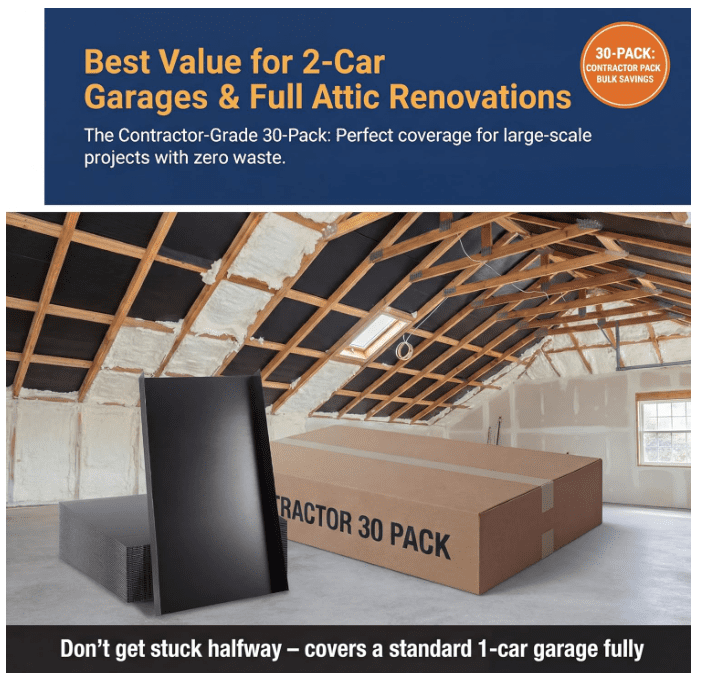
As mentioned in the warning above, you cannot complete an attic rafter insulation job without baffles. These inexpensive plastic or foam chutes staple directly to the underside of the roof deck, creating a permanent 1-inch to 2-inch channel for air to travel from the soffits up to the roof ridge.
How to Insulate an Attic Roof Rafters (Step-by-Step)
Grab your safety glasses, a good dust mask, and a heavy-duty staple gun. Here is how to do it properly.
- Measure Rafter Depth & Spacing: Measure the depth of your rafters (usually 2×6, 2×8, or 2×10) and the distance between them (usually 16″ or 24″ on center). This tells you what size fiberglass batts to buy.
- Install the Baffles: Slide a ventilation baffle all the way down into the eaves (soffit area) between every single rafter bay. Staple them securely against the roof deck. If your roof is long, overlap a second baffle higher up to ensure a continuous air channel to the ridge vent.
- Cut and Press the Insulation: Unroll your unfaced fiberglass insulation. Press it gently into the rafter bay, directly against the baffles. It should fit snugly side-to-side (friction fit) so it doesn’t fall down on you. Do not compress it too tight; fiberglass needs its fluffy air pockets to insulate properly!
- Secure the Insulation (Optional but Recommended): If the friction fit isn’t holding, use wire insulation supports (lightning rods) that bow outwards and bite into the wood framing to hold the heavy batts in place.
- Install a Vapor Barrier (Climate Dependent): If you live in a cold northern climate, building codes usually require a 6-mil polyethylene plastic vapor barrier stapled across the face of the insulated rafters before you hang drywall. In hot southern climates, this is often skipped to allow the walls to dry inward. Always check your local building codes!
Frequently Asked Questions
Do you need an air gap between roof and insulation?
Yes, absolutely. You must maintain a continuous air gap of at least 1 inch between the roof deck and the insulation. This allows outside air to flow from the soffit vents to the ridge vent, preventing moisture buildup, mold, and premature roof rot. Use plastic or foam baffles to create this gap.
What is the best insulation for attic rafters?
Closed-cell spray foam is the best-performing insulation for attic rafters because it provides the highest R-value per inch and completely seals air leaks. However, for a DIY budget, high-density fiberglass batts paired with proper ventilation baffles are the most practical and popular choice.
Can I use faced insulation on attic rafters?
It is generally better to use unfaced insulation in roof rafters, especially if you plan to cover the ceiling with drywall. Using faced insulation (which has a paper vapor retarder) can sometimes create a double-vapor-barrier trap if not installed perfectly in accordance with local climate codes.